Arkansas’ biodiesel industry has failed to live up to its early promise, and Troy Hornbeck says he knows why.
Hornbeck, who with his two brothers, Jon and Jeff, founded Arkansas SoyEnergy Group LLC of DeWitt in 2007, cites inconsistent government support in the form of tax credits and hesitation on the part of corporations like retailers, trucking companies and marketing firms.
Declining gasoline prices that cut demand for biodiesel and the increasing popularity of compressed natural gas as a fuel are two other factors behind the industry’s doldrums, the Arkansas Economic Development Commission and others say.
Currently, only two biodiesel producers remain in the state, a review by Arkansas Business indicates, down from four in 2007, according to a report from the Arkansas Energy Office.
In 2011, Hornbeck Seed Co. in DeWitt was bought out by Bayer CropScience, an international company with U.S. headquarters in Research Triangle Park, North Carolina. Arkansas SoyEnergy, which at one time employed 20 to 25 people, was closed around the time of the purchase.
Troy Hornbeck, whose family had owned Hornbeck Seed Co. since its founding in 1981, still owns the seed-crushing facility at the DeWitt site, but said he is now looking to sell and buyers are interested.
The time spent away from running his own business with his brothers has given Hornbeck valuable insight as to why the biodiesel industry — facing a “perfect storm,” as he called it — has dropped out of the headlines.
“The industry was fledgling at that point and that was 2007-2009,” Hornbeck said. “There was work being done at the state level, legislatively, and some federal work with tax credits, but one of the issues that we ran into at our facility was that the tax credit is a year-to-year process, and there was no consistency for the consumer or those bioplants.”
Hornbeck is referring to tax credits approved by the state Legislature that sought to allow the biodiesel industry to sell fuel competitively with petroleum diesel manufacturers. For example, the state’s Biotechnology Development & Training Act, which was repealed in 2009, provided an income tax credit for biofuel producers to cover costs of buildings, equipment and the purchase of licensing, among other things, in order to protect intellectual property rights.
“It was a year-to-year process, so you never knew if it would be passed in the Legislature until that final hour,” he said. “And if you remember, at that time, financial institutions were going through a crisis. And at that same time, financial institutions were looking at the biodiesel plants and saying, ‘There’s no stability here because you can’t guarantee if that dollar is going to be here.’
“And the government would never come out and say, ‘We’re going to do this [tax credit] for a two-, three-, four-year period,’ so there was no stability there financially, so a lot of the institutions started being negative toward that.”
The Next Crop
In addition to inconsistency, Hornbeck said, corporations and legislators just simply didn’t understand the science behind the industry or even the industry itself.
“The bottom line is that they thought it was going to hurt their fuel consumption, their mileage, their engines,” he said. “Even in a B20 blend, they were scared to death,” Hornbeck said, referring to the blend that is 20 percent biodiesel and 80 percent petroleum diesel. “Now we know that’s all a myth and biofuel is very safe, but back in those days we were still fledgling and there was a lot of skepticism and we just didn’t have the support.”
Despite small, grassroots efforts like Delta Bioenergy in Dewitt, Hornbeck said it will be difficult for entrepreneurs to revamp the industry, but he hopes plants with multiple feedstocks will take the opportunity to grow.
“Our plan, which was probably a bad idea on our part, was to use solely soybeans, because that’s what we grow in southern Arkansas,” he said. “I think a plant needs to have multiple feedstocks because that’s what lets you buffer the environment and the climate of the biodiesel industry better than what we had at the time.”
Scott Hardin, a spokesman with the Arkansas Economic Development Commission, said gasoline prices, always in a state of flux, are a key reason behind the changing fortunes of the state’s biofuel industry.
“When the price of gas remains high, so does the interest level in production and consumption of numerous alternative fuels, including biofuels,” Hardin said. “With consistently low gas prices, we’ve not had as many inquiries regarding this technology, both from those seeking to manufacture it and those with an interest in individual consumption.
“AEDC has certainly not written off biofuel production in Arkansas,” he said. “If there were a new or existing biofuel production company considering new investment and jobs in Arkansas, we would certainly look forward to discussing this project.”
What is left of the biodiesel industry in Arkansas could see a new competitor in the coming years. Hardin said Arkansans are now expressing the most interest in compressed natural gas.
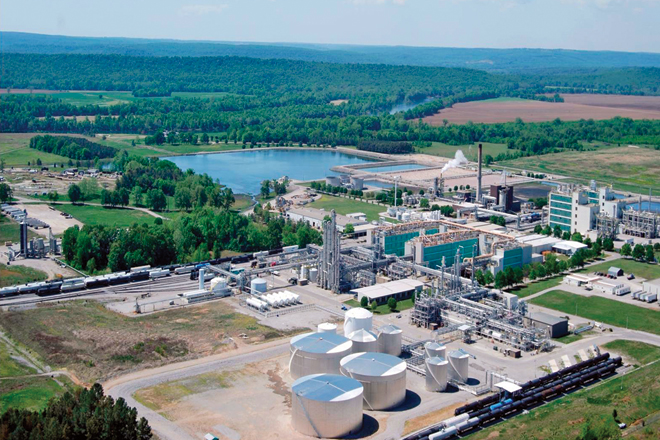
Arkansas now has only two biodiesel-producing plants: Future Fuel Chemical Co. of Batesville and Delek Renewables in Crossett. Delek is headquartered in Brentwood, Tennessee.
The two companies annually produce about 63 million gallons of biodiesel combined, according to a report last month by the U.S. Energy Information Administration.
Rose Sparks, the chief financial officer of Future Fuel, said the plant has the capacity to produce 59.9 million gallons per year, but she declined to disclose its average yearly output. A company quarterly report detailing Future Fuel’s finances from January to March said the plant had a net income of $8.1 million during that quarter. According to its 2013 annual report, Future Fuel had $444.9 million in revenue.
As of 2013, the company employed about 500 people. The company has a multiple feedstock operation and derives its products from resources such as soybean oil, beef tallow and pork lard.
Delek Renewables bought out Pinnacle Biofuels Inc. in January 2014 for about $11.1 million, according to the company’s 2014 annual report. Delek did not respond to requests for its financial figures for the Crossett plant.
With only 13 employees at the Crossett plant, Delek can produce about 43,000 gallons a day, but averages about 35,000. At capacity, the facility can produce 15 million gallons a year, according to Danielle Hudson, the plant’s office manager.
 Sign up for Daily E-news