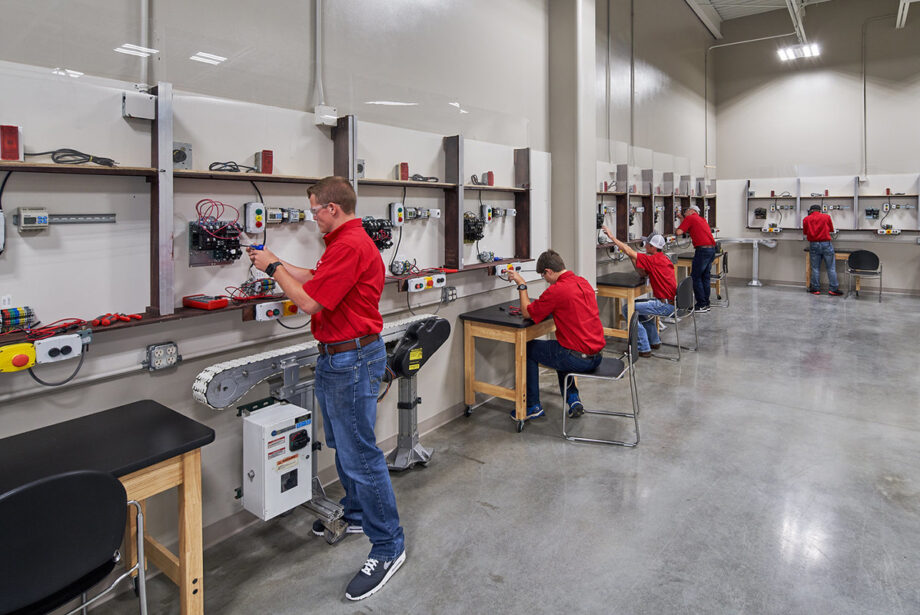
Not all paths to work include higher education, but Conway area educational institutions are putting their efforts into workforce development.
Local high schools, districts and higher learning institutions are using a number of methods and programs to educate and groom the workers of tomorrow, whether they are post-secondary students or not.
The Conway Area Career Center (CACC) on the Conway High School campus offers Career and Technical Education (CTE) certifications, programs of study and student activities, with workforce education in the fields of medical, welding, construction, culinary, auto collision, drafting and computer science.
“Students need a wide variety of opportunities to succeed in life,” said Conway Schools Superintendent Jeff Collum. “Higher education is extremely important and highly valued in our community. Workforce education should also be highly valued as it provides students who may not desire or plan to attend college a means of gaining a life skill or workforce skill that can ultimately propel them through life and help them be successful citizens and provide for their families.”
The CACC partners with more than 40 area businesses to help educate students on the workforce needs of local industries, and it serves approximately 1,600 high school students from Conway Christian, East-End-Bigelow, Greenbrier, Greers Ferry-West Side, Guy-Perkins, Heber Springs, Mt. Vernon-Enola, Quitman, Rosebud, South Side Bee Branch, St. Joseph and Vilonia.
Of course, the Conway area would prefer to see qualified, skilled workers use their training and education locally. The Launch Conway Fellowship is an initiative involving the University of Central Arkansas, the Conway Area Chamber of Commerce and local businesses to keep graduates in the regional workforce.
According to Ronnie Williams, former chief diversity officer and vice president of student services at UCA, the program provides fellows with experiential learning focusing on personal and professional development and career education.
The fellowship facilitates connections between local employers and students to create mentoring, internship and career opportunities, broaden community involvement and career awareness of each fellow and it will develop a cohort of pending graduates interested in employment in the Conway area.
“This program will address talent and workforce needs in every sector of the local business community,” Williams said. “It builds a reliable and meaningful network with business and community leaders.”
Community colleges have long been training grounds teaching important trade and technical skills to future workers. In recent years, institutions like the University of Arkansas Community College at Morrilton (UACCM) have gone beyond traditional training programs to format more customized training for specific business and industry needs.
“While many of these training needs are still coming from the traditional high-wage, high-demand programs, we are finding ways to design them and offer them on-demand and on the terms of the industry and those needing training,” UACCM Chancellor Lisa Willenberg said.
UACCM’s Workforce Training Office discusses specific needs with industry leaders and designs and offers training to meet those demands on an as-needed basis, she said.
As the COVID-19 pandemic accelerated the advent of automation, Willenberg noted that UACCM’s Industrial Mechanics and Maintenance Technology labs and programs are becoming some of the school’s most requested. One of UACCM’s newest and most popular training components is its American Welding Society (AWS) Accredited Test Facility (ATF) in which Certified Welding Examiners (CWE) and Certified Welding Inspectors (CWI) administer multiple levels of certification.
The school is also in the process of developing a program to train drillers and locators in running broadband conduit for fiber service. UACCM will become one of three facilities in the nation with formal training programs to provide these in-demand skills, Willenberg said.
“With the multiple federal government COVID related stimulus packages, there is a greater than normal demand for each of these skilled-type trades,” Willenberg said. “It’s a really challenging but exciting time for me as I come from a family of skilled laborers and these careers are currently surpassing the average wage of many four-year professional degree programs.”
A Young and Educated Workforce
3
Institutions of higher education in Conway
4
Community
colleges within a
30-mile radius
6
Institutions of higher learning within a
50-mile radius
353,050
Labor force within a 45-minute commute
Source: conwayarkansas.org
 Sign up for Daily E-news