
A lawsuit between two former legal colleagues in Little Rock offers a look into the contentious issue of third-party litigation financing, in which investors provide money to attorneys and reap rewards when cases pay off.
Little Rock attorney Christopher D. Jennings is suing the lawyer who fired him early this year, Anthony Johnson. Jennings claims Johnson is blocking his access to some former clients for a purely monetary reason.
Johnson, Jennings’ complaint says, wants to prevent class-action clients from switching to Jennings because “Johnson knows the well will run dry if his funders see clients leave.”
Johnson’s attorney called the allegations “ridiculous.”
The case highlights third-party litigation financing, a rising trend many legal professionals criticize, arguing that it drives up the cost of litigation and there’s little regulation. (See sidebar)
Abtin Mehdizadegan of Hall Booth Smith’s Little Rock office is representing Jennings, who said he was considering leaving Johnson’s firm before he was fired in January. Jennings said his former firm wasn’t on “firm financial footing,” and that Johnson had dismissed him after learning about his plans to leave.
Further, Jennings’ complaint, filed on Feb. 26, alleges that Johnson’s firm, which operates as the Johnson Firm, refused to turn over case materials for clients who wanted to follow Jennings to his new firm, Jennings PLLC of Little Rock. Some files still haven’t been forwarded, he says.
Jennings, who says he built up Johnson’s class-action practice, made stark allegations in his lawsuit.
“The only reason Johnson cares about the clients at all is to include them on his balance sheet to keep, what is upon information and belief, a [$50 million] line of credit and the hedge fund money flowing,” Jennings’ complaint said. “Upon information and belief, Johnson has pledged all of the future attorneys’ fees received for Plaintiffs’ class action work as security for his line of credit, one he uses to fund his extravagant lifestyle and unrelated business ventures,” the filing said.
Johnson, a former Arkansas Business 40 Under 40 honoree, denies Jennings’ allegations. One of Johnson’s attorneys, Michael Forde of Forde & O’Meara LLP of Chicago, told Arkansas Business that Jennings has all client files and names.
Forde also said it was “utterly false” that the Johnson firm wasn’t on firm financial footing.
“The Johnson Firm is very sound financially,” Forde said.
Generally, when lawyers leave a firm for another practice, their clients have the option to stay with the old firm, follow the attorney or find another lawyer.
As for third-party financing, Forde said the practice is “pretty standard in this industry.”
“The whole reason that the Johnson Firm learned of what Jennings was up to, in terms of setting up this competing law firm, was that he was going to these litigation funding firms and saying, ‘Hey, can you provide funding needed to set this up?’” he said.
Forde said that a law firm needs a source of financing to operate while cases are pending. So law firms “rely on third-party funding, whether it’s from a bank or from a litigation funding firm, to do that,” he said.
Forde said that he didn’t know the terms of the third-party financing at Johnson’s firm but the funds were invested in a portfolio of about 500 cases.

Johnson’s firm has its own complaint against Jennings that includes allegations of breach of contract, and it wants to have the dispute sent to arbitration.
Johnson’s firm alleged that before Jennings left the firm, “he set out on a course of duplicitous and underhanded conduct intended to steal the Johnson’s Firm’s clients, business, trade secrets, and employees. He conspired with another lawyer to start a competing law firm.”
Jennings disputes that there was a valid and enforceable employment agreement with the Johnson Firm, his attorney, Mehdizadegan, said.
“Jennings certainly did not steal Johnson’s business, trade secrets or employees,” he said.
He said that client information is not a law firm’s property. And the employees who left Johnson’s firm to join Jennings did so on their own, “which left no lead counsel for any of the class-action docket that remained with Johnson.”
Jennings wants the Johnson Firm to provide complete contact information for Jennings’ clients and transfer the complete files to his firm for those clients who want Jennings to represent them. That hearing date is set for July 22 in front of Pulaski County Circuit Judge Mackie Pierce.
Building a Docket
Jennings, a graduate of the University of Arkansas at Little Rock Bowen School of Law, said he had thought about leaving the Johnson Firm about a year or two ago.
Jennings had worked with Johnson since 2014, when he joined Johnson & Vines. That firm was founded in 2012 and handled mass torts and personal injury cases.
Jennings said he knew that Andrew Vines and Johnson were looking for attorneys to handle mass tort cases and class-action cases. “I think we ran into each other, traded emails, something like that. That’s what started that relationship,” he said.
Vines left the firm in 2017, and it later became known as the Johnson Firm. “I built a class-action docket there,” Jennings told Arkansas Business.
Jennings, whose practice area includes consumer class action, became concerned about the way the firm’s business was being handled. Johnson, Jennings believed, had used the class-action docket as security for a line of credit of $50 million issued by Calumet Capital LLC of Miami, Jennings’ court filings show. Calumet Capital said on its website that “we understand the business of contingent-fee law firms and tailor solutions to the needs of each client.”
Jennings said in the filing he feared that if a dispute between the Johnson Firm and the lenders developed, it “had the potential to negatively impact the class action clients,” to whom Jennings had a duty.
Jennings started exploring his options to leave the Johnson Firm and start his own practice. He hired a business consultant to help him locate a source of funding.
But Johnson learned of Jennings’ plans and fired him on Jan. 25. At the time, Jennings managed between 200 and 250 cases at the Johnson firm.
The firm also blocked his access to the firm’s systems and his client files, according to Jennings’ court filings.
A few days after Jennings was terminated, two other class-action attorneys at Johnson’s firm, Tyler Ewigleben and Winston Hudson, quit and began working for Jennings at his new firm. The three attorneys “had exclusively handled the class action matters at the Johnson Firm,” Jennings said in the filing.
Jennings said he was the primary point of contact for all co-counsel in class-action matters at Johnson’s firm.
Jennings said in the filing that his clients also began to follow him to his new firm. Jennings’ class-action cases accounted for the vast majority of the Johnson Firm’s revenue, he said in a filing.
Forde said that revenues by practice area varied by year. But he said the Johnson Firm’s class-action practice was less than 50% of the firm’s caseload.
Text Message Warning
Less than two weeks after Jennings was fired, Johnson sent him a text message saying they should talk “before this gets messier,” according to the text message attached as an exhibit in Jennings’ filing.
Johnson said in the message that “our fund” was about to hire a large law firm “to protect the fees that collateralize their loan. This is a $20B huge fund that presumed [sic] wants to throw the kitchen sink at shutting you down, or even dragging out fees for eternity with litigation.”
Johnson said that he was “open to a reasonable conversation around the cases” but that’s only if Jennings stopped what he was doing.
Forde said that the text message was “just another attempt by Mr. Jennings to distract from the real issue here, his breach of his employment contract.”
The Johnson Firm has four attorneys, and it recently hired William Sweetnam, who previously worked at Sweetnam LLC, a Chicago class-action litigation firm. Sweetnam and attorney Laura Edmondson, who graduated from the University of Arkansas School of Law in 2021, are the main class-action lawyers at the Johnson Firm.
Jennings told Arkansas Business that his new firm is “doing well.” But he wants the full files of his clients who followed him to his new firm. “We need to close up these loose ends, so we can go along on our way and represent our clients the way we need to,” Jennings said.
Third-Party Litigation Is Rising
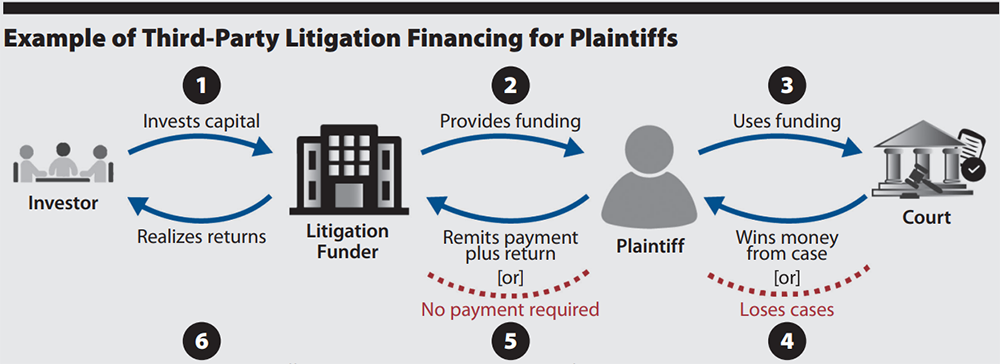
Third-party litigation is growing at a rapid pace.
“Demand for litigation financing continues to increase with no signs of slowing down anytime soon,” according to The Westfleet Insider’s 2022 Litigation Market Report. “In fact, new capital commitments to law firms and their clients grew by nearly 16% in 2022, the largest year-over-year growth rate ever reported in this publication.”
It said that the assets under management totaled $13.5 billion in 2022, up from $12.4 billion in 2021 and $11.3 billion in 2020.
Third-party litigation financing is an investment in litigation, said Rachelle Mortimer, the U.S. Chamber of Commerce Institute for Legal Reform director of legislative affairs.
In general, the financier provides money to a litigant, usually on a nonrecourse basis. So if the case results in a settlement or an award, the funder gets repaid. If not, the “funder basically loses out on that investment,” Mortimer said.
The repayment arrangement could be based on a multiplier of the investment or a percentage of the award.
Investors find it attractive because there’s always litigation and cases don’t follow the usual market trends.
“The litigation funders have also said in interviews and stuff they generally double their money on these investments, which is obviously a very good return on investment,” Mortimer said.
Supporters say the funding practice has several advantages, including giving underfunded plaintiffs money for court cases against well-funded defendants and allowing plaintiffs to transfer the case’s risk to a third party, according to a December 2022 report by the U.S. Government Accountability Office.
But the disadvantages include that court costs for defendants could rise, because the funds could encourage more meritless lawsuits, the report said. Also, the funds might discourage settling cases for a fair amount, as plaintiffs might ask for extra money to cover the cost of the funding that has to be repaid.
Another disadvantage is the funder might “exert control over the case (such as influencing decisions about litigation strategy or whether to settle)” and that might lead to conflicts of interest between attorneys and their funders, according to the report.
Mortimer said, in general, attorneys don’t have to disclose that their cases are being funded by third parties and there aren’t any uniform regulations on the litigation funding industry at the state and federal level. Regulations are, however, being worked on.
Congress has introduced the Protecting Our Courts From Foreign Manipulation Act of 2023, which would block sovereign wealth funds and foreign governments from funding lawsuits in the U.S.
Mortimer also said that four states have enacted laws to regulate litigation funding.
 Sign up for Daily E-news