For Gen Z, everything must be digital. And Arkansas banks are finding that expectations are high.
Born between the late 1990s and 2012, Generation Z is challenging traditional institutions to evolve faster than ever before.
Local bankers are figuring out what it takes to attract their youngest generation of customers, whether it be advanced digital tools or simplified processes.
Alex Carriles, executive vice president and chief digital officer at Simmons Bank of Pine Bluff, said that Gen Z has raised the bar to a “considerably higher level” on what banks need to do to attract and retain them as customers.
“Unlike other generations, Gen Z’s phone is their lifeline,” Carriles said. “If banks aren’t up to the expectations compared to other digital tools, they are going to fail.”
Mobile banking is essential for attracting Gen Z customers. According to a 2025 MarketWatch survey, 56% of Americans access their accounts through their phones, with younger generations leading this trend.
The survey also found that Gen Z checks their bank accounts more frequently than other generations, with 45% checking daily and nearly 20% checking multiple times per day.
And because the generation almost exclusively banks online, they determine if they like a bank within seconds, Carriles said.

“If you open our app, for example, you see your balance in two seconds,” he said. “The average time spent in the app is under 40 seconds. So if out of those 40 seconds, 30 are waiting for the app to load, you’re dead.”
Other banking executives in Arkansas agree that banks need to embrace the change or risk losing their future customer base, so they’re implementing new digital tools constantly.
“The thing that’s curious about Gen Z banking is it’s still evolving,” Blake Guinn, vice president of marketing and digital banking at First National Bank of Paragould. “With the technology-dependent generation, technology evolves too, so the needs are constantly moving and changing.”
But Gen Z still wants the ability to speak with someone in person, just in case, Guinn said.
“They want to be able to bank without ever dealing with a human being,” Guinn said. “However, when something goes wrong, they want that to be there for them, whether that be on the phone, being able to run by a branch, or being able to do that digitally. So it is still very well-rounded.”
Digital Tools
Arkansas’ financial institutions are putting in the work to win over Gen Z. Both Simmons and First National have implemented new mobile banking tools, improved their banking apps and adjusted marketing to appeal to a younger audience.
Streamlining the account opening process has been a priority. Gen Z customers are not likely to visit a branch to open an account, Carriles and Guinn said. So that capacity has to be available online.
To address this, Simmons created a new account type, dubbed “Coin.” Customers upload a photo of their driver’s license or ID, their Social Security number, phone number and email address, then verify their identity with a selfie. Carriles said an account can be opened within three minutes.
The Coin account also doesn’t require any initial funding. Customers have 45 days to put money in the account through a transfer, direct deposit or app like Venmo, Cash App, PayPal or Zelle.
“The skip funding has been very successful, and surprisingly, this is one of the accounts that has the highest percentage of direct deposit-enabled,” Carriles said. “More than 80% of the people that are opening these accounts are Gen Z and millennials.”
First National has also prioritized digital account opening. Existing customers there can open an account online by clicking one “add an account” option.
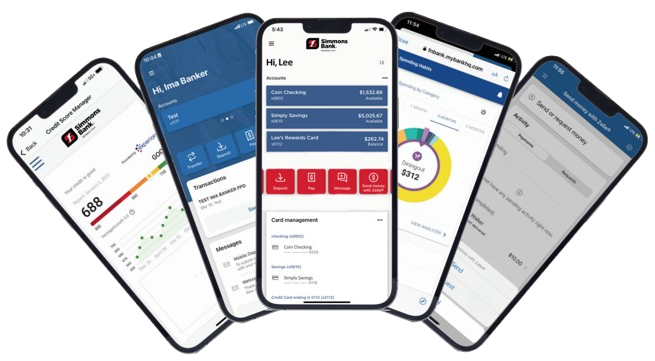
Guinn said mobile deposits for checks have become particularly important. “The mobile deposit feature is very popular among them because they get a check and think, ‘What the heck am I going to do with this?’”
Instant transfers are another priority. Just this year, Simmons launched instant access to mobile deposits, eliminating the traditional waiting period, which can take up to three business days. Now it takes five seconds, Carriles said.
“Gen Zs are used to 24/7 services that never stop,” Carriles said. “They’re not used to banker’s hours.”
Person-to-person payments have become a standard expectation. Guinn said banks have to be able to seamlessly integrate with payment apps. Both First National and Simmons have Zelle embedded in their mobile apps.
Simmons has also introduced an early payday option, in which customers can get their paycheck up to three days early, which Carriles said has been very popular with Gen Z.
And it seems the mobile trend is only beginning. According to a 2024 report from the Federal Reserve, the number of mobile transactions reached 7.9 billion in 2022, up from 800 million in 2018.
“If the technology is there, they’re going to push it to the limit,” Guinn said. “If there’s a feature, they’re going to run it all the way to its maximum capacity or fulfillment and challenge the capabilities of that technology. You think you’ve checked all the boxes, and then they will find a brand new box to check or a brand new button to push that you didn’t even know was there, because they can sometimes work the tech better than you can.”
But despite the digital focus, Gen Z consumers still value having access to physical branches. According to the MarketWatch survey, only 13% of Americans say they never visit a physical bank, though 47% visit just a few times a year or less.
“Research has shown that Gen Z still values being able to drive by a branch and know it’s there. They may never go in it, but they do value that it provides some comfort,” Guinn said. And he believes this is where smaller, community banks can find their niche. “If community banks our size can provide them with good technology while also being present and accounted for within their living space, they’re going to value that.”
Financial Habits
Gen Z customers may not own a checkbook, but research shows they save more than other generations.
A 2023 report from Publicis Sapient, a digital transformation consulting company, found that Gen Z saves an average of $857 monthly, which is nearly triple the $294 saved by millennials. The report characterizes Gen Z as “BNPL-loving and generally credit-averse,” meaning they prefer buy-now-pay-later services over traditional credit cards.
“Gen Z is more frugal than previous generations,” said Michael Casey, professor of finance at the University of Central Arkansas in Conway. He’s also the interim dean of the College of Business. “They’re more apt to pay off their debt, they’re more apt to save, and they don’t focus as much on career advancement and making a lot of money.”
Casey attributes this to Gen Z’s early economic experiences. The generation largely grew up in the aftermath of 9/11, the 2007-09 financial crisis and the COVID-19 pandemic. He said he sees a lot of trends in Gen Z’s financial habits that are caused by those experiences.
“They tend to believe more in social causes, and so they may bank with a bank that’s perceived to be more environmentally and socially conscious than its peers,” Casey said. “They tend to be more pragmatic with finances. In general, they don’t buy a lot of things; they tend to buy more experiences instead of a new product.”
And Carriles said with the adoption of savings accounts at Simmons, there is a much higher propensity for Gen Z to get a savings account than almost any other generation.
The Publicis Sapient report found that 82% of Gen Z have their sights set on homeownership, and that the generation ranks understanding finance as a high priority.
They’re also more interested in cryptocurrency and digital investments like non-fungible tokens (NFTs).

Erica Weston, director of education at Junior Achievement of Arkansas, has seen these trends firsthand at schools around the state. JA works with banks across the state to teach financial literacy in K-12 schools.
Weston said budgeting, saving and investing are three of the topics Gen Z students ask about the most. And Casey has seen similar trends among UCA students.
“They want to take their additional dollars or additional income, and they want to put it to work for them,” Casey said. “So they’re very interested in setting up a 401(k) or a tax-sheltered investment vehicle. They’re very interested in investing, and a lot of them will start very early.”
Weston said Gen Z has been the victim of a lot of misconceptions about their financial habits. And that the age group has benefited from the growing number of financial literacy programs like JA.
“I think Gen Z knows a little more than they’re given credit for,” Weston said. “Honestly, Gen Z is going to shock people.”
But because Gen Z uses new digital tools, there are more opportunities for fraud.
Guinn said that after elder populations, Gen Z are the second-most likely to fall victim to financial scams.
And Casey said there are risks with “neobanks,” or digital-only financial institutions, as they’re not as tightly regulated as traditional institutions. They’re also not insured through the Federal Deposit Insurance Corp. This makes it even more important for traditional banks to attract Gen Z as customers, Guinn said.
“I want banks and financial institutions to take ownership of the education of the youngest consumers and meet them, educate them where they’re at,” Guinn said. “Let’s go find them and put ourselves out there as a good, efficient helper that has the tools you need, but safety and soundness.”
Guinn and Casey said another new aspect of Gen Z is a lack of loyalty — but “not in a negative way,” Guinn said. Gen Z customers are more likely to change banks based on their personal needs, and they won’t bank somewhere just because their “grandma” or parents banked there, Guinn said.
This trend has been happening for a while, according to Guinn, but Gen Z really “rounded it out.” And he believes this just pushes banks to be better.
“We have to be there with them and find our space in that environment, or they will replace us, and rightfully so, because the consumer needs to drive who we are,” Guinn said. “It’s not wrong to drive companies where you want them to be. If we sit there with our arms folded and want to complain, you’re going to miss the boat. That’s our philosophy here; we’re acutely aware of who’s driving us and where we’re going to be in 20 years.”
Carriles agrees that meeting Gen Z’s expectations is vital for the future of banking.
“If we can be successful with them, everybody is going to be appreciative of our efforts,” Carriles said. “Treat them well. They’re the future.”
 Sign up for Daily E-news