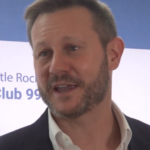
Lapis Carbon Solutions is hoping to do something no one else has in Arkansas, co-founder and CEO Reg Manhas says. The company has partnered with LSB Industries, a national ammonia product manufacturer, to develop Arkansas’ first carbon capture and sequestration initiative at LSB’s plant in El Dorado.
“We’re taking what’s going to be between 400,000-500,000 tons of CO2 out of their system,” Manhas says. “It’s equivalent to … 9-10% of all the vehicles on the road in Arkansas today in terms of CO2 emissions – so it’s big.”
Dubbed Project Blue and first announced in 2023, Manhas estimates the team will begin injecting captured carbon by the end of 2026 or early 2027. LSB was a natural partner, he says, because ammonia plants produce very pure CO2 as a byproduct of their industrial processes. The purity makes “capturing” – a process of intense compression – the CO2 easier.
“We have to dehydrate that CO2 to make sure there’s no water, because water can create corrosion when combined with CO2,” Manhas says. “It’s very advantageous for our business in the sense that the stream of CO2 that’s coming out is very pure from the get go.”
The injection process is familiar for Lapis’ team, made up of veterans of the upstream oil and gas sector. Much of the equipment is the same, though some materials are different, such as using chromium to line the wellbore instead of steel.
“The whole value idea around Lapis is taking all that experience from oil and gas and how to drill wells, how to look at the subsurface, all the logging, all the seismic interpretation, all the geoscience around oil and gas, and apply it to this new business,” Manhas says.
The CO2 will be stored beneath the LSB plant and above the Smackover Formation. Manhas said the stored CO2 will be injected approximately 6,000 feet underground into porous, briny rock formations.
Eventually — over the course of centuries — the CO2 will dissolve into the brine, forming an acid that will then react with other minerals in the surrounding rock to form solid carbonate minerals.
LSB will have the added benefit of being able to produce “blue ammonia,” an industry-recognized term for decarbonized ammonia.
“There’s a demand for that blue ammonia around the world,” said Manhas. “They’ve already sold some of that ammonia… They will receive a premium on the price for what they sell.”
 Sign up for Daily E-news