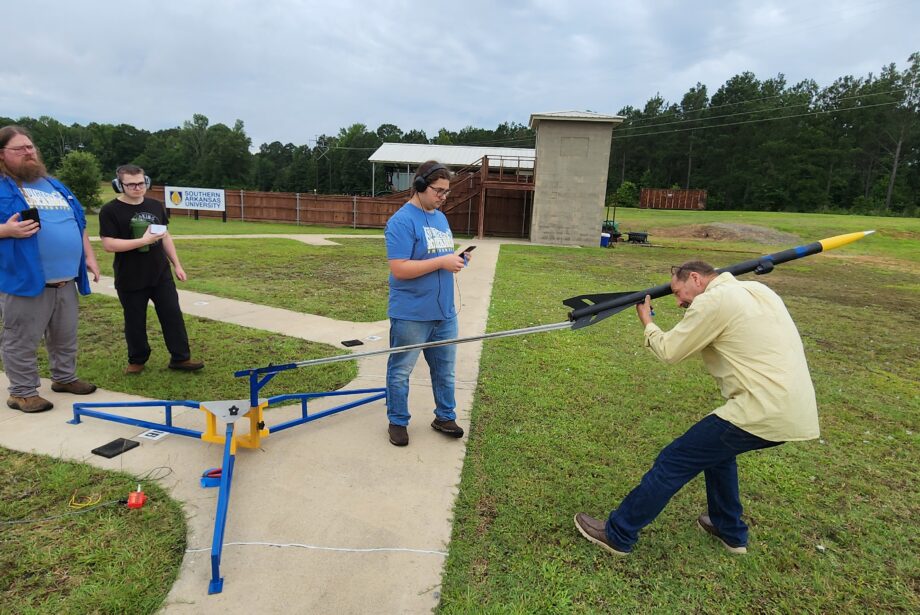
Southern Arkansas University in Magnolia recently held its second Arkansas High-Powered Rocket Workshop, where participants built and successfully launched nine rockets.
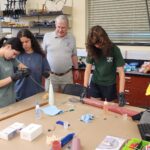
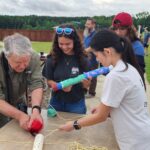
During the workshop, hosted June 9–12, high school juniors and seniors, their teacher mentors, undergraduate students and university professors worked in interdisciplinary teams to design, build and launch a high-powered rocket from scratch.
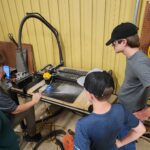
Students used 3D printers, Computer Numerical Control machines and laser cutters in SAU’s machine shop to fabricate components such as the rocket body tube, fins and camera bays. They also assembled the full rocket — including a parachute system and onboard electronics — and simulated their flight through model rocket software. The workshop culminated in a real rocket launch on the final day.
Participants in the workshop learned about design, propulsion systems, aerodynamics, stability and recovery mechanisms, according to Abdel Bachri, dean of the College of Science & Engineering and physics professor at SAU.
“They were introduced to aerospace simulation software, electronics integration and safety protocols — many of which align with Level 1 high-powered rocketry certification standards,” Bachri said. Level 1 is a certification that allows individuals to purchase and use certain rocket motors. It signifies that the individual has demonstrated the ability to safely build, launch and recover a high-power rocket.
Bachri said workshops like this are important for giving students a head start and showing them that high-tech careers are possible in Arkansas.
“Arkansas is home to a growing aerospace and defense sector, with companies involved in aviation, missile defense and satellite technologies,” Bachri said. “Developing a local pipeline of talent who are already familiar with aerospace principles and practices is vital to sustaining and growing this industry.”
Another benefit of the workshop was recruiting students to SAU, as well as STEM majors and careers. Bachri said hands-on learning is “critical” for STEM education.
And for many of the students, it was their first time in a machine lab or on a university campus.
“We cannot produce engineers fast enough in Southwest Arkansas,” Bachri said. “There are numerous job openings in the aerospace industry, chemical specialty sectors and now the rapidly growing lithium sector. Exposure can be the spark that ignites a future career in science or engineering.”
Arkansas Space Grant
The workshop was funded through a $30,000 grant from the Arkansas Space Grant Consortium (ASGC). The grant paid for rocket materials and supplies, as well as room and board for all participants. The workshop was free for participants, and at the conclusion of the event, teachers received a $250 honorarium and each student received a $50 travel subsidy.
Bachri said the accessibility was impactful because it allowed students from all backgrounds to participate. And the program is also only a week long to further that goal.
“Not all schools or students have access to semester-long rocketry courses or clubs,” Bachri said. “A one-week residential workshop levels the playing field and allows students from rural or underserved areas to participate in a transformative STEM experience without long-term time commitments.”
Frankum Performance Rocketry Products of Terrell, Texas, helped guide teams through safe fabrication techniques and ensured all the rockets met safety standards.
The grant allowed SAU to create a program that “rivals” metro areas or specialized academies, Bachri said. And that’s one of the goals of the ASGC.
“While attending the SAU Rocketry Program, I visited with a recent SAU Space Grant graduate who has secured a position with a local aerospace company. This program exemplifies the caliber of faculty, mentors and professionals across Arkansas who are dedicated to supporting NASA’s mission and driving workforce development in the aerospace sector,” Constance Meadors, director of the ASGC, told Arkansas Business. “As Space Grant Director, I am proud to champion and invest in homegrown talent.”

 Sign up for Daily E-news