


![TotalEnergies is based in La Defense, the skyscraper-filled business district just west of Paris. [Photo by stefan k on unsplash]](https://dqndh7utxx63f.cloudfront.net/wp-content/uploads/2025/07/stefan-k-Osr6aAlV-MA-unsplash_opt-scaled-e1754078413952.jpg)

Stuart Allen cut his teeth in the energy industry before finding his true calling: conserving and profiting from the Arkansas woodlands he roams as an avid outdoorsman.
Allen, founder and CEO of NativState, a forest carbon project developer in Conway, grew up in Beebe before heading to the Colorado School of Mines for his petroleum engineering degree. Twelve years ago, he joined Southwestern Energy of Houston, eventually tapping natural gas from the Fayetteville Shale.
Late last month, he was in NativState’s offices in Conway, its walls lined with the heads of some of his trophy bucks, discussing his company’s latest partnership.
The deal is with TotalEnergies of Courbevoie, France, a once-traditional oil and gas multinational that has been shifting its business model for a lower-carbon future.
“I can’t be specific on the transaction terms, but the deal itself, as described in the press release, includes a significant portion of our landowners today, about 240,000 acres, of which I’d say most are located here in Arkansas.”
The deal involves 280 private family landowners and 13 Improved Forest Management projects in Arkansas, Louisiana, Mississippi and Tennessee.
TotalEnergies said in a July 22 announcement that it will “prioritize emission avoidance and reduction” and use the carbon credits from 2030 onward “to voluntarily offset” future carbon emissions.
Allen founded NativState to partner with small forest landowners who agree to conserve their timberland for decades to sequester their carbon and reap the value of highly coveted carbon credits. Companies like TotalEnergies eagerly pay for the credits to fulfill commitments to reduce the carbon footprint of their operations.
Allen said his background as a petroleum engineer helped him negotiate the deal, one of several NativState has with big players in the energy sector.
“As a petroleum engineer, I’ve spent a long time in the energy space, and I think I understand a little bit about what their needs are as we face a lot of the challenges with the demand [for carbon offsets], whether it’s on the oil and gas side or in reference to these data centers that take up an unbelievable amount of energy,” Allen told Arkansas Business.
The deal took shape over more than a year, giving Allen, a 2025 Arkansas Business 40 Under 40 honoree, a chance to show off Arkansas several times to members of TotalEnergies’ team. He also got to travel several times to Paris.
“They decided to make one of their largest purchases of carbon offsets from NativState, and they love the aspect of working with small landowners and helping them sustainably manage their forest and provide an economic incentive for that sustainability.”
In turn, the small timberland owners and NativState provide “a very large toolkit” for TotalEnergies and similar partners to meet their global carbon reduction ambitions.
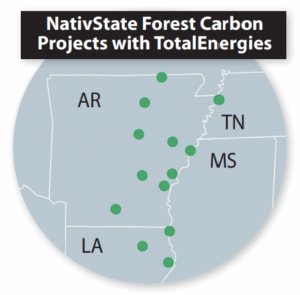 Founded in 1924 as Compagnie Française des Pétroles, TotalEnergies now has 100,000 employees in about 120 countries, and 3,000 service stations in France alone. But it has been diversifying into electricity and renewable energy for years, and plans to be producing 1.5 million metric tons of sustainable aviation fuel per year by 2030.
Allen said NativState’s founding premise was to give small landowners access to the global carbon market. “We partner with these landowners, whether they have 20 or 40 or 400 acres, and we have a growing team of about 60 employees who do everything from the inventory side of it, the accounting side, to forestry and biometrics,” he said. “We quantify the amount of carbon out there, compute what would happen under traditional harvest conditions, and use the American Carbon Registry, which is based here in Arkansas as a Winrock International subsidiary, to register the carbon credits.”
ACR, a nonprofit with offices in Little Rock, bills itself as the world’s first private carbon crediting program for offsets.
Companies seeking carbon offsets need large-scale deals to make economic sense. NativState eases the way “by aggregating a lot of small landowners, packaging them up,” Allen said. “In return, we pay the landowners a royalty, right off the top, just as if they had minerals in the Fayetteville Shale.”
Economies of scale mean that larger landowners — those with, say, 12,500 acres or more — get a little better royalty rate.
“It’s a 40-year commitment to sustainable forest management, essentially,” Allen said. “One thing we really pride ourselves on is providing professional foresters and professional wildlife biologists to help landowners make long-term decisions. You don’t manage a forest with a clock. You manage it with a calendar that goes out decades.”
In its July 22 announcement, TotalEnergies said the NativState partnership confirmed its commitment to conservation and enhancing “carbon sinks.” Adrien Henry, its vice president of nature-based solutions, said the company was “thrilled to support NativState to scale up their operations, directly benefiting the environment and their local communities.”
Allen said he felt privileged to help landowners embrace sustainable forestry, and let them benefit financially for it.
“We work with landowners, their children and even their grandchildren,” Allen said. “We help them to see the legacy they’re going to leave in 40 years. And on top of that, we’re able to pay and give them an economic incentive through sales of these carbon offsets to our partners. It’s a good feeling.”
 Sign up for Daily E-news










