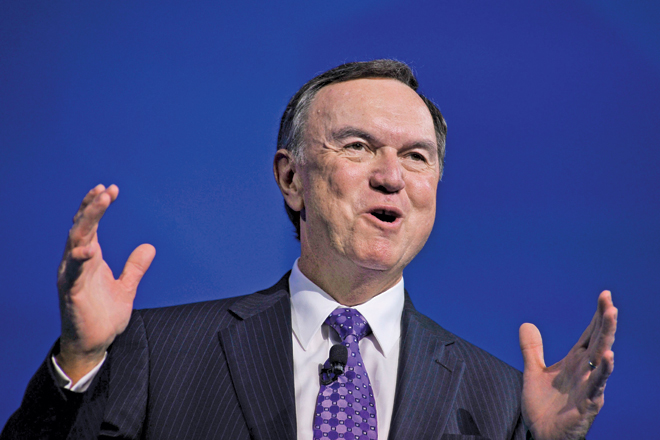
Mike Duke was paid $20.7 million last year as CEO of Wal-Mart Stores Inc., and he cashed out another $7.1 million worth of stock options.
Mike Duke is the No. 1 guy at the No. 1 company in the world, so it would be a surprise if he weren’t No. 1 on Arkansas Business’ list of the state’s highest-paid public company executives.
And the CEO of Wal-Mart Stores Inc. is at the top of the list — but only because we’ve changed our definition of total compensation. In past years, Arkansas Business added value realized from exercising stock options to the total compensation package that companies reported to the Securities & Exchange Commission. This year, however, we are reporting the cash value of exercised stock options but have not included that amount in total compensation.
This change was made because, under SEC reporting requirements that have become standardized, the estimated value of stock options is included in total compensation when the options are granted. To also include the actual value when the options are exercised is to count the same options twice, although the benefit may come in different fiscal years.
By that formula, Mike Duke’s compensation package of $20.7 million puts him at the top of the list.
More: Get the full list of public company executive compensation.
But if value realized by exercising stock options is included, Duke’s total of $27.8 million is a distant third behind the haul made by the top two executives at Dillard’s Inc. last year — roughly $36 million each for CEO William Dillard II and President Alex Dillard, more than $31 million of which came from stock options.
The phenomenal run-up in the price of Dillard’s stock — from about $3 in the spring of 2009 to a 2012 peak just under $90 — encouraged all of the Little Rock retailer’s top executives to cash out. Chief Financial Officer James I. Freeman realized $18 million from exercising stock options, while Executive Vice Presidents Drue Dillard Matheny and Mike Dillard gained $19.7 million and $18.8 million respectively on their options.
Ranked by compensation coming directly from the company, no Dillard’s executive ranked in the top 10. But the “named executive officers” for whom full financial data was included in Dillard’s annual proxy statement grabbed five of the top six positions when money from stock options was included in the total.
How much public companies should pay executives remains controversial, although government efforts to directly involve shareholders in pressuring directors to rein in executive pay have largely failed.
Take Our Poll: Are public company executives overpaid? Weigh in here.
After three years, the “say on pay” provision of the Dodd-Frank Wall Street Reform & Consumer Protection Act has delivered overwhelming approval of whatever compensation policies directors craft and recommend to shareholders.
“The ‘say on pay’ experiment is a bust,” Jesse Eisinger, a senior reporter covering Wall Street and finance for ProPublica, wrote in June.
John Carney, senior editor for CNBC.com, noted earlier this month that shareholders of only 57 of the 2,173 companies that had cast say-on-pay ballots so far this year had rejected the compensation policies, and at 72 percent of companies the approval rating topped 90 percent.
“In fact,” Carney wrote, say on pay “may even be encouraging rising pay for top executives who can now point to direct shareholder approval of their pay packages.”
Highest-Paid Including Stock Options
When value realized by exercising stock options is added to total compensation, the following Arkansas executives were the highest paid in the most recently completed fiscal years:
| Compensation | Option Income | Total | |||
|---|---|---|---|---|---|
| 1 | William T. Dillard II | CEO, Dillard’s Inc. | $4,890,494 | $31,120,000 | $36,010,494 |
| 2 | Alex Dillard | President, Dillard’s Inc. | $4,849,733 | $31,120,000 | $35,969,733 |
| 3 | Michael T. Duke | President & CEO, Wal-Mart Stores Inc. | $20,693,545 | $7,124,229 | $27,817,774 |
| 4 | James I. Freeman | SVP & CFO, Dillard’s Inc. | $5,173,519 | $18,012,000 | $23,185,519 |
| 5 | Drue Matheny | EVP, Dillard’s Inc. | $2,332,338 | $19,661,426 | $21,993,764 |
| 6 | Mike Dillard | EVP, Dillard’s Inc. | $2,352,808 | $18,802,000 | $21,154,808 |
| 7 | David M. Wood | Former President & CEO, Murphy Oil Corp. | $18,211,157 | $18,211,157 | |
| 8 | Rosalind G. Brewer | EVP, Wal-Mart Stores Inc. | $14,457,122 | $14,457,122 | |
| 9 | C. Douglas McMillon | EVP, Wal-Mart Stores Inc. | $9,563,093 | $3,485,383 | $13,048,476 |
| 10 | William S. Simon | EVP, Wal-Mart Stores Inc. | $11,221,797 | $660,994 | $11,882,791 |
| 11 | Charles M. Holley Jr. | EVP & CFO, Wal-Mart Stores Inc. | $6,638,670 | $1,628,989 | $8,267,659 |
| 12 | Jeffery R. Gardner | President & CEO, Windstream Corp. | $7,995,350 | $7,995,350 | |
| 13 | James V. Lochner | COO, Tyson Foods Inc. | $7,801,420 | $138,249 | $7,939,669 |
| 14 | Kevin G. Fitzgerald | EVP & CFO, Murphy Oil Corp. | $6,553,986 | $1,322,295 | $7,876,281 |
| 15 | Donnie Smith | President & CEO, Tyson Foods Inc. | $7,844,679 | $9,278 | $7,853,957 |
| 16 | Steven A. Cossé | CEO, Murphy Oil Corp. | $4,611,906 | $3,020,596 | $7,632,502 |
| 17 | Roger W. Jenkins | EVP, Murphy Oil Corp. | $6,266,192 | $637,438 | $6,903,630 |
| 18 | Jeffrey H. Fox | Executive Chairman, Convergys Corp. | $5,184,109 | $1,089,769 | $6,273,878 |
| 19 | John H. Tyson | Chairman, Tyson Foods Inc. | $4,217,434 | $2,005,740 | $6,223,174 |
| 20 | George G. Gleason II | Chairman & CEO, Bank of the Ozarks Inc. | $3,483,389 | $2,070,298 | $5,553,687 |
Dodd-Frank also requires publicly traded companies to reveal how their CEO’s pay compares with that of their median employee, but the SEC has yet to issue regulations on just how those ratios are to be reported.
In April, the Bloomberg financial wire service reported that CEOs of companies included in the Standard & Poor’s 500 Index are paid, on average, 204 times that of rank-and-file workers in their industries. That, according to Bloomberg’s research, is an increase of 20 percent in four years.
When Bloomberg ranked CEO pay as a multiple of an industry-specific average worker pay, Wal-Mart’s Duke ranked 18th. His compensation of $18.1 million in the fiscal year that ended Jan. 31, 2012, was calculated at 611 times the $29,688 average pay and benefits package for retail workers.
By the same measure, Donnie Smith, CEO of Tyson Foods Inc. of Springdale, ranked No. 211. His compensation of $7.8 million in 2012 was 196 times the $39,934 average for food manufacturing workers, according to Bloomberg. Tyson objected to the methodology, saying the industry average excluded thousands of management jobs and didn’t recognize benefits that Tyson provides that other companies don’t.
On Arkansas Business’ list, Smith ranks seventh, and he added less than $10,000 to his income by exercising stock options.
How Stock Options Work
A stock option is the right to buy a share of stock during some future period and at a price set by the company. The exercise price — also called the “strike” price — does not change with the market price.
When the market price of a company’s stock rises, executives may choose to exercise their options to buy stock at the lower exercise price. The shares are, in most cases, quickly resold at the higher market price.
The difference between the exercise price and the market price is the value realized by exercising stock options. In this week’s list of Arkansas’ highest-paid public company executives, the value realized by exercising stock options is reported in a separate column but is not included in the executive’s total compensation figure.
 Sign up for Daily E-news