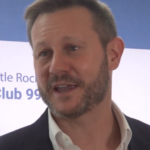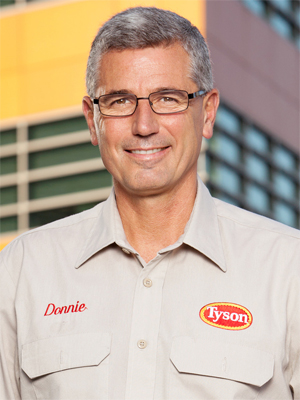
Donnie Smith
It was all about the brands for Tyson Foods Inc. of Springdale.
Tyson officially began the process of buying Hillshire Brands Co. of Chicago on Wednesday, according to a filing with the Securities & Exchange Commission. The meat processor giant expects to pay a shade over $8 billion for more than 124 million outstanding shares at $63 per share.
Throw in another $553 million to assume Hillshire’s net debt and the $8.55 billion price tag is steep, even for a deep-pocketed, profitable company such as Tyson. Hillshire will become a wholly owned subsidiary of Tyson after the deal’s completion.
For Tyson executives, though, the chance to acquire Hillshire’s enviable top-rated brands was irresistible. Tyson CFO Dennis Leatherby called the chance to buy Hillshire, even at such a premium price, a “one plus one equals three opportunity” in a conference call May 29 when Tyson announced its original attempt to buy Hillshire at $50 per share or approximately $1.7 billion less than the final tally.
Leatherby said the acquisition makes strategic sense for Tyson, which has announced a desire to drive growth in its prepared foods division. Tyson’s prepared foods division is 86 percent private label, while Hillshire is 89 percent brand names, and not just any brand names but top brands such as Ball Park hot dogs and Jimmy Dean sausage.
“When you think about that, the power of combining those together is just phenomenal,” Leatherby said. “It’s really just a great combination.”
For good measure, Tyson will send another $163 million to Pinnacle Foods Inc. of Parsippany, New Jersey, as a condition of the deal. Hillshire had sought to purchase Pinnacle for $4.23 billion in early May, but Tyson would only consummate its acquisition of Hillshire if the Pinnacle deal was scotched.
Tyson’s payment is a termination fee on behalf of Hillshire for abandoning the Pinnacle purchase. Tyson’s purchase of Hillshire is the largest in company history, dwarfing its $3.2 billion acquisition of IBF Inc. of Dakota Dunes, South Dakota, in 2001.
Tyson originally attempted to purchase Hillshire at $50 per share, but competition from Pilgrim’s Pride of Greeley, Colorado, soon morphed into a brief bidding war that pushed Hillshire’s per-share value up by 70 percent — some $3.2 billion.
Tyson, which earned $213 million on revenue of $9.03 billion for the fiscal quarter that ended March 29, would surely have preferred to scoop up Hillshire for more of a bargain, but CEO and President Donnie Smith said the opportunity couldn’t be passed up, even after the price tag soared.
“We operate in a competitive and complex marketplace that demands bold steps to remain an industry leader,” said Smith in a statement after the definitive agreement was signed July 2. “I am confident that together Tyson Foods and Hillshire Brands have the right products and the right people to create years of enhanced shareholder value and ensure more choices for our customers and consumers.”
Hillshire’s acquisition was Tyson’s fourth in the prepared food segment in the past 18 months. In February 2013, Tyson bought Don Julio Foods of Clearfield, Utah, a maker of tortillas and snacks, and in June of that same year, Tyson acquired Circle Foods LLC from a Montreal investment firm.
Circle Foods, based in California, produces frozen and refrigerated Mexican foods. In January of this year, Tyson bought Bosco’s Pizza of Warren, Michigan, a maker of stuffed breadsticks and frozen pizzas.
Tyson was also reported to have been a potential buyer of Michael Foods Group Inc., a distributor of egg and dairy products. Post Holdings Inc. later acquired Michael Foods.
Smith said Tyson had been researching Hillshire for a year before jumping in with an offer shortly after Pilgrim’s Pride in late May. The company’s leadership had been wanting to grow, especially in the prepared foods division.
“We’ve been looking at our growth options for months,” Smith said in a conference call after the $63 per share offer in June. “Although to the outside world this might appear to be happening quickly, I want to assure you that we’ve been thinking a long time about Hillshire and how it can complement Tyson Foods.
“A couple of years ago, we began working with our board and advisers to do a complete assessment of ways to grow our company, and that assessment involved a deep dive on what we aspire to be in prepared foods. [W]e cast a wide net and we looked a number of significant opportunities and put them various filters, and the company that kept coming out on top was Hillshire.”
Smith said the company’s goal was to have brands in the top two of the retail prepared and breakfast foods market. Hillshire has top-ranked products such as Jimmy Dean sausage, Hillshire Farm sausage and Ball Park hot dogs.
“With the acquisition of Hillshire Brands, not only would Tyson Foods have the No. 1 brands of chicken and stack-pack bacon, we’d also have the No. 1 brands of sausage, breakfast sandwiches, hot dogs, corn dogs and super premium sausage,” Smith said. “And we’re looking forward to combining Tyson and Hillshire to create a $40 billion consumer-centric, insights-driven marketing organization that would position us as a clear leader in retail-prepared foods with iconic brands.”
Some analysts have questioned whether Tyson Foods paid too much for Hillshire, which reported sales of $4 billion in 2013. Smith said Hillshire was a strategic fit and popular, profitable brands such as Jimmy Dean and Ball Park are not often available for purchase.
Smith said Tyson predicts the combined companies will eventually release synergies of $300 million annually by improved efficiency with marketing, distribution and the like. The combination also presents wonderful growth in the market, Smith said.
“When we looked both at the synergies but also the growth potential, when you combined those two and looked out in a forward view, that’s where we put forth an acquisition at a value that creates shareholder value and significant shareholder value over time,” Smith said. “This acquisition accelerates our growth into prepared foods, and we’ve been very focused on both prepared foods and value-added chicken as the accelerators in our growth strategy. We’re purchasing these assets not only for what they are today but for their potential to create additional value.”
Tyson Foods said combining with Hillshire would make Tyson the No. 2 company in the world in frozen foods categories. Tyson said it was third in sales for a 52-week period ending in May with $2.4 billion, while Hillshire was eighth at $1.3 billion.
The combined sum of $3.7 billion would put Tyson second behind Nestle, which reported $7.7 billion in sales during the same period.
Tyson Foods has also focused on growing internationally, something that may slow down even more while the Hillshire transaction goes through. In January, Smith said during an earnings report conference call that Tyson would scale back on its chicken operations in China because of losses there due to low demand and an oversaturation of the market.
Smith said Tyson would hold off on building new company-run chicken houses but would obtain land-use rights so Tyson could ramp up operations when the market conditions were more favorable.
The Hillshire acquisition could play a major role in Tyson Foods’ international operations, Smith said.
“We do not see the demand for protein contracting in the future,” Smith said. “I think demand worldwide for protein is going to continue to grow at … around 2 percent a year, and we think most of that growth is going to come outside of the U.S.
“We don’t want to, in any way, leverage our future growth in international with a short-term decision. We always keep a long-term approach.”
 Sign up for Daily E-news