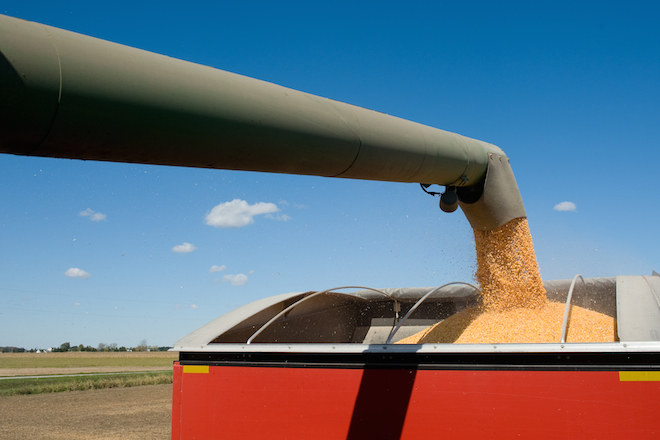
Grain is loaded into a trailer.
Even if the 78th Arkansas General Assembly had passed a law in 1991 regulating grain dealers, some agriculture officials believe it wouldn’t have prevented the losses threatened by the collapse of Turner Grain Merchandising Inc. of Brinkley.
The bill, sponsored by former Democratic state Sen. Lu Hardin, would have granted the Arkansas State Plant Board oversight of grain dealers operating in Arkansas. It would have required dealers to obtain a license and maintain a minimum net worth. And it would have allowed the board to audit grain dealers’ financial resources and their “ability to pay for grain purchased by them.”
The bill, which passed unanimously in the Senate but died after reaching a House committee, has been noted by state agriculture officials in recent weeks as Arkansas farmers have grappled with millions of dollars in potential losses caused by Turner Grain’s failure to fulfill grain contracts.
Now, officials involved in Arkansas agriculture are focusing on researching and drafting a law that could regulate grain dealers in Arkansas and protect farmers. It’s widely expected that the Legislature will take up the issue during its next general session, which begins in January.
Arkansas Secretary of Agriculture Butch Calhoun said he’s talked to several lawmakers about a proposed bill. But both Calhoun and State Plant Board Director Darryl Little reiterated that attention to detail is important in this process.
“We don’t need a quick, knee-jerk fix,” Little said. “We need to study it.”
Steve Eddington, vice president of public relations for the Arkansas Farm Bureau, said the nonprofit organization has been approached by several lawmakers about a bill and is researching other states’ grain dealer laws.
But he was unable to characterize the role the bureau might play in the ongoing discussions.
“Our policy positions are defined by our membership,” Eddington said in an email Tuesday to Arkansas Business. “I have every expectation that expanded policy on this subject will be introduced and discussed before and around our state convention, which is the first week in December. Our board defines our legislative priorities after policy is set each year.”
Along with the Agriculture Department and its State Plant Board, Little said the Attorney General’s office and the National Agriculture Law Center at the University of Arkansas in Fayetteville have offered help as regulators weigh their options.
Possible Regulations
Little said his staff’s research indicates that about 35 states have some kind law regulating grain dealers.
“There are a lot of variations in them,” he said. “We’re trying to find what will be a good match here.”
Little presented lawmakers with key pieces of laws from various states at an Aug. 22 meeting of the Joint Committee on Agriculture, Forestry & Economic Development.
Some require grain dealers to submit yearly financial statement to acquire a license. Others require dealers to post bonds and submit to regular audits.
Little said those requirements would be key elements for any proposed legislation.
Other requirements might include indemnity funds, which provide both cover to producers in the case of a dealer failure and an avenue for producers to reclaim a portion of their losses.
Other states, like Iowa, have indemnity funds that pay the producer up to 90 percent of the losses. Iowa has a cap of $300,000 per claimant.
Indemnity funds are “not in most of the other states that have laws, but we’ll look at it,” Little said.
If a grain dealer law is passed, Little said he would like to establish a fee structure that would generate between $300,000 and $400,000 a year to hire additional auditors.
The 1991 Bill
In an interview last week with Arkansas Business, Hardin said the Farm Bureau originally approached him about sponsoring a bill regulating grain dealers.
Hardin, then a state senator, remembered the bill as “pretty simple” and “straightforward,” but also referred to it as a “very good, solid bill.”
More: Download the 1991 bill here (PDF).
“It would have — before anyone could deal with farmers and before money could change hands — they would do due diligence on grain firms and would require a financial statement be submitted to the Plant Board,” Hardin said. “And [the dealers] would have to show they had a certain net worth, and be bonded.”
Hardin said the bill sailed through the Senate on a unanimous vote, 32-0, and was sent to the House Agriculture & Economic Development Committee.
By then, Hardin said, the grain dealers had gotten wind of the bill and had begun lobbying against it. Legislators added amendments in committee. While Hardin couldn’t remember specifics about the changes, he said would they have harmed the bill.
“I remember being concerned about the amendments,” Hardin said.
Eventually, the bill was recalled by the Senate. Hardin later withdrew the bill altogether.
No Second Try
Speaking during the Aug. 22 agriculture committee meeting, Mike Churchwell, a grain warehouse section manager for the State Plant Board, recalled that the big argument against the 1991 bill was money.
While he didn’t have estimates, Churchwell told Arkansas Business that the bill was expected to at least double the program costs for the State Plant Board.
Hardin said he doesn’t think the cost would have been an issue, remembering the State Plant Board said it could handle it.
“The issue of there being a lot of money or cost — that just isn’t really a factor because you’re just looking at financial statements,” Hardin said.
Hardin said there might also have been concerns about government overregulation.
Since the bill failed in 1991, there have been no other attempts at legislation regulating grain dealers in Arkansas.
“Because this is a major issue involving millions of dollars… that’s the interesting question, is why it wasn’t revisited,” Hardin said.
Churchwell said the reason can be chalked up to lack of interest.
“There really hasn’t been anything to that magnitude [of Turner Grain],” Churchwell said.
 Sign up for Daily E-news