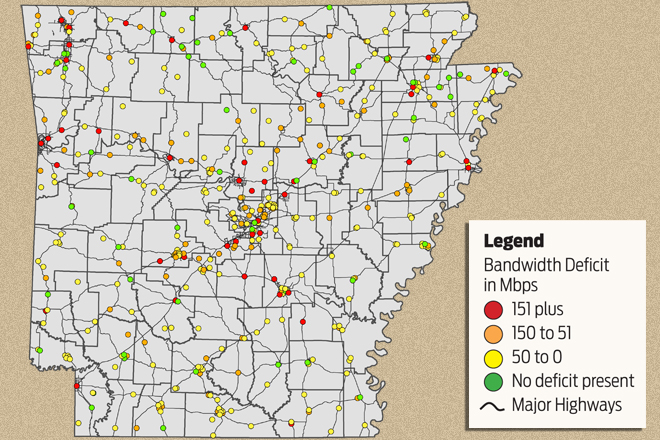
A map of which K-12 schools are operating at bandwidth speeds of 100 megabits per second for every 1,000 students and staff members. Each dot represents a public school acting as a bandwidth distribution point for nearby educational facilities.
Have you wondered what’s behind those TV ads encouraging “a simple change of law” to allow Arkansas students “to use our taxpayer funded Internet network”? Here’s a primer:
The ads are the work of FASTERArkansas — Fast Access for Students, Teachers & Economic Results, a committee of business leaders, nonprofits and school superintendents. While the message may be getting lost in the clutter of political ads ahead of the Nov. 4 midterm election, FASTERArkansas isn’t asking for your vote. It’s asking the public to pressure legislators to tweak, preferably through a special session before Gov. Mike Beebe’s term ends in January, a state law that sailed through the Legislature almost unnoticed in 2011.
Act 1050 was a quiet victory for telecommunications companies because it expanded the Telecommunications Regulatory Reform Act of 1997 to prohibit the state from offering not only telephone but voice, data, broadband, video and wireless services.
The bipartisan bill included exemptions for emergency services, higher education, health care and law enforcement. But three days before final passage, the broader exemption for an “education institution” was literally crossed out of the bill, effectively prohibiting the state from offering broadband services to public schools.
The Arkansas Department of Education was never asked how the bill would affect Arkansas schools, the Quality Digital Learning Study Committee, consisting of key education and telecom stakeholders, reported in May. As a telecom regulatory bill, it was considered by the House Insurance & Commerce Committee instead of the Education Committee before passing through both the House and Senate without a single no vote.
K-12 schools still use APSCN, the Arkansas Public School Computer Network, a state-funded, copper-wire network that dates back to Act 4 of 1992. But Act 1050 prohibits them from connecting to ARE-ON, the fiber-optic Arkansas Research & Education Optical Network that connects public universities to the Internet at vastly higher speeds.
Education SuperHighway of San Francisco, in a study commissioned by the Arkansas Legislative Council, found that the old APSCN provides less than 10 Mbps of connectivity for 65 percent of Arkansas’ K-12 schools. How much is that? The Federal Communications Commission recommends the typical American family with four connected devices have at least 15 Mbps, but the average household has about 7.
As a result, most school districts buy additional broadband from private telecom companies at wildly varying costs, according to a study conducted for the Arkansas General Assembly.
This is good for telecoms, of course. The Education SuperHighway study estimated that school districts in the state paid about $8 million in fiscal 2013 for broadband provided by the private sector (and about $11 million for APSCN).
And that helps explain why private-sector Internet providers — including AT&T Inc., CenturyLink Inc. and Windstream Holdings Inc. — have formed their own lobbying group in opposition to FASTERArkansas: Arkansas Broadband Coalition for Kids. ABC for Kids contends that connecting schools to ARE-ON will create a redundant infrastructure at taxpayers’ expense while making government a direct competitor with private industry.
But FASTERArkansas also has some heavy hitters on its team, including Acxiom EVP Jerry Jones, who chairs the committee, and the Walton Family Foundation, which has given money to get the message out. Beebe has publicly endorsed the group’s efforts.
“Whatever the reasons were behind the exemption passed in 2011, it has become clear that Act 1050 has impeded our progress in developing a reliable and efficient broadband infrastructure for Arkansas students,” Beebe said when the Arkansas Board of Education adopted the Arkansas Digital Learning Study at a meeting in June. “Giving K-12 schools the opportunity to access ARE-ON will provide better online availability for our students and save our taxpayers money.”
Gov. Beebe has repeatedly said he would consider calling a special session to amend the law before his term ends Jan. 13. At a FASTERArkansas supporter luncheon at Acxiom Corp.’s headquarters in Little Rock on Sept. 30, Beebe said he wouldn’t call legislators to Little Rock until after the mid-term election — and not even then unless he is certain he has the votes necessary to amend.
As of last week, the governor’s spokesman, Matt DeCample, said, the votes were just not there. Even if they were, many representatives are out of town at the end of the year, and it would be difficult to reach a quorum to amend the law.
 Sign up for Daily E-news