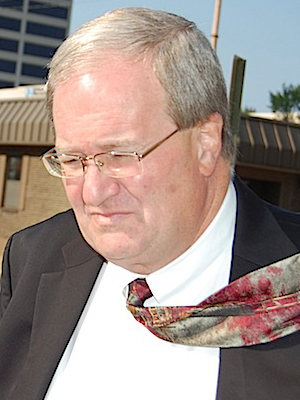
Steve Standridge
THIS IS AN OPINION
We'd also like to hear yours.
Tweet us @ArkBusiness or email us
Sitting there in the retro-vintage federal courtroom in Hot Springs, I listened to Steve Standridge of Mount Ida try to make a federal judge feel bad for not giving him more time to come up with millions of dollars in restitution.
At least, that’s how he sounded to me — like a guy who had been able to talk his way to fortune and fame in the insurance industry using the classic sales technique of appealing to emotion.
If you read my full report winding up Standridge’s case last week, you know that U.S. District Judge Susan Hickey was unimpressed. She sentenced him to 60 months in federal prison and ordered him to report in mid-January.
One pitch Standridge, through his defense attorney, made in a memorandum prior to sentencing was that he could have filed for a “quick and easy bankruptcy” but hadn’t because he wanted to pay his victims in full.
By his sentencing day, Standridge had figured out what even most casual observers of bankruptcy law know: His debts were incurred almost entirely as a result of fraud and were therefore not the sort of debts that could be discharged through bankruptcy. “Now I know I would have seen criminal charges from that too,” he told Judge Hickey.
If anything Standridge said that day was true — and I qualify it because his demonstrated willingness to lie was breathtaking — then he and his business weren’t in financial trouble in the first place. Instead, he put his own money and credit on the line in order to help two clients keep their businesses going.
Standridge has never admitted that premium finance fraud was his idea, but it seems unlikely that two of his insurance clients independently came up with an idea for defrauding banks and insurance companies in a way that would require an insurance agent to be part of the scheme. Danny Wood pleaded guilty to a bank fraud independent of Standridge, but I have to wonder if the late Gregory Hunt would have ever become a felon if he had never met Steve Standridge.
Both Wood, owner of two lumber mills, and Hunt, whose family owned a construction company, were apparently desperate to try to save their businesses as the construction industry tanked in 2009. It seems to me that they, not Standridge, were better candidates for bankruptcy — although no bankruptcy is easy or particularly quick.
So why didn’t they seek bankruptcy protection instead of defrauding banks? For that matter, why didn’t Little Rock real estate developer Steve Clary call a bankruptcy attorney before he misappropriated part of a bank loan? He ended up in bankruptcy anyway — and in prison.
I called Little Rock bankruptcy attorney Jim Dowden for insight. When should a business owner call a bankruptcy attorney? Is there a snappy rule of thumb — when this happens, pick up the phone?
Unfortunately, Dowden said, there’s no one-size-fits-all answer. But there is this: By the time someone calls a bankruptcy attorney, it is usually too late to head off bankruptcy — and not just because bankruptcy attorneys have one hammer and everything looks like a nail.
“One in a hundred,” he said, seek advice before they are too far gone. And while Chapter 11 reorganization can be a business-saver if pursued early enough, Dowden told me that even 11s are generally filed too late to avoid conversion to Chapter 7 liquidation.
Look, bankruptcy is by definition a bad thing. It represents a failure. No one wants to need bankruptcy protection. But orderly discharge of debts was so important to our Founding Fathers that the first article of the U.S. Constitution empowered Congress to set up a uniform system for dealing with bankruptcies.
And bankruptcy is infinitely better than other desperate moves. I have heard U.S. District Judge Leon Holmes say more than once that the story of an upstanding member of society who accesses someone else’ money with the intention of paying it back promptly is common, and requires prison time.
I said all that to say this: If it has crossed your mind that you or your business might need bankruptcy protection, call a lawyer. You could be the one in 100. Whatever you do, don’t start using someone else’s money, not even just temporarily. Down that path lies federal prison.
This is the last regular issue of Arkansas Business of 2014, the last that will bear a front-page reminder that we’ve been doing this thing for 30 years.
I want to take this opportunity to thank our loyal readers. Our paid subscriber base is not at the peak it reached in 2009, but I’m very proud to say that it is still above its 10-year average — something very few publications can claim.
Here’s to a prosperous 2015 filled with interesting, valuable business news.
(Email Gwen Moritz, editor of Arkansas Business, at GMoritz@ABPG.com.)
 Sign up for Daily E-news