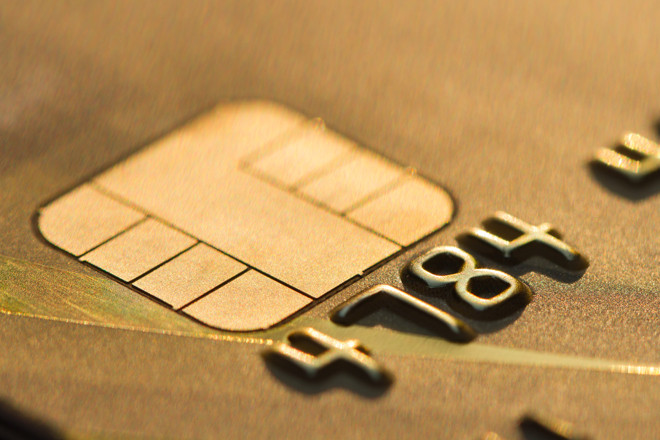
The race to get American consumers to use debit and credit cards equipped with EMV chips has been more of a sluggish walk than a run in recent years.
The technology, which uses a chip embedded in the cards to record transactions in place of a magnetic strip, has been used for years in other parts of the world. The acronym stands for Europay, MasterCard and Visa, a nod to the companies that initially employed the technology.
Some warmly refer to the technology and its use as “dipping the chip.” Instead of swiping a card, which transfers information from a magnetic strip to the store’s machine, users hold the card’s chip contact area to the device to send information.
The EMV cards provide more security options than traditional ones, including authenticating transactions and encrypting information. By comparison, a traditional card can easily be cloned by copying the information on its strip and can be used repeatedly after that.
MasterCard and Visa are pushing the adoption of the cards by shifting liability for fraud losses to merchants or issuers over the next few years if an EMV card is not used during a transaction. By 2017, liability will also be shifted for ATMs and gas pumps.
But despite the looming deadlines, Arkansas — like the rest of the country — is progressing slowly in rolling them out. Geoff Riordan, the president of AAMSCO of Little Rock, which provides training and installation of card systems and financial industry consulting, said many banks were waiting to see if the deadlines, which are frequently pushed back, would hold firm. AAMSCO hosted a gathering in west Little Rock of bankers and card issuers earlier this month — titled the Race to EMV Conference — that focused on the technology.
At a seminar introducing attendees to the technology and its history, no one raised his hand when asked who had begun implementing the new cards.
Riordan said banks in the state were largely watching each other to see if the technology would be implemented, but that data breaches at Target and Home Depot put an additional emphasis on rolling out the new system. He said he didn’t know of a single bank in Arkansas that wouldn’t eventually adopt the new cards, which he said should start showing up in the mail by the middle of the summer with the rest coming in the fall.
There’s no penalty for not meeting the deadline, Riordan said, except that the cards that aren’t EMV are the ones that will be vulnerable.
According to EMVCo, the global facilitator for EMV technology, only 0.03 percent of card-present transactions in the U.S. between July 2013 and June 2014 were made with an EMV card. By comparison, 96.33 percent of the transactions in a group of 37 European countries used the chip cards. Worldwide, nearly 30 percent of financial transactions using a card were EMV.
Deployment of the technology worldwide is also substantial: 2.37 billion EMV cards are in circulation and there are 36.9 million card readers in use, according to EMVCo.
“The continued adoption of EMV chip cards and terminals globally emphasizes the important role this technology plays in securing physical payment transactions,” Dave Meadon, EMVCo’s executive committee chair, said in a statement. “EMVCo last released data in Q4 2012, which showcased 1.62 billion EMV cards in circulation and 23.8 million terminals active worldwide. … These are impressive figures.”
Bill Holmes, the president and CEO of the Arkansas Bankers Association, said banks in the state are already motivated to adopt more secure payments because they often bear the brunt of fraud losses. He said that the cost of adopting EMVs will be “significant.”
“We don’t know numbers yet. It will be expensive but it’s worth it to keep the latest technology. And, obviously, we’re here to protect our customers and their data and solve as much of the breach problem as possible,” Holmes said.
Riordan said that at the same time, the financial industry is watching how mobile payment systems such as Apple Pay and CurrentC will affect card use in the future with their added security features. But he said no one expects cards to disappear completely.
“Right now with mobile applications, you’ve got several players that are trying to come up with their own applications to be the leader in that,” Riordan said. “The bottom line is that although mobile applications will become more prevalent, it’s still not going to replace the cards and the EMV chips and that technology going forward.”
 Sign up for Daily E-news