As one of the seminal events in the history of Little Rock and the wider civil rights movement, the battle to desegregate Little Rock Central High School beginning in September 1957 offers many individual images and stories comprising the larger narrative of that time.
One of the most famous and often-quoted is attributed to Little Rock socialite and activist Adolphine Fletcher Terry. Frustrated by the manner in which the crisis denied educational opportunity and eroded the community’s image, she told newspaper editor Henry Ashmore in late summer 1958, “The men have failed. It’s time to call out the women.”
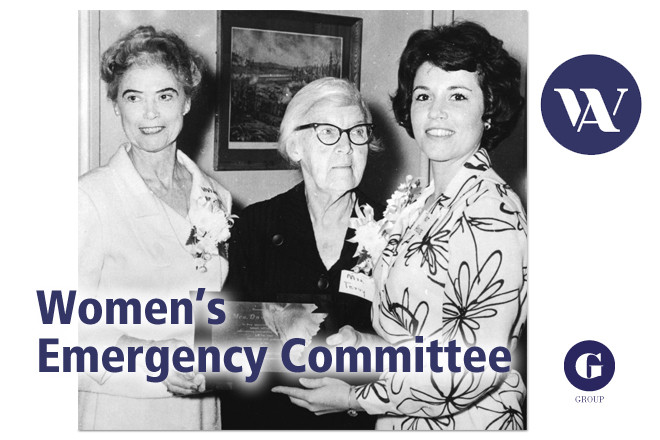
Terry, Vivion Brewer of Scott and Velma Powell of Little Rock founded the Women’s Emergency Committee to Open Our Schools (WEC) along with 48 like-minded women in September 1958. The WEC was a response to Gov. Orval Faubus’ summertime order to close the schools rather than comply with desegregation.
“For days I walked about unable to concentrate on anything, except the fact that we had been disgraced by a group of poor whites and a portion of the lunatic fringe,” Terry wrote. “Where had the better class been while this was being concocted? Shame on us.”
WEC was the first organization to publicly oppose the order and, despite members’ lack of political experience, launched a campaign to reopen the schools. It was an uphill climb, made more challenging when Little Rock residents voted that month to uphold the governor’s order, scrapping the 1958-1959 academic year, known thereafter as the “Lost Year.”
As the organization redoubled its efforts through flyers and local advertising, the white, predominantly well-to-do women that filled its ranks soon felt segregationist backlash. To shield them, the WEC kept its membership and meetings secret and officially adopted the mantra, “Neither for integration, nor for segregation, but for education.”
Still, known association with WEC meant an integrationist brand, accompanied by hate mail, threatening phone calls or even domestic turmoil.
“Some of [the members] asked us not to send mail to their homes,” said Brewer in a 1976 interview for the Southern Oral History Program at the University of North Carolina. “Unfortunately, I know of a few divorces that came from this period.”
Unsurprisingly, WEC leadership caught the lion’s share of harassment. Brewer, who served as the group’s media spokesperson, was particularly recognizable.
“When we first had our office, it was in the old Capital Hotel building, right on the main floor. Pickets would walk up and down outside, you know, and stare in at us,” Brewer said. “Our husbands absolutely refused to let us stay there over Sunday. They were just afraid, with so few people around, we would have trouble. Finally we moved that office, because it was just too public a place. It’s hard to know why people hate like this.”
Meanwhile there was work to do: In November 1958, five of six school board members resigned and the WEC worked to repopulate the board with members sympathetic to their cause. The ensuing election seated a 50-50 split between segregationists and so-called “moderate” board members.
The turning point came in May 1959 when, acting alone, the three segregationist board members fired 44 teachers and administrators they considered pro-desegregation. The highly-organized WEC quickly took advantage of the resulting community outrage and began contacting voters to support deposing the segregationist board members via a special election.
WEC members spent the run-up to school board elections taking petitions door-to-door, contacting voters, arranging carpools to the polls and acting as poll watchers. When the dust cleared, the three moderate members remained and the segregationist members were removed. Little Rock’s high schools reopened in August 1959.
In 1963, WEC members voted to disband the organization, but many members continued their local activism. Terry pursued a number of community causes and Brewer worked to improve early education opportunities for black students in her native Scott.Another member, Sara Alderman Murphy, established the Little Rock branch of the multicultural Panel of American Women, a group which sought to build community across racial and religious lines. Countless others felt empowered by WEC in ways beyond the cultural dictates and gender stereotypes of the time.
Many members are now deceased and those who remain are often hesitant to discuss those days for fear of reviving dormant tensions. However, they leave behind — in their own words and by inspiring the words of others — accounts of their courageous activism that will ensure the story does not fade into the recesses of distant memory.
In 1996, a documentary on the WEC “The Giants Wore White Gloves” premiered at the Hot Springs Documentary Film Festival. Sara Alderman Murphy’s firsthand account of the WEC, Breaking the Silence: Little Rock’s Women’s Emergency Committee to Open Our Schools, 1958-1963, was published posthumously in 1997. That same year, papers pertaining to the Central High School integration crisis and formation of WEC were donated to the University of Arkansas as the Velma and J.O. Powell Collection. In 1998, Brewer’s The Embattled Ladies of Little Rock, 1958–1963: The Struggle to Save Public Education at Central High published posthumously.
Also in 1998, then-First Lady Hillary Clinton spoke in Little Rock at commemoration ceremonies of the 40th anniversary of the group’s founding. In 2007, The Arkansas Historical Quarterly published “Power from the Pedestal: The Women’s Emergency Committee and the Little Rock School Crisis” as part of its “The 1957 Little Rock Crisis: A Fiftieth Anniversary Retrospective.”
 Sign up for Daily E-news