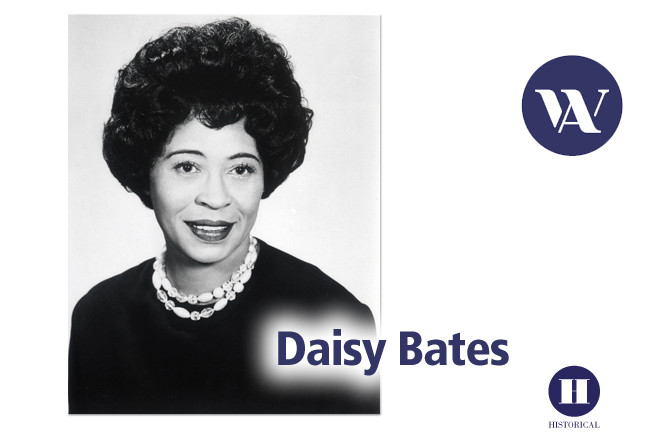
Daisy Lee Gatson Bates endured a tragic childhood in south Arkansas but made it her life’s work to make sure other African-American children might have an easier path to equality.
Her efforts to organize the Little Rock Nine and see those students successfully integrated into Little Rock Central High in 1957, and Bates’ exhaustive work as a crusader for school integration elsewhere, have made her name synonymous with civil rights worldwide.
An activist, writer and publisher, Bates, who suffered a heart attack and died in 1999, is known primarily for her work as a mentor to the black students who integrated Central and for her efforts to protect them. With her husband L.C. Bates, she published the Arkansas State Press newspaper, which advocated for the civil rights of blacks.
Bates was president of the Arkansas chapter of the National Association for the Advancement of Colored People (NAACP), elected to that position in 1952, and wrote the book “The Long Shadow of Little Rock” based on her experiences fighting segregation at Central. A street in the Central High historic district of Little Rock bears her name as does an elementary school in the Little Rock School District.
The third Monday in February is officially designated Daisy Bates Day in Arkansas; Bates received an honorary doctor of laws degree from the University of Arkansas in 1984; she received an official commendation from the Arkansas General Assembly; won the 1988 American Book Award; was a joint recipient with the Little Rock Nine of the 1958 Springarn Medal from the NAACP; and was named Woman of the Year in 1957 by the National Council of Negro Women.
Born in Huttig (Union County) in 1914, Bates was raised by her foster parents, Orle and Susie Smith, after her biological mother was sexually assaulted and murdered by three white men and her father left home. For many years, Bates believed the Smiths to be her biological parents, but at age 8 she learned the circumstances of her mother’s death and the lack of justice for the crime. The knowledge fueled her anger and motivated Bates even further to strive for civil rights.
In her essay, “The Death of My Mother,” Bates quotes her adoptive father on his death bed:
He said, “You’re filled with hatred. Hate can destroy you, Daisy. Don’t hate white people just because they’re white. If you hate, make it count for something. Hate the humiliations we are living under in the South. Hate the discrimination that eats away at the South. Hate the discrimination that eats away at the soul of every black man and woman. Hate the insults hurled at us by white scum and then try to do something about it, or your hate won’t spell a thing.”
Bates never forgot his advice and has credited it as the source of her strength for leadership.
She married Smith, a former journalist, in Little Rock in 1942 and the couple founded the Arkansas State Press, which quickly became an important voice for the black community in the state.
The paper championed civil rights, and Bates became active in the civil rights movement. As the head of the NAACP’s Arkansas branch, she played a crucial role in the fight against segregation.
Bates and Smith chronicled the ongoing fight to integrate Little Rock schools following the landmark, 1954 U.S. Supreme Court ruling in Brown v. Board of Education that declared school segregation unconstitutional. Even after the ruling, black students in Arkansas who tried to enroll in white schools were turned away.
Then in 1957, Bates organized and mentored the group of black students who collectively became known as the Little Rock Nine. The students tried to attend Central for the first time on Sept. 4, and were met with jeers and the Arkansas National Guard, sent by segregationist Gov. Orval Faubus.
Undeterred, the group made Bates’ home its headquarters in the battle to integrate Central, and Bates became the face of the Nine, their advocate and supporter. Finally, on Sept. 25, President Dwight Eisenhower sent federal troops to supercede the National Guard, uphold the law and protect the Nine.
With U.S. soldiers providing security, the students gathered at Bates’ home and made their historic walk into the school.
Once successfully enrolled, the students continued to face harassment and intimidation, and Bates continued to support them despite receiving threats herself.
Advertising revenue for the Bates’ newspaper suffered as well. In 1959, they were forced to shut down the paper. Three years later, her account of the school integration battle, “The Long Shadow of Little Rock,” was published. Bates spent much of the 1960s in Washington, D.C., working for the Democratic National Committee and on anti-poverty projects for the Lyndon Johnson administration.
Bates’ status as one of the country’s leading civil rights leaders was recognized in 1963 by her selection as the only woman to speak at the Lincoln Memorial at the March in Washington. Bates moved back to Arkansas in 1968 to become executive director of the Economic Opportunity Agency in Mitchellville, then an all-black town just north of Dumas in Desha County.
L.C. remained in Little Rock while Bates stayed in Mitchellville during the week. This marked the start of a new phase in Bates’ life in which she focused on economic self-sufficiency for the black community.
While in Mitchellville, Bates was able to secure grants and donations for community improvements including a sewer system and a Head Start program. In 1974, she returned full-time to Little Rock, where she worked on various community projects.
Bates revived the State Press in 1984 — her husband died in 1980 — but sold it in 1988.
In May 2000, Bates’ memory was honored in a ceremony held at Robinson Auditorium in Little Rock and attended by more than 2,000 people, including President Bill Clinton, who described her achievements by comparing them to a diamond chipped away in form but one that shines ever more brightly.
 Sign up for Daily E-news