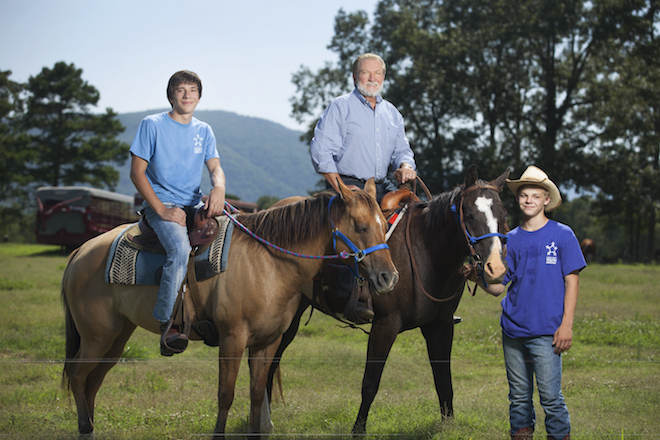
Larry Stone with kids who live on one of the Arkansas Sheriffs' Youth Ranches, where they have responsiblities like taking care of the animals and helping with normal household chores in the homes where they live with foster parents.
Since 1996, Larry Stone has been on the board of directors for the Arkansas Sheriffs’ Youth Ranches — and it all began when a friend asked him to buy a table at the first Arkansas Children’s Award Dinner.
Stone said he had never heard of the ranches and had no idea what they did, but he wanted to help nonetheless. Now Stone himself is the honoree at the 20th annual dinner.
As CEO of Stone Ward in Little Rock, Stone already has a lot on his plate, but that hasn’t stopped him from becoming deeply involved with the ranch and other charities, including the Make A Wish Foundation, the Thea Foundation and Ronald McDonald House.
Since Stone joined the board of the Arkansas Sheriffs’ Youth Ranches, the organization’s assets have grown from $2 million to $26 million, and the nonprofit has grown from one campus to three.
The organization’s mission is to address, remedy and prevent child abuse and neglect by creating safe, healthy and permanent homes for children. The ranches give foster kids a place to call home, with many able to live with their biological siblings. At the ranches, they are able to have normal lives: they live with house parents, attend public school and have a place to call home, rather than being moved around by the state foster care system.
The dinner honoring Stone will take place at 7 p.m. Wednesday, Oct. 14 at the Little Rock Marriott Hotel. Tickets are available here, and you can learn more about Sheriffs’ Youth Ranches at their website.
Arkansas Business talked to Stone about his involvement with the nonprofit and the importance of charity work.
Q: Why did you decide to get involved with the Ranch?
A: When I saw that thousands and thousands of people, through small donations, were contributing to this cause, it convinced me that this is the real deal. This is a cause that has real benefit, that people believe in — and it has true and positive outcome.
Q: What’s one of the most important things that has happened at the Ranch since you became involved?
A: Since I’ve been connected with the ranch we’ve gone from one campus to three, we’ve expanded the geographic footprint, we have established new programs and we’ve served more kids, and so a lot of good things have happened. But it really comes back to the core purpose of what we’re doing, and it just happens over and over again that a child got a second chance at a good life. It’s just amazing to see that transformation. And that’s truly the most important thing that happens there.
Q: How do you balance your work at the Ranch with your work at Stone Ward?
A: There are times when your schedule gets to be where you have to make a choice what you do, but overall it’s really not that difficult. It’s pretty easy to keep that in balance … And you find, that if you’re really wanting to do both of those things, you find time for that. You spend less time doing something that’s probably not as important and you fill up the time that you have with more important things and it pretty well takes care of itself.
Q: Why do you think it’s important for people to be involved in charitable/volunteer work?
A: First and foremost for me it’s the second half of the Greatest Commandment, which is to love everybody around you and do for them what you would do for yourself, and that’s important to me. So it starts there. But then to fill that in a bit, we all have a desire and a need for contributing and fulfillment and doing something of value. And you can find that in service to others.
Q: What has your volunteer work taught you?
A: Working with the Ranch and the kids has shown me that divine heart transplants can and do happen every day, because of the dedication of these people who are willing to do this and the generosity of the people who contribute to this organization to make this happen.
Q: What are your goals for the Ranch in the future?
A: The need is greater now than it has ever been, which is kind of nonsensical or illogical — you’d think it’d be the other way around. But, according to the statistics at the Governor’s recent Restore Hope Summit, there are 4,387 children in the foster care program in the state but only 2,940 foster home beds were available. So you see that gap of kids who need a foster home.
The Ranch has space and physical capability to serve more kids, but we’re limited by the financial resources we have. If more people knew about the Ranch, we could add more kids, we’ve got more places, we could build more facility because we got the space, but there’s a cost attached to that.
 Sign up for Daily E-news