THIS IS AN OPINION
We'd also like to hear yours.
Tweet us @ArkBusiness or email us
With the 2016 election right around the corner, the candidates are searching for wedge issues to appeal to large swaths of the electorate. Medicaid expansion, especially in Arkansas and other states that have already broadened the federal program, is proving to be a major sticking point.
The Affordable Care Act contains a provision that expands Medicaid coverage to almost all individuals with incomes below 138 percent of the poverty line. But in the U.S. Supreme Court’s 2012 decision to uphold the ACA’s constitutionality, the court ruled that the federal government could not compel states to expand their Medicaid programs. At this point, 30 of them have chosen to (Arkansas did so in 2013).
The arguments over whether to expand Medicaid vary state by state, but proponents often point to the federal government’s offer to foot almost the entire bill. For example, Ohio Gov. John Kasich supported Medicaid expansion as a way “to bring Ohio money back home” — that is, avoid bearing any of the cost.
But new research of ours suggests that this argument may be lacking, since it doesn’t account for associated increases in state and local spending.
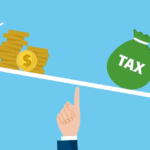
Analyzing all federal funding to state and local governments finds that each additional dollar of federal money sent to the states is associated with an average increase of 82 cents in new state and local taxes. Across all states, a hypothetical 10 percent increase in federal grants to state and local governments would be associated with approximately $50 billion in additional increased state and local taxes, charges or other revenue sources. In real terms, this translates to an additional government burden of $158 per person. This is in line with existing peer-reviewed research that concludes that each dollar of additional federal grants is associated with 54-86 cents in new state and local taxes.
Implementing the ACA’s Medicaid expansion in the remaining 20 states, which would cost the federal government an estimated $469.2 billion over the next decade, would therefore cost state and local governments an additional $318.4 billion.
And the fact that these 20 states have not expanded the program reflects a realization that “free” federal money can be very expensive after all.
But how does federal government spending, which should theoretically crowd out state spending and taxes, in reality increase spending and associated taxes? The U.S. Government Accountability Office suggests two ways. First, federal grants usually require matching state spending, which is often paid for by increased taxes or fees. Many necessitate a dollar-for-dollar match in spending by state or local governments. Second, federal grants often have a maintenance of effort condition, which requires states to prolong the funding after a certain time frame. In this way, the federal government guarantees that federal money adds to state spending, rather than takes its place.
Yet even when the federal government promises to cover nearly 100 percent of the cost, as it has done with Medicaid through 2016, state taxes can still increase because of increased ancillary costs, such as additional infrastructure and personnel. (Just think of the extra hospitals that must be built or additional nurses hired to accommodate more Medicaid users.)
In Arkansas, for instance, each additional dollar of federal transfers — such as Medicaid expansion — is associated with a corresponding 59-cent jump in state and local taxes. A hypothetical 10 percent increase in federal transfers would translate into approximately $390 million more in state and local spending (and an additional $130 per person in new taxes and fees).
These findings shed new light on the potential consequences of accepting federal money. While Medicaid expansion might make sense in some states, the people of Arkansas should know firsthand that federal money isn’t “free.” It costs them billions of dollars.
 |
Eric Fruits is president of Economics International Corp., an economics consulting firm based in Portland, Oregon.Dan Greenberg is president of the Advance Arkansas Institute, a nonprofit research and educational organization committed to advancing public policy based on free markets, individual liberty and limited, transparent government. |
 Sign up for Daily E-news