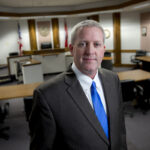
Attorneys John Goodson of Texarkana, W.H. Taylor of Fayetteville and others involved in a class-action lawsuit against the USAA insurance company have been ordered to explain why they shouldn’t be sanctioned for abusing the federal court system.
The case of Mark and Katherine Adams vs. United Services Automobile Association was the subject of an in-depth report in Arkansas Business on Dec. 14 — a report cited by U.S. District Judge P.K. Holmes of Fort Smith, the chief judge of the Western District of Arkansas, in a show-cause order filed Monday. (Mark Adams was incorrectly called Michael in some court documents.)
The order suggests that the report by Senior Editor Mark Friedman was the first time the court realized that the parties jointly dismissed the case from Holmes’ court on June 22 was refiled the next day, with a proposed settlement attached, in Polk County Circuit Court.
(Update, Wednesday, Dec. 23: The settlement was approved in state court.)
“Notably, although his matter was pending in this [federal] Court until June 22, the stipulation was signed by counsel on June 16, 2015, and specifically defines ‘Court’ as ‘the Circuit Court of Polk County, Arkansas,'” Holmes noted in his order.
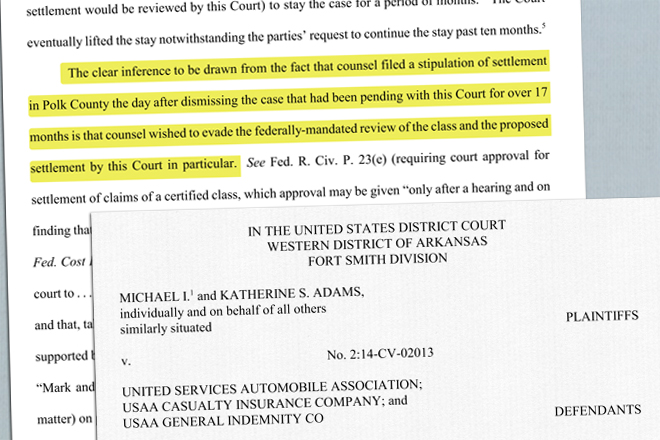
“The clear inference,” Holmes wrote later in the order, “to be drawn from the fact that counsel filed a stipulation of settlement in Polk County the day after dismissing the case that had been pending with this Court for over 17 months is that counsel wished to evade the federally-mandated review of the class and the proposed settlement by this Court in particular.”
Goodson, his law partner Matt Keil and W.H. Taylor of the Fayetteville firm of Taylor Law Partners were among 14 attorneys representing the Adamses and the proposed class of plaintiffs in federal court. When the case was refiled in Polk County the next day, only Goodson, Keil and three attorneys from the Taylor firm continued to represent the plaintiffs.
Goodson is the husband of state Supreme Court Justice Courtney Goodson, who is running for the position of chief justice.
Three Connecticut lawyers and Lyn Peeples Pruitt of the Mitchell Williams firm in Little Rock represented USAA.
Calls to Goodson, Keil, Taylor and Pruitt were not immediately returned Tuesday morning.
All 18 attorneys have been ordered to explain why Holmes should not impose non-monetary sanctions — the only kind he has available. A date for the show-cause hearing had not been set by Tuesday morning.
Specifically, Holmes instructed the attorneys to convince him that they had not engaged in improper “forum shopping,” had not wasted government resources “only so counsel could gain leverage in settlement negotiations” and had not been guilty of “generally inappropriate procedural gamesmanship.”
In his sharply worded seven-page order (PDF), Holmes noted that he had presided over a similar case that the Adamses brought against another insurance company, and that he had ordered the parties to make changes to their proposed settlement in that case that were more favorable to the class of plaintiffs. That case was settled to Holmes’ satisfaction less than three weeks before the case against USAA was dismissed from federal court and refiled in state court.
“Counsel in this case would have been aware, therefore, of the kind of terms the Court would consider fair, reasonable, and adequate in regard to the claims asserted in this matter,” Holmes wrote. And he said he “can only conclude” that the parties decided to move the case to state court because they anticipated that his court “would be diligent in its duty to protect the interest of absent class members” and would be unlikely to approve a settlement that favored the plaintiff’s lawyers and the defendants “while largely failing to protect the interests of the class.”
 Sign up for Daily E-news