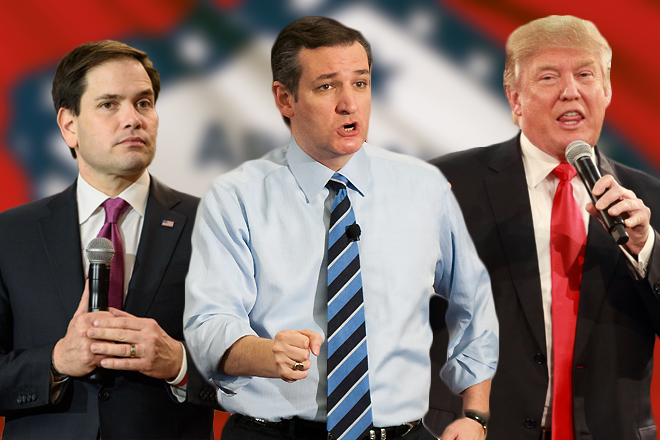
Marco Rubio, Ted Cruz () and Donald Trump lead in polling of Arkansan's preference for GOP presidential candidates. | (Crush Rush/Andrew Cline/CJ Hanevy)
(Editor’s Note: Welcome to our Arkansas Business #ARPX Primary Preview extravaganza. Once again, we asked Robert Coon and Blake Rutherford to assess what we’ve seen — and will see — in the final hours of the Arkansas and Super Tuesday primary. Arkansas Business Online Editor Lance Turner moderates the discussion.)
Lance Turner: This weekend, the top contenders for both parties’ presidential nomination barnstormed the state, some making their second and third jaunts of the season. Has the Legislature that moved the primary season from May to March been vindicated? Was it worth the hassle, and do you think the early date will remain?
Robert Coon: Based on the increased attention that Arkansas has received this year from presidential candidates, proponents to move the state’s primary election to March are unquestionably vindicated.
To be fair, the hassle associated with making the move and educating voters about the change is real. Furthermore, by holding the primary elections in early March, from a practical standpoint the timeframe between filing period and Election Day is fairly compressed. Not to mention the winter months are altogether less conducive for campaigning — multiple holidays, colder weather and shorter days.
I would contend that the move was ultimately worth it, as evidenced by the fact that Arkansans will have a real and influential voice in the presidential election this year by voting on Super Tuesday. I just hope we’ll resist the temptation to move it again in the near future, as to not create more confusion among voters, which could result in depressed turnout.
Voter participation in the United States lags far behind that of other developed nations, and from a state perspective, Arkansas’ participation rates already tend to fall below the national average.
Blake Rutherford: If the decision about primaries was motivated first by money and second by candidate attention then sure, the proponents are certainly vindicated. What it means long term, I don’t know, but I’ve long thought that regional primaries were a good idea and in that regard, Arkansas’ participation on a day that also involves Texas, Tennessee, Oklahoma and Alabama makes sense to me.
Predictions for President
LT: What are your top-line predictions for the presidential race in Arkansas? On the GOP side, previous polling indicates we’re looking at a battle between Donald Trump and Ted Cruz, but has the establishment’s endorsement of Marco Rubio made this a closer three-man contest?
Robert: This is probably where I should point out that these are my personal views, and that it’s worth noting that my company, Impact Management Group, is formally engaged with the Rubio campaign.
The last available public polling conducted in Arkansas, in early February, showed Ted Cruz (27 percent) with a marginal lead over Donald Trump (23 percent) and Marco Rubio (23 percent).
Nationally, since that time, Trump and Rubio seem to have gained momentum, with Cruz holding fairly steady with perhaps some upward movement. Trump continues to draw large crowds, and never fails to entertain; however it is becoming more apparent that he has a ceiling of support.
Rubio is clearly benefitting from the continued winnowing of the field both as it relates to voter support and fundraising. He has garnered a number of high-profile endorsements from southern state governors in recent weeks, including Arkansas Gov. Asa Hutchinson.
In regard to Arkansas on Tuesday, I would anticipate a battle for first between Trump and Rubio, with Cruz nipping at their heels.
Blake: I’m not sure we really know where the Arkansas Republican electorate is, although Robert may intuitively have a better sense of this. We have one poll that shows the race fairly evenly divided between Cruz, Trump and Rubio.
They’ve all spent time in the state. Recently, Rubio managed to coalesce some important establishment support behind him, which means something only if endorsements actually influence undecided voters. I’m not sure that they do, at least not this year, when emotion — be that anger or fear — seems to be fueling a lot of voters.
Each of the candidates has a constituency; in Arkansas it appears that it’s more evenly divided them. The race will be close with very little space between first, second and third.
The Trump Phenomenon
LT: Maybe here is where we go ahead and confront the Trump phenomenon. The “establishment types” seem poised to finally take on the reality TV billionaire, including Hutchinson, who had some pointed words about Trump for NPR last week. What more are we likely to see? Is it too little too late?
Robert: There’s plenty of debate on whether it’s too late, but regardless of opinions on the timing, what’s clear is that the assault has begun.
In the last debate, both Rubio and Cruz turned their focus to attacking Trump head on, both on specific policy issues (health care, foreign policy, the Supreme Court, immigration) and his lack of any real substance.
Since then Cruz, Rubio and third-party groups like Club for Growth have unleashed a barrage of attacks on Trump aimed at slowing his momentum and sowing doubt in voters’ minds about his integrity, character and inconsistencies in his record. In the past few days alone we’ve seen new attacks launched — Trump University fraud, tax return secrecy and illegal immigrant hiring practices — signaling that there’s still plenty in the oppo file on Trump, and likely more to come.
The vote on Super Tuesday will be the first opportunity to see if these new lines of attack on Trump are effective in curbing his popularity. If they are, expect the Republican establishment, and conservative advocacy groups alike, to double down.
Blake: Trump’s caught a few helpful breaks in this election.
First, the Right to Rise SuperPAC, which spent more than $150 million in support of Jeb Bush, allocated less than 2 percent of that to exploiting Trump’s dubious business record, which it could have done with greater ease and efficiency than any other campaign. (Right to Rise spent a lot more than that attacking Rubio.)
Second, Rubio’s terrible debate performance prior to New Hampshire crippled, perhaps for good, his chance to become the clear alternative to Trump at a time when it would have made a substantial difference.
And third, the field simply has stayed to large for too long, which has provided the various constituencies inside the GOP multiple alternatives. There’s no indication that Ben Carson or John Kasich are leaving the race anytime soon, and if Ted Cruz wins Texas today, he’s in it until the convention, I imagine.
Is it too little, too late? Trump has won three of the first four states and is ahead by quite a lot in a majority of Super Tuesday states as well as Florida, where he leads by 20 points, and Ohio, where he leads the sitting governor by 5 points.
Are the attacks Rubio and Cruz are mounting enough to cause the GOP electorate to rethink its position? I suppose the safe answer is that we’ll know later today. But the reality is probably no, these attacks won’t be enough — not because they are without merit, but because they came too late.
Hillary, And Locking It Down
LT: While the GOP seems conflicted — to say the least — over what a Trump nomination might mean for the party, Hillary Clinton seems to be in a good position to button up her campaign against Bernie Sanders. What are her prospects over the next few weeks, and how does Arkansas figure in? Will we see any significant pockets of Sanders support in Arkansas?
Blake: Hillary Clinton has commanding leads in every Super Tuesday state except for Bernie Sanders’ home state of Vermont. I think that she performs very well on Super Tuesday through March 15th. By that point, she have a near lock on the number of delegates required to secure the nomination. Arithmetically, it will be all but over.
But to your point about pockets of Sanders’ support, let’s not forget that he has money and, to some degree, support from millennials. The Clinton campaign will have to manage against both as she develops her general election strategy.
Robert: Ted Cruz and Hillary Clinton don’t have much in common, but the “Southern strategy” is one they have both been counting on.
For Hillary, that plan seems to be in hand. Much of Sanders’ appeal is his populist message, and he’s taken advantage of states where Hillary lacked strong support, especially higher African-American turnout.
The southern states give Hillary an opportunity to regain her footing, run up the score on Sanders, and solidify her position as the Democratic frontrunner. I expect Hillary to win Arkansas handily, without any real fight from Sanders.
Asa, On the Ballot
LT: On Sunday, the Arkansas Democrat-Gazette reported how Asa Hutchinson is endorsing candidates in eight legislative races — and supporting them monetarily via his Asa PAC. Obviously, the governor is aiming to maintain the support he needs for Arkansas Works/private option 2.0. Just what all is at stake today for the governor?
Blake: Robert will know more about the long-term implications of this on the legislative dynamic among Republicans, but there is always some element of political risk for an statewide elected official to play in party primaries. Certainly Gov. Hutchinson isn’t the first to do it, and he won’t be the last.
But if the calculus his advisors have made is that he must engage in order for these candidates to win, then there’s obviously greater political risk by remaining on the sidelines. If the candidates the governor is supporting lose, Arkansas Works has an uncertain future at-best.
Robert: The governor has planted his flag in the ground on these eight legislative races, making no bones about his support for his preferred candidates in these races. His support has been based on both the broader construct of how these members tackle tough issues in general, but also specific to those that have supported the Arkansas Works/private option plan.
Should his preferred candidates win, it will send a strong statement to the Legislature (and the public) that the state’s alternative to traditional medicaid expansion is not the political liability that many think it is. Conversely, should they lose, the future of Arkansas Works/private option is most certainly in jeopardy.
While the outcome of these races won’t alter the makeup of the Legislature before the upcoming special session, it will clearly have an effect on how many members of the House and Senate vote to reauthorize Arkansas Works/private option as they consider whether it’s a hill worth dying on.
Finally, if election day is a split decision, with some of the preferred candidates winning and some losing, expect the Arkansas Works/private option issue to continue to be the same political football it is today, both inside the legislative chamber and in the campaign arena, for years to come.
Supreme Spending
LT: On to the state Supreme Court. There’s been dark money by the sackful in both races, but mainly for chief justice. Does any candidate have an edge on Tuesday? And, after the dust settles, should we expect to see real movement toward a change in how we elect appellate judges?
Blake: I suspect that by virtue of name identification, Justice Goodson has the edge in Tuesday’s race. But this one has become so messy that it’s difficult to gauge voter attitudes in light of it all.
I don’t know whether you’ll see a real movement toward a change in how Arkansas elects appellate judges, but I think the flood of dark money, interest group engagement, and the particularly brutal nature of this race is an indication that the judicial selection process, at least for appellate court judges, is in need of repair.
Merit appointments were part of the discussion that led to Amendment 80, and the Legislature has the authority to craft a solution and send it to the people for consideration. What would such a process look like? That’s a discussion that should be taking place. State Rep. Matthew Shepard has provided some thought leadership on the issue.
A different idea is to consider the process Vermont has in place. There, the governor makes judicial appointments after receiving a list of potential nominees cultivated by a nominating board. The gubernatorial appointees are subject to confirmation by the state Senate, serve six-year terms, and face retention by the General Assembly. And an alternative to that is to have a system that provides for one fixed term, say 10 years, which is the length of time judges currently serve in South Carolina, but with no possibility of retention.
Robert: The campaign for chief justice has been one of the more politically charged races this cycle. We’ve seen more attack ads, dark money and 11th hour oppo research dumps in this race than any of the others.
[Justice] Courtney Goodson was always expected to have the financial edge in this race, based on personal wealth and deep-pocketed trial lawyer connections. However, as you noted, outside groups have invested heavily in TV and direct-mail efforts aimed at exposing her vulnerabilities. I wouldn’t think that prior to this race either candidate had widespread recognition amongst the public at large, and definitely not strong statewide bases of support. Considering that, in combination with significantly more punches appearing to land on Goodson, its hard for me not to give the edge to Kemp.
I’d expect we’ll see quite a bit of discussion in the next legislative session not only about potential new spending disclosure rules, but also merit-based appointment. Though while it may seem like a viable option to some today, moving away from popular election to appointment of judges would not take away the people’s vote (a controversial idea), but also very possibly might serve no other purpose but to move the political stakes involved with these races to future gubernatorial and state legislative races.
Boozman’s Primary
LT: On to the Republican primary for U.S. Senate in Arkansas, which — let’s be honest — should be a layup for incumbent John Boozman. Robert, what’s the looming match-up between Boozman and Democrat Conner Eldridge going to look like in Arkansas? Are we looking at a costly campaign?
Robert: By most accounts Conner Eldridge is a sharp, impressive guy (I’ve never met him) and appears to be a solid nominee for the Democrats. However, John Boozman is extremely well liked (amongst Republicans in particular), and he has a solid conservative voting record that is unquestionably in line with the majority of Arkansans.
Much is often said about Boozman’s polling numbers, and his sometimes lower than expected name ID numbers. But Boozman is an understated policymaker – a far cry from many of the headline seekers, showmen and entertainers we’re becoming more accustomed to in the political realm. That doesn’t mean that he’s weak; it simply means that he keeps his head down, works hard and gets the job done.
Eldridge seems to be having some success in fundraising, and I expect by the time it’s all over he’ll have spent every penny he raises. And while they may have had to get things going earlier than they’d liked due to a completely pointless primary challenge from Curtis Coleman, Boozman’s campaign is rolling along now, and is in fine shape heading into November.
I don’t expect we’ll see the high level of spending that we saw in the Tom Cotton-Mark Pryor and Boozman-Blanche Lincoln races of old, primarily because the possibility for a Dem pickup in this seat is quite low at this point and it really isn’t (or shouldn’t be) on the DSCC pickup list.
The one wildcard that I’d flag in this race is what happens on the GOP presidential ticket. Should Trump win the nomination, Republican candidates all down the ballot will likely suffer at least marginally. Would that be enough to change the outcome in this race? Extremely unlikely. But for Republicans in more tenuous races, a Trump candidacy could be a complete nightmare, which is all the more reason that Democrats, as far as I can tell, are watching Trump’s current success while they eat popcorn and throw high-fives to each other.
LT: Sticking with the Senate race, Blake, from a national perspective, how the U.S. Senate shaping up heading into November? How does the tenor of the presidential race affect Senate races?
Blake: The U.S. Senate races across the country are going to be very interesting, and sitting here at the beginning of March it looks like a favorable map for the Democrats.
The Democrats need to win four seats along with the presidency to gain control of the Senate. Out of the gate they appear to be in very good shape to win Republican seats in Illinois and Wisconsin. After that, New Hampshire, where incumbent Republican Kelly Ayotte is being challenged by Democratic Gov. Maggie Hassan; Florida, which is the seat left open by Marco Rubio’s decision to run for president; and Pennsylvania, where I’ve been expatriated for nearly three years, are all very real possibilities for the Democrats.
Ohio is also in play, assuming the Democrats nominate former Gov. Ted Strickland to run against incumbent Sen. Rob Portman. And keep your eye on Missouri, where the Democrat, Secretary of State Jason Kander, is going to make a serious bid against Republican Sen. Roy Blunt. It’s a year where strong Democratic candidates are also running for governor and attorney general in that state.
But it’s not a perfect map for the Democrats. They have to protect seats in Nevada and Colorado, which are not locks.
There are two national variables, one a lot more important than the other, that will impact these Senate races. The most important variable is who is at the top of the GOP ticket. Right now, it looks like it will be Donald Trump. What effect will he have down the ballot? On Monday, Senate Majority Whip John Cornyn suggested this: “We can’t have a nominee be an albatross around the down-ballot races.” Is Trump an albatross? If the No. 2 person in the Republican controlled Senate believes so, I think there’s cause for concern.
Less so is the matter of the vacancy on the U.S. Supreme Court.
Sen. Mark Kirk of Illinois broke with the Republican leadership and called for a vote on the president’s nominee. But thus far, Sens. Ron Johnson (Wis.), Kelly Ayotte (N.H.), and Pat Toomey (Penn.) are sticking with McConnell. Whether the Democrats will be able to make it a campaign issue depends a lot on the president and his nominee.
LT: What a night it’s going to be. Any other thoughts?
Robert: That’s all I’ve got. I’m just ready to sit back and watch the ballots get counted.
Blake: I believe we’ve covered it all, LT. Great to be with you both again.
(Robert Coon is a partner at Impact Management Group, a public relations, public opinion and public affairs firm in Little Rock and Baton Rouge, Louisiana. You can follow him on Twitter at RobertWCoon.)
(Blake Rutherford, formerly chief of staff to Arkansas Attorney General Dustin McDaniel and Philadelphia Attorney General Kathleen Kane, is now a member of Cozen O’Connor’s government and regulatory and state attorneys general practices, as well as Cozen O’Connor Public Strategies, in Philadelphia. You can follow him on Twitter at BlakeRutherford.)
 Sign up for Daily E-news