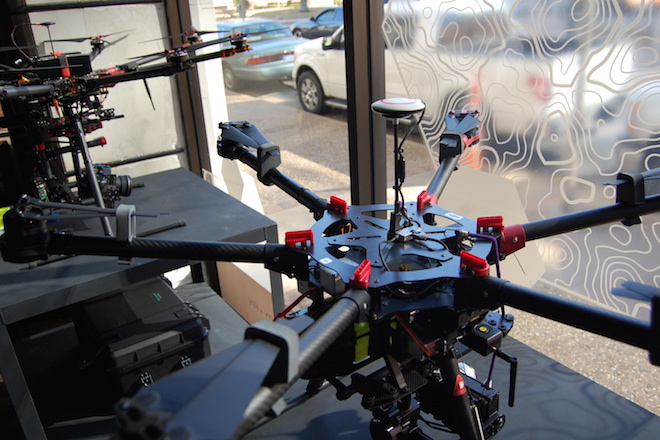
An unmanned aerial vehicle at the ArkUAV store.
Drones have the potential to revolutionize agriculture in Arkansas, but the nature of that revolution remains unclear, farmers and those who work with them say.
The aviation technology is in its infancy, and the Federal Aviation Administration’s delay in developing final rules regarding the piloting of drones — also known as unmanned aircraft systems (UAS) and unmanned aerial vehicles (UAV) — has delayed adoption of the technology (see FAA Delay Costing Little Rock’s ArkUAV Firm.) But the economic impact of the agricultural use of drones appears as vast as their uses.
Up to 80 percent of the entire commercial market for drones could be dedicated to agriculture, according to a recent Bank of America Merrill Lynch Global Research report. The report estimated the agricultural drone market at $2 billion in 2015. This market has the potential to create 100,000 jobs in the United States alone and $82 billion in economic activity between 2015 and 2025, the report said.
Agriculture in Arkansas is a $16 billion business, one-quarter of the state’s economy, the Arkansas Farm Bureau says.
“As far as Arkansas goes, it could make a huge difference over in eastern Arkansas,” Rusty Rumley said of drone use. For row crops — soybeans, corn, cotton — “that right there is where I’ve been hearing a lot of the excitement,” said Rumley, a staff member of the National Agricultural Law Center at the University of Arkansas in Fayetteville.
Drone use also could have a big impact in forestry, a $3.2 billion business in Arkansas.
The immediate utility of drones lies in their ability to capture data, primarily photos and other images but many other data points as well. And just as big data is transforming business, it’s transforming agriculture, specifically “precision agriculture.”
The USDA defines precision agriculture as a management system based on information and technology. It is site-specific and it uses data on soils, crops, nutrients, pests, moisture or yield “for optimum profitability, sustainability, and protection of the environment.”
Think of it like this: In the beginning — or shortly thereafter — there was the Earth, and then along came the farmer, with his plow and his digging stick, and then 10,000 or so years later along came the computer.
And now, here comes the drone. It’s just another agricultural tool that allows a farmer to capture information about his patch of Earth that, usually with the help of a computer, he can use to maximize profit and minimize expense, maximize yield and minimize inputs.
For example, Rumley said, “In the past, farmers have basically had to walk the fields to try to find pests, and it’s an extremely laborious process. With the advancements of the thermal imaging of cameras and all these new tools that they’ve got, they’re going to be able to micromanage things like nutrient applications, pesticide application,” he said. “We’re seeing a whole lot of potential benefit.”
Drones, using visual and near infrared imagery, can assess the health of crops, looking for signs of pests or disease, judging nutrient levels and measuring soil moisture. This information can be used to gauge the most beneficial application of inputs like pesticides, herbicides, fertilizer and water. And that precision reduces waste.
The American Farm Bureau Federation has calculated that farmers using drones to gather crop information can see a return on investment of $12 per acre for corn, $2.60 per acre for soybeans and $2.30 per acre for wheat.
With advances in technology, the industrialization of agriculture is giving way to the computerization of agriculture. One result: the increasing use of robots, or agribots. Drones are just flying agribots.
Currently, agribot use is heaviest in the harvesting phase. But once agricultural drone use becomes widespread, that could change.
Underlying the adoption of drones and other agribots are demographic changes — lack of laborers, aging farmers — and the increasing size of farms.
“Farms get bigger all the time and have fewer farmers farming the same amount of land,” said Brandy Carroll, assistant director of commodity activities and market information for the Arkansas Farm Bureau. “We do have labor challenges as well in this state, so they have to use technology to do the things that we used to do with people. And I think that drones are playing an important part in that, particularly as it relates to row crop agriculture and irrigation practices.
“Instead of having to drive around a field in a truck, particularly after a rain when it’s super muddy and you can’t necessarily do that, you could use your drone” to see if crops are inundated or irrigation is still needed.
“It’s a cost savings, it’s a time savings, and it’s also potentially very much a water savings, which helps conservation efforts,” Carroll said.
Unanswered, however, are questions about adoption of drone technology in Arkansas and its economic impact.
“You also run across a myriad of implementation issues, like to what extent are ag producers going to be able to utilize the technology,” said Zac Bradley, director of public policy at the Arkansas Farm Bureau. “To try to monetize it in terms of what the impact might be Year One would probably minimize how big of a deal this could be long term to agriculture.”
Some farmers will want to own their own drones — their price varies widely, from $1,500 to over $25,000 — and others will prefer to hire crop consultants who will use drones to provide crop scouting services.
Carroll expects drone use to be a combination of the two methods. “I think that some farmers — no matter how these [FAA] regulations come out — I do think you’ll have some farmers who are intimidated by that,” she said. “You already see that. You have some farmers who rely very heavily on crop consultants and some farmers who rely more heavily on themselves and the Extension Service. I think it depends on personality and size of their operation and how comfortable they would be utilizing the technology.”
 Sign up for Daily E-news