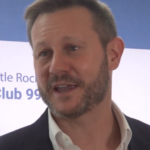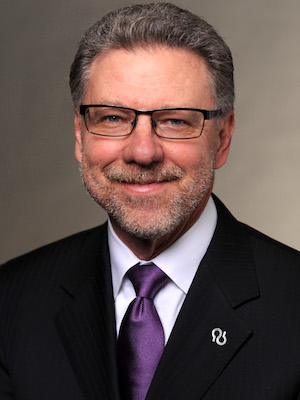
Harry Johns, president and CEO of the Alzheimer's Association.
The number of Arkansans suffering from Alzheimer’s disease is expected to increase almost 25 percent — from 54,000 to 67,000 — by 2025 as the state’s population continues to age, according to Alzheimer’s Association President and CEO Harry Johns.
During a quick trip to Little Rock on Wednesday, Johns met with U.S. Rep. French Hill, R-Ark.; Gov. Asa Hutchinson; University of Arkansas for Medical Sciences staff and others working to combat the disease.
Johns told Arkansas Business that the cost of care for Alzheimer’s patients in the U.S. reached a “staggering” $236 billion this year. Johns also said the cost of care could jump to $1.1 trillion, mostly in Medicaid and Medicare dollars, in 2050.
The high costs come as more than 5 million people in the U.S. battle the disease. And the number is growing. Across the country, the number of people with Alzheimer’s could nearly triple by 2050 to about 14 million if “we can’t get it corrected,” Johns said.
That’s why one of the association’s goals is to increase the federal government’s investment in Alzheimer’s research, which Johns said is “terribly underfunded.”
Johns said cancer research is at $5.5 billion a year. But until a few years ago, Alzheimer’s research was only at $400 million — despite it being the most expensive disease weighing on the health care system. It’s also deadly. While mortality rates for several cancers, stroke and heart disease are down, the mortality rate for Alzheimer’s patients is up by 67 percent, Johns said.
Research funding now stands at almost $1 billion. But researchers say they need at least $2 billion a year, Johns said.
One platform the association has used to get more funding is the National Alzheimer’s Project Act, which Congress passed in December 2010. It’s the nation’s first strategic plan to address the disease. The act calls for an effective treatment and prevention plan to be in place by 2025.
The governor has appointed a commission to advance the state’s plan to meet the act’s goals. Susan Neyman, executive director of the Arkansas chapter of the Alzheimer’s Association, said Arkansas is one of 44 states that have a plan.
“We appreciate that kind of leadership,” Johns said.
The national association has also been focusing on early detection and providing 24/7 support for caregivers and patients. It has a chapter in every state.
Johns said caregivers and patients who know what they’re dealing with make a big difference in patients’ quality of life. He added that only half of the estimated 5 million who have the disease are diagnosed — and half of those aren’t told by their doctors at the time they are diagnosed.
Some of the costs associated with care are a result of that ignorance, as many patients have other chronic illnesses that, combined with Alzheimer’s, could result in unnecessary hospitalization.
Last week, researchers at Harvard University released a new theory that Johns said essentially claims infection is a different kind of Alzheimer’s trigger. But he said more work needs to be done.
“Our scientists were present when that theory was initially presented, and they, as well as other scientists, think that it’s pretty intriguing…,” he said. “Anything that will help us identify either what we could do in our own health behaviors or what we could do to identify drug targets, anything, any theory that ultimately helps us identify those types of things is potentially good.”
The association has also pushed for new diagnostic criteria. Much has been discovered concerning stages of the disease, Johns said.
The nonprofit has also found that a heart-healthy diet and heart-healthy behaviors can lessen cognitive decline, although evidence doesn’t yet prove that Alzheimer’s can be prevented.
Johns also said the association is privately funded by individual donors and that money is spent on research that has changed the direction of the field. He said federal research could be done on a larger scale and further the private research that invests in areas that the federal government might not invest in.
 Sign up for Daily E-news