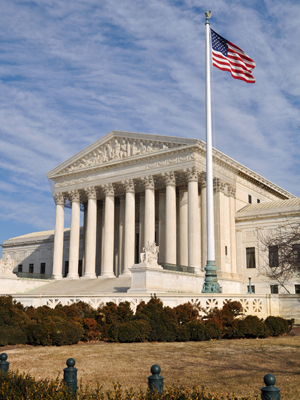
LITTLE ROCK – The U.S. Supreme Court ruling striking down a Texas abortion law is the latest wrinkle for efforts in Arkansas to further restrict the procedure now that Republicans are firmly in control.
The nation’s highest court last week struck down Texas’ requirement that doctors who perform abortions have admitting privileges at nearby hospitals and that clinics meet hospital-like standards for outpatient surgery. Justices rejected Texas’ argument that its law and follow-up regulations were needed to protect women’s health.
Arkansas has already lost its fight over its 12-week ban on abortion, and is fending off lawsuits over efforts to place restrictions on the abortion pill and to cut off Medicaid funding to Planned Parenthood. Both abortion rights supporters and opponents appeared to acknowledge the latest ruling is narrowing the path forward for attempts to restrict the procedure.
“Arkansas, like Texas, has a profound interest in protecting the health of all women, but today’s unfortunate ruling puts that at risk,” Republican Attorney General Leslie Rutledge said in a statement last week. “The court has issued a decision that makes it even more challenging for a state to provide common sense health and safety regulations for abortion procedures.”
It’s unclear how the ruling will affect Arkansas’ fight over last year’s law placing new restrictions on how the abortion pill is administered in the state. The law imposed a restriction similar to Texas’, requiring doctors providing the abortion pill to maintain a contract with another physician with admitting privileges at a hospital who agrees to handle any complications. Arkansas is appealing a federal judge’s decision temporarily blocking that law’s enforcement.
Rutledge and Planned Parenthood of the Heartland say they’re evaluating the ruling on the Texas law to see what impact it has on Arkansas’ restrictions. But Planned Parenthood and other abortion rights supporters viewed it as a signal to lawmakers and courts.
“Other state laws will need to be evaluated in light of today’s ruling, but it certainly paves the way for the courts and lawmakers to reject these dangerous laws,” Rachel Lopez, a spokeswoman for Planned Parenthood of the Heartland, said in an email last week. “That is why we are taking this fight state by state.”
If Arkansas ultimately fails to keep the abortion pill restrictions, it’ll be the latest setback for a movement that has been trying to take advantage of a friendlier political environment in the state.
With Republicans controlling both chambers of the Legislature as well as all statewide offices, abortion opponents have enjoyed victories at the statehouse. Other prohibitions approved by the Legislature last year include a 48-hour waiting period between an in-person meeting and the procedure, and a ban on the use of telemedicine to dispense the abortion pill.
But the courthouse is another matter. The U.S. Supreme Court in January refused to revive the state’s 12-week abortion ban. In striking down the Arkansas law in 2014, U.S. District Judge Susan Webber Wright said it was unconstitutional and violated the 1973 Roe v. Wade decision that legalized abortion until the time a fetus could viably survive outside the womb. A fetus is generally considered viable at 22 to 24 weeks. A federal appeals court panel upheld Wright’s decision last year.
The state is also fighting a lawsuit over Republican Gov. Asa Hutchinson’s decision to terminate the state’s Medicaid contract with Planned Parenthood over videos secretly recorded out-of-state by an anti-abortion group. A federal judge has ordered the state to continue paying Medicaid claims for three Planned Parenthood patients who have sued the state, and the organization is seeking to expand that ruling to any current or future Medicaid patients.
Despite the court-level setbacks, abortion opponents said they still think there are additional restrictions lawmakers can seek that they are portraying as efforts to protect women’s health. Abortion rights supporters say that portrayal is a sham. How Arkansas’ defense of the abortion pill restriction fares before the courts may determine the next battleground in the Legislature next year over the procedure.
Andrew DeMillo has covered Arkansas government and politics for The Associated Press since 2005. Follow him on Twitter at Twitter.com/ademillo.
(Copyright 2016 The Associated Press. All rights reserved. This material may not be published, broadcast, rewritten or redistributed.)
 Sign up for Daily E-news