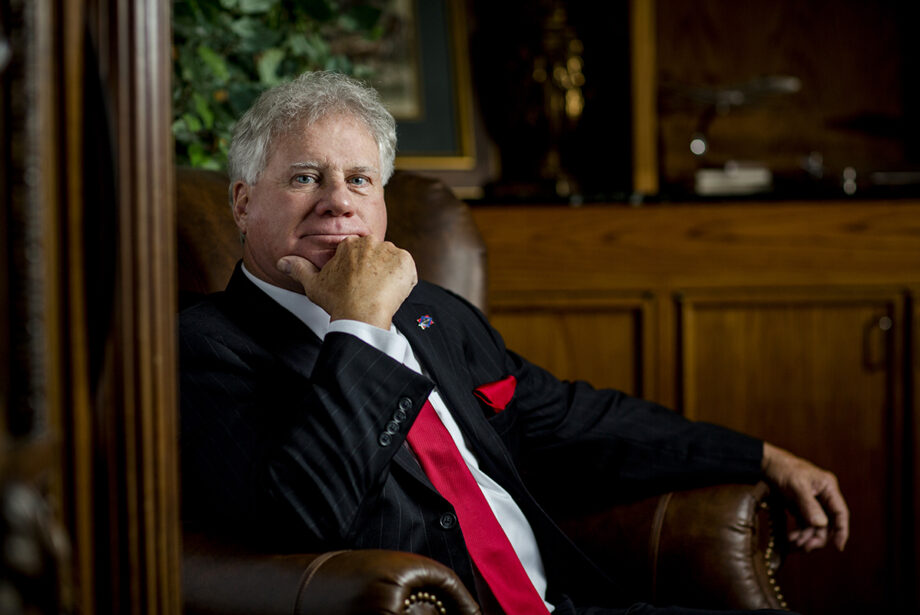
John W. Allison says he’s the world’s youngest 70-year-old. He still goes by Johnny. He still talks fast — sometimes too fast — and still pops out of his chair to fetch papers off his desk or to holler for help from his assistant. His new truck — a four-door 2016 Ford F-250 customized to simulate the Excursion that ended production in 2005 — delights him as much as it would any 16-year-old.
One might instead conclude that he’s actually the oldest living example of attention deficit disorder, if it weren’t for his amazing attention to one thing: fixing companies.
Allison is chairman of Home BancShares Inc. of Conway, the parent company of Centennial Bank, indisputably one of the best-performing banks in the country. He’s its biggest shareholder, with stock worth about $200 million, and he says his job these days is to impose discipline on a bank that is one of the most efficient money-makers despite completing 19 acquisitions between 2003 and 2015 that have pushed its assets to nearly $10 billion.
And banking was a sideline for the first two decades of his career. He made his starter fortune in manufactured housing; by fixing companies in that industry, he achieved his goal of being a millionaire by 30.
“On paper,” he said recently.
Allison’s parents were early retailers of manufactured homes in Jonesboro, and he learned about sales and financing as a teenager — as well as the manual labor of digging trenches for water lines to the family’s mobile home park. The only excuses for not working, he said, were church and football practice.
After graduating from Arkansas State University and completing a few months of training for the Army National Guard in Fort Polk, Louisiana, Allison took a job with a Conway mobile home manufacturer called Barcraft.
“And I ultimately bought 23 percent of that company before I had enough sense to read a financial statement. And when the dust settled, I realized the company that I had just bought into was about six or seven hundred thousand dollars in the red, and the owners were taking money out of it hand over fist.
“It’s a good story; it’s a great lesson.”
When he threatened to leave, his partners turned the reins over to Allison, who was not yet 25. He turned the company around, sold his stock and started a new mobile home plant with the backing of a publicly traded Texas company called Castle Homes.
Once again, he had unwittingly bought into a failing company. “The only profitable operation they had was my Arkansas operation,” he said. Once again, it was his job to fix it. Castle went into bankruptcy, and he bought controlling interest for $1.
“I was running a public company at the age of 29 and dealing with the SEC and all the rules and regulations. It was just an amazing experience in my life, and we were making really good money,” he said.
Eventually the stock that had been nearly worthless was valued at $17 a share. He sold enough to clear about a million dollars after taxes, “and that’s when I invested in banking.”
Specifically, Allison invested in First National Bank of Conway, where he had recently been appointed to the board of directors.
At his second or third board meeting, representatives from Union National Bank in Little Rock offered to buy the bank. The realization that someone else thought there was more profit potential made Allison want to beat them to it. He put together a group of investors and was the bank’s largest shareholder and chairman within six months of joining the board.
“I didn’t know what the FDIC was, I didn’t know anything about money,” Allison said, but he knew this: Banking was “far simpler” than running three plants with 1,200 employees building and shipping 25 mobile homes a day.
After a few more months and a visit from the Federal Deposit Insurance Corp., “The president called me and said, ‘They just gave us an MOU.’ I said, ‘That’s good, isn’t it?’”
A memorandum of understanding from the FDIC is not good. It was time for Allison to start fixing things again.
“That was the best experience,” he said in his rapid-fire style. “We went in and cleaned it up and fixed it. Fixed the bank. Merged it into First Commercial Corp. … and that’s where I learned banking.”
Most importantly, he had a front-row seat as the FCC made lemonade when “Texas blew up” in the late 1980s, his first taste of buying failed banks.
“Where there’s bad news, there’s good news,” Allison says. The meltdown also gave him the opportunity to buy 8,000 repossessed mobile homes. “I bought ’em and sold ’em, and that changed my life financially.”
The $900,000 he invested in First National of Conway turned into $11.1 million worth of First Commercial stock in 1984, and his piece of First Commercial was valued at $50 million when Regions paid a breathtaking four times book value for it in 1998.
Through it all, Allison stayed in the mobile home industry. It was from the office of his Spirit Mobile Homes that he was kidnapped in 1997 by the escaped prisoner who had been convicted of kidnapping Jo Ann Lieblong, wife of investment adviser (and Home BancShares director) Alex Lieblong four years earlier. Forced to drive, Allison escaped unhurt by crashing his Mercedes convertible.
In 1999, he and Robert “Bunny” Adcock paid $5 million for the Bank of Holly Grove, moved the charter to Conway and started the string of acquisitions that escalated after taking Home BancShares public in 2006.
No bank — and, arguably, no bank executive — was better prepared to take advantage of the epidemic of bank failures that began in the last half of 2008. HBI, its charters consolidated and renamed Centennial Bank, made six FDIC-assisted acquisitions in Florida in 2010 alone.
Unlike the old First Commercial days, when the regulators only sold deposits and real estate, these FDIC deals came with the assets and guarantees on the problem loans.
“And if you bid it right, they pay you to take ’em. The key was how long does it take you to fix ’em?” Allison said. “And this team I have put together is amazing. It’s not me — I tell you, I’m humbled.”
That “generational” opportunity to get paid to acquire banks has petered out, and the new regulations that the financial crisis inspired have created an acquire-or-be-acquired environment. So now Johnny Allison is back to traditional deal-making, which seems to both delight and frustrate him.
“The deal is the key,” he emphasizes. “If it’s good for the seller and not for the buyer, it’s not a good deal. If it’s good for the buyer and not for the seller, it’s not a good deal.”
As Home BancShares’ largest shareholder, Allison says his interests are always aligned with his investors. “The lowest compound annual return that any Home Bancshares deal has ever done was me and my original investors, and it’s over 17 percent compound annual return,” Allison brags. “I structure deals were everybody can win.”
Unfortunately, not all of the sellers understand the currency he’s dealing in. In 2015, Home BancShares bid on three Texas banks, but the sellers accepted higher bids instead.
“We were outbid by a total of $30 million on all three bids. Had they taken Home BancShares stock, they’d be up $150 million today when they are down with the others.”
Allison shrugged and kept talking.
“I’ve never done a dilutive deal. I’m the largest shareholder. Why would I dilute myself?”
But getting richer isn’t even his goal.
“I’m rich enough. I can’t spend what I’ve been blessed with.”
Instead, playing what he calls “one serious business game” has been “extremely rewarding to me because we’ve made so many people wealthy. We’ve educated kids, we’ve paid off homes, we’ve secured retirement for hundreds and hundreds of Arkansans.”
See more at Ten Arkansas Business Icons Have Stories to Tell
 Sign up for Daily E-news