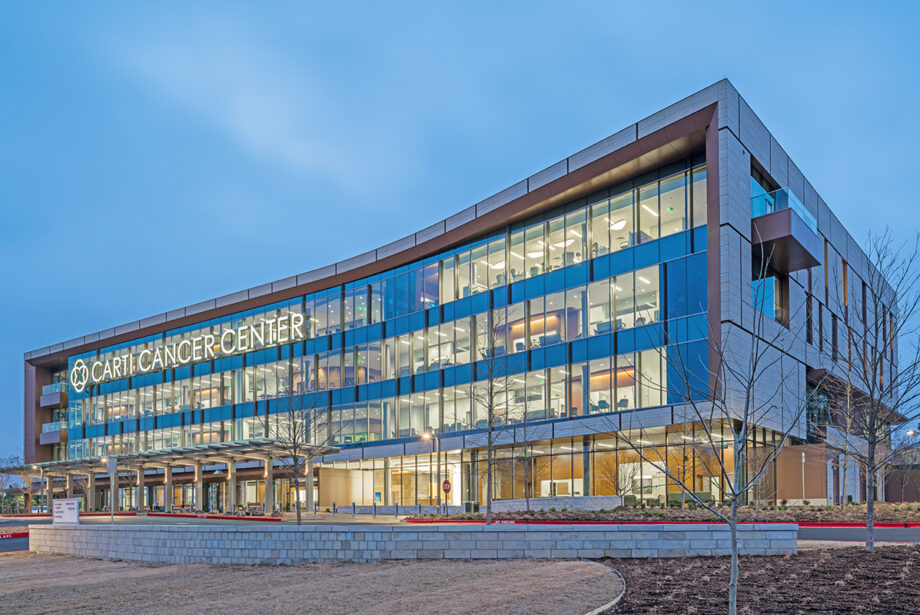
CARTI already was experiencing operating losses before it opened its $88 million cancer center in west Little Rock last November.
In the months since then, Central Arkansas Radiation Therapy Institute Inc. has seen its operating losses widen to $20.5 million over the last three fiscal years and missed a financial benchmark for its $49 million bond, which forced it to hire a management consulting firm.
Whether it is back on track remains to be seen.
CARTI President and CEO Jan Burford recently told Arkansas Business that she is concerned because in the first quarter of its fiscal year that began July 1, the outpatient cancer care provider saw a 2 percent increase in the number of patients on Medicare, the federal health care insurance program for people 65 and older and for the disabled. Medicare’s reimbursement for cancer treatment is generally less than the cost to provide the service, Burford said. For the fiscal year that ended June 30, nearly 58 percent of CARTI’s patients were on Medicare.
“We don’t know that it’s a trend,” she said. “Every once in awhile it will go up a month or two here or there.”
Burford blamed the operating losses on several one-time events, such as a delay in receiving a piece of medical equipment, the cost associated with the move to the 175,000-SF cancer center and a massive computer conversion.
“We had a year with just several things that hit us,” she said. “Maybe we would have weathered one of them, but not all of them.”
For the fiscal year that ended June 30, CARTI’s reported an operating loss of $13.8 million, which included $5.9 million for depreciation and amortization. That caused the Little Rock nonprofit to fall below the required debt-service coverage ratio on the $49 million bond issue that was used to build the four-story center.
“It’s definitely something we don’t see all the time,” said Emily Wadhwani, a director of Fitch Ratings Inc. of Chicago, which provides the credit rating for CARTI. “It’s definitely something of concern because if repeated, it could lead them toward default, which is very unusual for an investment-grade credit.”
In September, Fitch lowered its rating on CARTI’s bond from BBB+ to BBB-, which is the lowest investment-grade rating. Fitch’s outlook remained negative.
Burford said she made plans to hire a management consultant firm, which CARTI was required to do by Nov. 15, when she learned in late spring that CARTI was going to miss its debt service covenant. The consulting firm, Berkeley Research Group of Emeryville, California, was hired in August. It has studied CARTI and given its assessment about what should be done.
Burford said she was encouraged by BRG’s findings because “there’s plenty of opportunity” to improve CARTI’s financial health, mainly through cost-saving initiatives.
“It’s not one big bucket that we’re spending too much money on,” she said. “It’s a lot of small things that need to change.”
BRG’s suggestions will be put in place over the next year or two.
Burford declined to provide specifics of BRG’s recommendations because the details hadn’t been shared with CARTI’s doctors. But she said CARTI doesn’t anticipate any layoffs, as it had in the middle of 2015. There might be some staffing changes, such as when a full-time employee leaves, two part-timers might fill that vacancy, Burford said.
BRG didn’t recommend making “any big change in physician compensation,” she said. CARTI has several of the highest-paid nonprofit employees in the state. (See CARTI Doctors Highest-Paid on Nonprofits List.)
Still, by June 30, CARTI expects its reserve to meet its required debt-service ratio.
Wadhwani said she thinks most of the one-time events that caused losses for CARTI shouldn’t be repeated. “They’ve taken some pretty serious steps toward getting themselves back to a positive operating margin,” she said.
Fitch said in its report that it would review the consultant’s recommendations and CARTI’s second-quarter numbers in early 2017 and “may take rating action as appropriate.”
Patient Numbers Rise
In late 2013, CARTI began construction of its four-story cancer center.
Burford told Arkansas Business in 2014 that the building was necessary because CARTI was seeing more patients. The institute treated about 3,000 patients in 2011, but by 2013 — after CARTI acquired a couple of doctor groups — the number of patients had jumped to 20,000 annually. It now sees more than 22,000 patients a year.
CARTI planned to use the new building to offer services such as medical, surgical, interventional and radiation oncology, diagnostic radiology and hematology.
In addition, the center was expected to create savings because all of CARTI’s physician offices and support staff would be under one roof. Burford told Arkansas Business in 2014 that she didn’t know how much those savings would be.
In the recent interview, Burford said that medical oncology is not a profitable business. CARTI had to build the new building to bring all the care under one roof, “not because it would be a financial windfall, because it’s not.” The new building made it easier on patients because they could get all their cancer care in one location.
For the fiscal year that ended June 30, 2013, CARTI reported operating income of $2 million on $108.7 million of net patient revenue.
But financial problems were simmering.
The sequestration component of the 2011 Budget Control Act mandated $1.2 trillion in budget reductions during 10 years. As a result, CARTI said, it missed out on about $2 million in federal funds.
For the fiscal year that ended in mid-2014, CARTI reported an operating loss of $3.6 million, which included $3.75 million for depreciation. Its net patient revenue, however, was $136 million, up 25 percent from the previous year.
Fitch affirmed its BBB+ rating with a stable outlook in September 2014, when the cancer center project was near its halfway point.
“While Fitch believes the project will position CARTI as the leading provider for all outpatient cancer care in the service area, the risks associated with large capital projects, including delays and cost overruns, will persist over the near term,” Fitch said in the 2014 report.
Fitch also noted that CARTI had a “thinner operating performance than expected, due in large part to the unbudgeted addition of two medical oncology practices.” Little Rock Hematology/Oncology became part of CARTI on Dec. 1, 2011, and Hematology Oncology Services of Arkansas joined CARTI on Jan. 1, 2013.
CARTI, however, was expected to be back on financial track with its operating results in fiscal 2015, Fitch said. Fitch warned that CARTI’s planned $40 million contribution for cancer center projects at the new building “leaves little room for error in improving cash flow.”
ACA Means Changes
Meanwhile, health care changes were taking place.
The Affordable Care Act didn’t have a significant impact on CARTI in 2014, the effective year for the centerpiece of the legislation, requiring Americans to have health insurance and offering financial assistance in the form of tax credits or expanded Medicaid for those who couldn’t afford to buy insurance.
But in 2015, the ACA ushered in a new wave of financial problems for CARTI. A number of patients moved from plans with deductibles of $1,000 to deductibles of $6,300, Burford said.
“And then, of course, you get cancer,” she said.
She said many patients couldn’t afford their deductibles, so CARTI started asking for payment up front instead of collecting it on the back end.
In addition, Medicare reimbursements for radiation oncology were being lowered. “Oncology reimbursement was hit worse than anything,” Burford said. “I’d been an administrator for several decades, and I’d never seen back-to-back years with those kinds of events.”
Making matters worse, Arkansas Blue Cross & Blue Shield also lowered its reimbursement for radiation oncology services, said Jeff Burton, CARTI’s vice president and chief financial officer. Nearly 28 percent of CARTI’s patients for the fiscal year that ended June 30 had ABCBS.
As a result of the lower payments, CARTI laid off 11 full-time equivalent employees in July 2015.
“We don’t like to do layoffs,” Burford said. “We wanted to avoid it, but 20/20 hindsight, I should have done it a year earlier, as painful as it was.”
The cancer center has about 350 employees, and CARTI has about 100 full-time equivalent employees at its other locations across Arkansas.
For the fiscal year that ended June 30, 2015, CARTI reported an operating loss of $3.1 million, including $4.1 million for depreciation. Compounding the loss was the fact that CARTI had forecast operating income of close to $2 million.
The numbers alarmed Fitch and it revised its outlook from stable to negative.
“CARTI’s single-specialty platform makes it inherently vulnerable to reimbursement pressures, though its scale helps to offset these risks somewhat,” Fitch said in its September 2015 report.
Savings — and Expenses
CARTI, however, thought that its finances would be improved in its fiscal year that ended midyear 2016. It projected a $2.3 million operating income because several cost-saving initiatives were already underway.
During 2015, CARTI pushed to combine its four different electronic medical record systems and three different billing systems across its clinics around the state.
“You just couldn’t be efficient and stay on top of everything with that situation,” Burford said.
The conversion project cost about $500,000.
Just before the cancer center opened, CARTI was supposed to receive a second Positron Emission Tomography-Computed Tomography (PET/CT) scanner, which cost between $2 million and $3 million. CARTI’s current scanner “our vendor tells us is the busiest one in the country,” Burford said. “We really had needed a second machine for a long period of time.”
The manufacturer was supposed to build a machine and deliver it by Oct. 31, 2015, but the delivery date kept getting pushed back. The machine never was delivered, and CARTI missed out on that revenue. It has since changed manufacturers and the new machine is expected to be delivered in January.
In addition, for a few months as the building was opening, CARTI lowered its patient volume by about half, Burford said. “We wanted it to be very smooth for the patients,” she said. But it never recovered from that lull in patient volume around the move.
CARTI also had higher overtime costs tied to the move.
Burford said she learned in late spring that CARTI’s cash reserve wouldn’t be meet the requirement of its bond issue.
Burton, CARTI’s CFO, said the interest and principal payment on the bond was $3.4 million. CARTI was required to reserve 1.2 times that amount, but Fitch said it the actual ratio was 0.69.
If CARTI doesn’t have at least 1 times the debt-service amount by June 30, “it will be an event of default,” Fitch said.
Burford said she expects CARTI to meet the ratio.
She said that the Berkeley Research Group had a number of suggestions on ways CARTI could save money. “It’s doable and it’s manageable,” Burford said. “And we’re looking forward to getting started with it.”
CARTI
Fiscal year ending June 30
| 2013 | 2014 | 2015 | 2016 | |
| Total unrestricted revenues, gains and other support |
$108,921,572 | $136,713,269 | $148,003,950 | $152,193,655 |
| Depreciation and amortization | $2,679,811 | $3,757,120 | $4,086,309 | $5,893,202 |
| Total expenses | $106,901,132 | $140,303,902 | $151,131,684 | $165,990,153 |
| Operating income | $2,020,440 | -$3,590,633 | -$3,127,734 | -$13,796,498 |
| Operating income without depreciation and amortization |
$4,700,251 | $166,487 | $958,575 | -$7,903,296 |
| Other income* | $13,786,634 | $13,350,590 | $5,881,274 | $8,641,732 |
| Net income | $15,807,074 | $9,759,957 | $2,753,540 | -$5,154,766 |
*Other income includes investment return and grants received from CARTI Foundation Inc.
Source: Financial statements on file with Electronic Municipal Market Access, a service of Municipal Securities Rulemaking Board
 Sign up for Daily E-news