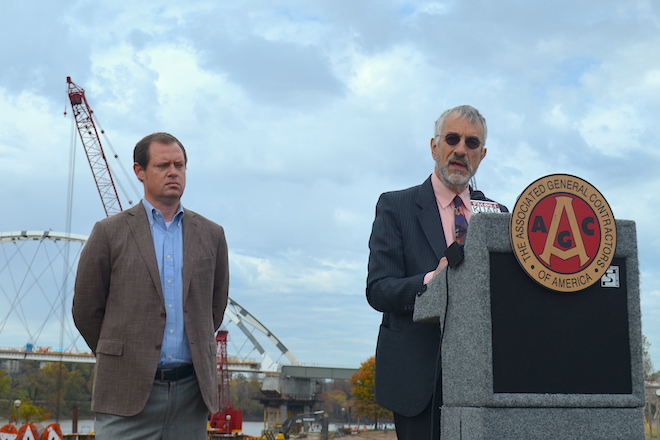
Kenneth Simonson, chief economist for the Associated General Contractors of America, speaks Tuesday in North Little Rock as Thomas Dickinson, incoming president of the Arkansas AGC and general manager of McGeorge Contracting Co. in Little Rock, looks on.
The Associated General Contractors of America and its Arkansas chapter said Tuesday that the Little Rock metropolitan area had placed fourth out of 358 metros nationwide in total construction jobs lost between October 2015 and October 2016.
The Little Rock metro also ranks sixth in the percentage of jobs lost.
At a news conference in North Little Rock, the association said it was committed to making sure President-elect Donald Trump’s aim to invest $1 trillion in infrastructure improvements becomes a reality. Members of the AGC said they are formulating an agenda to present to the new administration next year that will likely ask for less regulation in some areas of the construction industry.
Kenneth Simonson, chief economist for the national organization, said thousands of jobs could be retained if the public sector invested more in public infrastructure. He said improvements are needed; the American Society of Civil Engineers gave a D-plus grade to the nation’s public infrastructure because of age, deterioration and overuse.
“The good news is there appears to be a growing bipartisan consensus emerging in Washington in support of enacting a major new infrastructure program early next year,” Simonson said.
Simonson said the AGC’s findings show that Arkansas has started losing construction jobs again — 400 over the past year — after steadily adding them for three years.
While construction job growth is on an upswing in many places, about one in five metro areas lost construction jobs this year, Simonson said.
He also said the drop is more pronounced in the Little Rock-North Little Rock-Conway metro, which was one of the fastest growing markets last year but has since lost 1,800 construction jobs. That’s a 10 percent decrease, from 17,600 a year ago to 15,800 people now, he said.
Michael Pakko, state economic forecaster for the University of Arkansas at Little Rock’s Institute for Economic Advancement, said the AGC is using the most up-to-date and comprehensive figures but warned that monthly figures can fluctuate.
“We have seen weakness in construction employment here in Arkansas, mostly within the past several months,” Pakko said. “It looked like things were a bit stronger over the course of 2014 and 2015 but then late 2015 and 2016, things turned down again.”
Some areas of the state are offsetting losses elsewhere, though, and construction in the Fayetteville metro area is doing particularily well, Pakko said.
“The data that we get month-to-month is eventually revised once a year,” Pakko said. “So, next March, we’ll get a new view of what this looks like.”
Simonson said Tuesday, “Unfortunately, the prognosis is not good.” He noted that both Dodge Data & Analytics and ConstructConnect predict a “very sharp decline in the value of construction starts in the first 10 months of this year compared to the first 10 months of 2015.”
Pakko disagrees, at least where Arkansas is concerned. He said he tries to predict how things will look and believes that construction was a bit stronger in late 2015 and the first quarter 2016 than the most recent figures reflect.
Pakko estimates that, once the monthly data is revised, Arkansas construction jobs will be up by about 1,000 for 2016.
Simonson said some of the recent job losses could have been avoided were it not for a 2.2 percent decline in public spending nationally on public works over the past year. Public spending decreased by 8.9 percent on sewage and waste disposal; by 9.3 percent on water supply; by 4.8 percent on transportation facilities; and by 0.7 percent on highways and streets.
But private nonresidential and residential construction are going up by 7 to 8 percent a year, he said.
Thomas Dickinson, incoming president of the Arkansas AGC and general manager of McGeorge Contracting Co. in Little Rock, said the local chapter is concerned about the national organization’s findings but finds the Trump administration’s plan to be encouraging.
He said the state group’s main objective is to increase workforce development and highway funding.
Simonson was asked why a disparity exists, with 23 states seeing an increase in funding and the state as a whole apparently seeing an uptick in construction jobs. He said it’s part of the economy following a “stop-go pattern.”
The country’s economic recovery since the Great Recession has been inconsistent, with periods of sharp expansion and contraction, Simonson said.
“We do have states that are more dependent on one sector or another and they are catching the cold when somebody sneezes in that sector … I think the value of a national, a federal infrastructure program is that it does channel money to where projects are most needed if it’s properly designed,” he said.
Although the AGC doesn’t have a preferred plan, its members are having conversations about what would attract enough votes in Congress, Simonson said.
He also said the national organization doesn’t have a preference for any particular type of construction project, but “as an economist, I have to say I’d like to see the money go where it’s going to earn the highest return, not just for the investor in that, but helping society, the U.S. as a whole become more competitive and raise the standard of living…The needs are across the board.”
Dickinson said school, transportation and jail projects generate the greatest returns for Arkansas.
 Sign up for Daily E-news