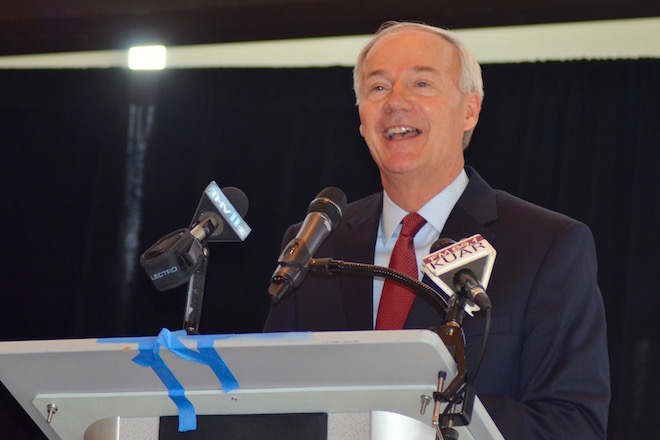
Asa Hutchinson
LITTLE ROCK – To appease some conservatives pushing for deeper tax cuts than what he wanted, Republican Gov. Asa Hutchinson turned to a familiar strategy as he championed his tax relief plan for thousands of low-income Arkansans: a task force to call for bigger reductions in two years. It’s a tactic that’s assured passage of his $50 million proposal, but also guarantees that a bigger fight and tougher choices will await those sent to the Capitol for the 2019 session.
Hutchinson’s plan to cut taxes for more than 600,000 Arkansans making less than $21,000 is expected to win final passage in the state Legislature Mondayafter clearing the House and Senate with near-unanimous support. It was no small feat for a governor who admitted his plan was more modest than other Republicans had hoped for, and who had expected this year’s plan to be a harder sell than his much larger tax cut approved two years ago.
The tough sell will be over the next several months, as legislative leaders put together a task force Hutchinson included in his tax cut plan. The 16-member panel, set up to recommend more comprehensive changes to the state’s tax code, is required to have its first meeting called within 30 days of the Legislature formally adjourning its session, which is expected to occur April or May.
The format is similar to the task force Hutchinson and lawmakers formed two years ago when they voted to keep the state’s hybrid Medicaid expansion. That legislative task force eventually backed Hutchinson’s plan to keep the expanded coverage, but with new restrictions. That hybrid expansion was reauthorized last year, but only after a protracted debate and an unusual procedural move after facing resistance from a handful of Republican opponents.
Likewise, the task force on tax cuts sets the stage for another divisive debate among Republican lawmakers on the size and types of reductions Arkansas can afford. The bigger question will be how the state can afford those cuts.
“Coming down here in 60 days and trying to pull together a $200 or $300 million tax cut strategy or approach is not the best method,” Senate Majority Leader Jim Hendren told reporters this month. “It’s like trying to reform Medicaid. It needs a lot of work and effort and thought.”
The second part of Hutchinson’s tax cut package – an income tax exemption for veterans’ retirement benefits – could offer a hint of the fight lawmakers could face in two years. A plan to raise taxes on manufactured housing to help pay for the veterans’ exemption was scrapped after facing resistance from lawmakers who called it unfair to poor and rural residents. But the new plan to instead tax downloaded music and e-books is likely to face just as much opposition from some Republicans in the Legislature.
It remains to be seen whether the reworked bill will prevail, but it shows how difficult of a time lawmakers are going to have when they begin targeting other exemptions that have powerful lobbies behind them.
The task force, however, provides just as many political opportunities for Hutchinson and Republicans as it does peril. The panel’s final recommendations are due two months before the 2018 election and are likely to be the platform for the GOP as they party tries to maintain, and possibly even expand, its grip on the Legislature.
It could also provide an opening for Democrats, who are still trying to recover from last year’s election losses. The expected defeat of a low-income tax cut measure before the House last week gave a spotlight to Democrats, who are worried that the push for further cuts for higher-income earners could come at the expense of key state services. The credit idea is one the party hopes to revive in two years.
“I’m hopeful the task force will look at that and a lot of other things that affect working Arkansans, and I think that’s what this was targeted to,” House Minority Leader Michael John Gray said after the House rejected the tax credit plan.
The panel’s talks will begin as the state’s budget still faces plenty of uncertainty, with the state’s net revenue running behind forecast so far this fiscal year and questions still surrounding the future of the hybrid Medicaid expansion under the Trump administration. Despite these unknowns, legislative leaders say they’re confident the task force won’t go too far in its push for more cuts.
“I have faith they’re not going to take us down a road in which Arkansas can’t afford to go when it comes to the budget,” House Speaker Jeremy Gillam said.
Andrew DeMillo has covered Arkansas government and politics for The Associated Press since 2005. Follow him on Twitter at Twitter.com/ademillo.
(Copyright 2017 The Associated Press. All rights reserved. This material may not be published, broadcast, rewritten or redistributed.)
 Sign up for Daily E-news