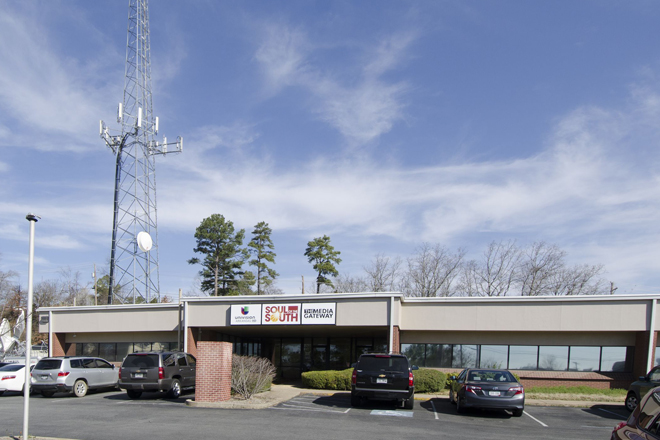
The Soul of the South building at 1 Shackleford Drive in Little Rock.
The legal battle over the broadcast license of KMYA-TV, Channel 49, is entering its 23rd month with resolution nowhere in sight.
The litigation among investors in the Soul of the South Network remains a roadblock to a $2.7 million sale to William Pollack’s LR Telecasting of Memphis.
Ownership of the KMYA broadcast license resides with I Square Media, led by Shashwat “Shash” Goyal, a Little Rock hotelier; Dr. Ladly Abraham, a Little Rock pulmonologist; and Dr. Mangaraju “Raj” Chakka, a Little Rock cardiologist.
This trio of Soul of the South investors is being sued for fraud, breach of contract, breach of fiduciary duties and more by another group of investors in the network.
The lawsuit was brought against them by two limited liability companies and a limited partnership representing the interests of Melba Marshall, Richard Mays Sr., Mac Hogan and Linda Harding.
The case was filed on behalf of Mays’ Skylar Media LLC, Marshall Media LLC and Hogan Family Ltd., Harding, SSN Funding Ltd., SSN Networks Inc. and Rock City Media LLC, the corporate umbrella for the Soul of the South Network.
Other named defendants are Pollack’s LR Telecasting and Rebel Media, representing a 90 percent stake in I Square Media held by Goyal, Abraham and Chakka.
Thanks to the overlapping ownership of the various parties in I Square Media and Rock City Media, the Soul of the South investors have a stake on both sides of the dispute.
“It’s not nearly as complicated as the court file might indicate,” said Richard Mays, whose Little Rock law firm is representing the plaintiff group.
The crux of the dispute is that a 2014 round of funding for Soul of the South was predicated on Rock City Media gaining the KMYA broadcast license, according to the complaint.
A $10.4 million new markets tax-credit financing package flowed to Rock City, but the transfer of the KMYA license didn’t happen.
Without this funding coordinated by Arkansas Capital Corp., the struggling 24-hour regional broadcast network targeting African-Americans couldn’t have kept going.
The lawsuit challenges I Square Media’s control of KMYA and its legal authority to turn the license into cash.
Meanwhile, operational control of the station is said to be in the hands of Pollack’s group while the fight in Pulaski County Circuit Court plods onward.
The I Square Media defendants counter that the sale of KMYA was a purchase option that was never fully exercised by Rock City Media.
With some of Little Rock’s most prominent law firms scrutinizing the new markets transaction on behalf of various clients, Mays isn’t buying that argument.
“You don’t get a tax credit on an option,” he said. “I don’t think all those lawyers were off at Disneyland when all of this happened.”
Broken Agreement
When Soul of the South was launched nearly five years ago, KMYA operated as a MeTV affiliate. The station continues as an affiliate of the network touted as the “The Definitive Destination for Classic TV.”
But the Little Rock station was envisioned to serve as the flagship for Soul of the South, and a broken agreement for KMYA to broadcast the network’s programming is among the bones of contention.
“That’s how you tie into the community, by putting local content on the air and selling local advertising,” Mays said.
“That’s the most significant reason I sued the individuals, because I felt they had a fiduciary duty to put the programming on the primary channel. The failure to do that was a breach of their fiduciary duty.”
KMYA-TV is among a cast of broadcast ventures that do business out of the Media Gateway facility at 1 Shackleford Drive in west Little Rock. The KMYA license is actually two: the full-power digital KMYA-DT in Camden supported by the low-power KMYA-LP in Sheridan.
While Soul of the South isn’t broadcast over cable through KMYA, the network does broadcast locally over the air through KKYK-CD, UHF digital channel 16. According to the network’s website, Soul of the South reaches viewers over the air in two Texas markets, Houston and Beaumont; Nashville, Tennessee; Baton Rouge; and Orlando, Florida. Via cable, Soul of the South airs in New York; Jackson, Mississippi; and Dayton, Ohio.
The KMYA broadcast license was viewed as an integral part to successfully build the Soul of the South Network in connection with the new market tax credit funding.
“That’s the heart of the matter,” Mays said. “That was why we were doing the deal. And then after we got the new market tax credit funding, it was ‘No, we’re not going to do that.’”
He wonders if greed clouded the judgment of the adversarial investors in the form of the first-ever broadcast incentive auction by the Federal Communications Commission in 2016.
“Some thought the auction offered a substantial opportunity for profit-taking, with $50 million to $60 million a possibility for the KMYA license,” Mays said. “That proved not to be the case.”
KMYA attracted zero interest from bandwidth-hungry telecoms, or anyone else.
 Sign up for Daily E-news