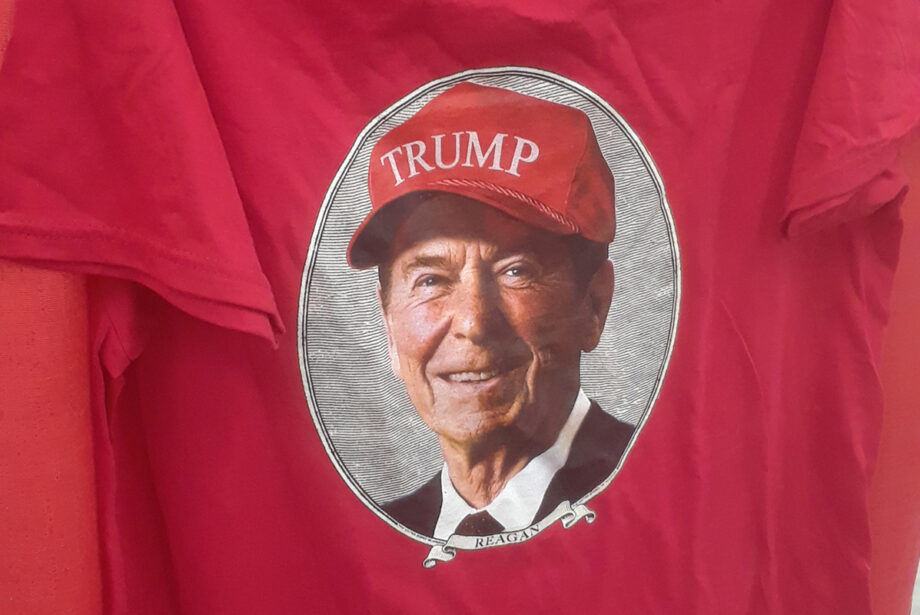
A t-shirt on display in the Arkansas Republican Party booth at the Arkansas State Fair
THIS IS AN OPINION
We'd also like to hear yours.
Tweet us @ArkBusiness or email us
“The Sneetches” — those birdlike creatures with either plain yellow bellies or “stars upon thars” — are old enough for Medicare, and yet Dr. Seuss’ children’s classic on the dangers of tribalism seems as fresh as today’s Twitter feed.
Tribalism is not something I have generally given much thought to. Oh, sometimes I refer to my Facebook friends as a tribe, but the only thing they have in common is me. When I started listening regularly to Charles Sykes’ “Daily Standard” podcast last year, I wasn’t exactly sure what he meant when he described his goal as “smart, conservative and nontribal.”
It’s becoming clearer all the time.
It’s been decades since I stopped assuming I was a Democrat just because my parents were. The early realization that no political party had a birthright to my loyalty never felt like a loss to me. Embracing political independence seems far more difficult later in life, as evidenced by a crop of recent books and articles produced by longtime conservatives who have either walked away from the Republican Party or clung to it only in hopes of dragging it back from the clutches of Trumpism.
Known collectively as the Never Trump movement, they have formed something of a tribe of their own — or perhaps simply group therapy. Sykes is one of them, and his 2017 book, “How the Right Lost Its Mind,” was released in paperback earlier this month. I recommend it as a road map to understanding how the Party of Reagan morphed into the Party of Trump.
With that foundation, I can also recommend “Trumpocracy: The Corruption of the American Republic,” published in January by David Frum, another Never Trump conservative. It contains one of the scariest warnings I’ve ever read: “Maybe you do not care much about the future of the Republican Party. You should. Conservatives will always be with us. If conservatives become convinced that they cannot win democratically, they will not abandon conservatism. The will reject democracy.”
Rick Wilson, longtime Republican political operative, reached No. 1 on The New York Times’ list of bestselling nonfiction with his August release: “Everything Trump Touches Dies.” Not nearly as scholarly or serious as Sykes or Frum, Wilson takes potshots at fellow Republicans who, in his estimation, enabled the Trump takeover of the Grand Old Party.
Next on my reading list is “The Corrosion of Conservatism: Why I Left the Right,” released last week by Max Boot, historian, foreign policy analyst and columnist for the Washington Post.
Boot was a guest on Sykes’ podcast last week, and I was riveted by what felt like an intimate conversation between two mature men — Sykes is 63, Boot 49 — who have both been rattled by the realization that their beloved Republican Party was not a coalition of shared ideas and values, as they had believed for decades.
“The question I have is were we wrong about a lot of things?” Sykes asked, still sounding baffled although he’s struggled with the question for many months.
Boot, a refugee who arrived from Russia as a 6-year-old, said he too had been forced into a reevaluation.
“My rethinking was really spurred by the rise of Donald Trump, which began more than three years ago when he came down that damn escalator at Trump Tower and started attacking Mexicans as rapists and murderers,” Boot told Sykes. “And that was so antithetical to everything I believed in, I thought he would never gain any traction in the Republican Party.”
When Trump was instead warmly embraced, “that was a wake-up moment for me,” Boot said. People he had considered friends and fellow-travelers became strangers “because they are willing to stand up for things I find repugnant.”
Beyond refusing to go with the tribal flow away from his long-held beliefs, Boot has begun to question things he believed and why he believed them. In one of the most candid admissions I’ve ever heard, Boot acknowledged that he had concentrated on foreign policy and allowed the tribe to tell him what he believed about other issues.
Leaving the party has been “liberating but it’s also scary,” he said. “It makes you realize why people become part of this ideological or party tribe, why people substitute party dogma for independent thinking, because it frankly saves a lot of time. You don’t have to really think, well, what is my position on Issue X? You just say, well, what are my compatriots on Fox News and the Republican Party or down at the local diner — what are they saying? I’m with that.”
In celebration of independent thought, I’m looking forward to reading Boot’s new book. And I may pull out “The Sneetches” to celebrate the fact that we are all far more alike than different.
 |
Email Gwen Moritz, editor of Arkansas Business, at GMoritz@ABPG.com and follow her on Twitter at @gwenmoritz. |
 Sign up for Daily E-news