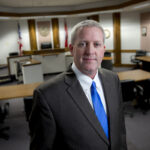
Janine Parry
The 20th annual Arkansas Poll, released Thursday by the University of Arkansas, found strong support for Gov. Asa Hutchinson’s re-election bid and proposals that would raise the state’s minimum wage and require voters to show photo identification at the polls.
The poll, designed and analyzed by UA political science professor Janine Parry, also found a majority of respondents, 69 percent, feel the state is headed in the right direction. And 87 percent of respondents felt they were doing better or the same financially compared to last year.
Parry said Arkansas’ historically low unemployment rate is reflected in respondents’ financial realities.
“You can see an uptick in all those areas. … Those are high percentages,” she said. “Not many folks out there doing worse or projecting that they’ll do worse next year, and that’s a good sign for Arkansas’ economy.”
The poll was conducted statewide Oct. 1-28 and included 800 telephone interviews with a random sample of adult Arkansans. The margin of error is plus/minus 3.5 percent.
More: See full results from the annual survey.
The poll has been a good predictor of election outcomes; the UA cites a track record of coming within 2 points of actual results over its 20-year history.
This year, the poll asked about two ballot issues: Issue 2, which would require voters to show photo ID when voting, and Issue 5, which would gradually raise the minimum wage from $8.50 to $11 per hour by 2021.
Seventy-three percent of “very likely voters” were in favor of voter ID; 24 percent opposed. Sixty-seven percent were in favor of the minimum wage hike; 29 percent opposed.
The poll didn’t address Issue 4, which would allow casinos at four sites in Arkansas. Parry said she didn’t include the issue in the poll for a number of reasons, but mainly because it’s difficult to explain accurately and concisely in a phone call with respondents.
“The casino gambling one, to really try to capture exactly what it’s proposing, is virtually impossible to do on the phone and ask all the other questions you want to ask,” she said.
The poll found high approval ratings for Hutchinson: 61 percent approve, 23 percent disapprove and 17 percent didn’t know or refused to say. Hutchinson’s approval was down 1 percentage point from 2017. Last year, only 16 percent voiced disapproval.
Hutchinson has a comfortable lead in his race against Democratic challenger Jared Henderson, with 59 percent of likely voters versus Henderson’s 35 percent. “Other” received 6 percent of the vote. (Libertarian nominee Mark West is also running.)
Fifty percent approve of Donald Trump as president, while 46 percent disapproved and 4 percent didn’t know or refused to say. Among “very likely voters,” those numbers were: 53 percent approve, 44 percent disapprove and 3 percent didn’t know or refused to say. Trump’s approval rating had increased by 3 percentage points among all respondents since 2017; his disapproval rating grew by 6 points.
The poll also showed a change in how Arkansans view climate change.
Asked if global warming, or climate change, would pose a serious threat to them or their way of life in their lifetime, 46 percent said it would, compared to 30 percent the year before. Forty-four percent said “no change,” down from 61 percent in 2017. Eleven percent didn’t know or refused to say.
Other results from the poll:
Of those surveyed, 32 percent identified as Republican and 32 percent identified as Independent. Another 28 percent said they thought of themselves as Democrats.
Of those who said they were Independents, 39 percent said they were closer to being Republican and 35 percent said they were just Independent.
Twenty-three percent of respondents said the most important issue facing Arkansas today is health care, up from 14 percent in 2017 and 19 percent in 2016. Drugs came in second, at 21 percent, up from 8 percent in 2017. Those issues were followed by education (16 percent), the economy (15 percent), politicians/politics (13 percent) and crime (9 percent).
On abortion, 17 percent said it should be illegal under any circumstances, 58 percent said it should be legal only under certain circumstances, and 21 percent said it should be legal under any circumstances. That 21 percent is up from 13 percent in 2017.
On gun control, 44 percent said they favored stricter measures, while 10 percent said gun control should be less strict and 43 percent favored no change to gun control laws.
More Arkansans, compared to last year’s poll, support gay/lesbian rights, including the recognition of same-sex marriages (49 percent), housing (88 percent), jobs (90 percent) and adoption (54 percent). All of those numbers were up compared to 2017.
But the respondents were split on whether the increasing number of people of different races, ethnic groups and nationalities make workplaces better, with 45 percent saying it makes them better. Another 45 percent said it makes no difference, and 7 percent said it makes them worse.
The majority of those surveyed think the following make no difference in the workplace: growing racial/ethnic diversity (46 percent), more openly GLT people (59 percent) and a growing emphasis on diversity (43 percent).
But 53 percent said more women in the workplace make it better, and 40 percent said more immigrants make it better. Also, 37 percent said immigrants make no difference, and 16 percent said they make a workplace worse.
Half of respondents said they would be the same, financially, a year from now, while 40 percent said they’d be better and 9 percent said they’d be worse.
The poll is sponsored by Diane D. Blair Center of Southern Politics and Society at the UA. It was conducted by Issues & Answers Network Inc. Through a partnership with the Northwest Arkansas Council, the poll conducted an additional 400 interviews with respondents in Benton and Washington counties to show results specific to that region.
 Sign up for Daily E-news