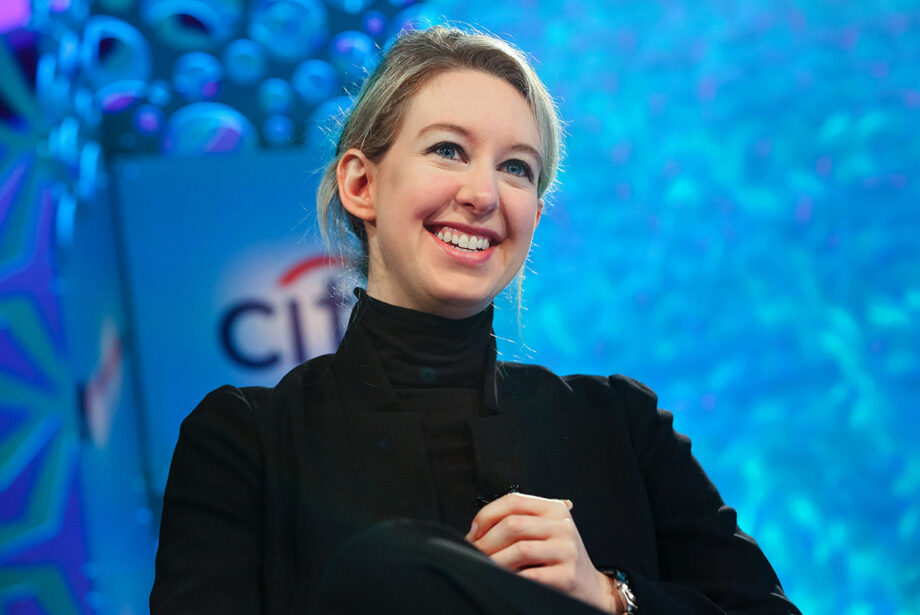
Elizabeth Holmes, then the CEO of Theranos, appears at the 2014 Fortune Most Powerful Women Conference in Laguna Niguel, California.
THIS IS AN OPINION
We'd also like to hear yours.
Tweet us @ArkBusiness or email us
The New York Times published an article last month headlined, “Why High-Class People Get Away With Incompetence.” I noticed a link to it on Facebook and clicked immediately because I had minutes earlier finished reading “Bad Blood: Secrets & Lies in a Silicon Valley Startup.”
Yes, I know I’m a year late in reading John Carryrou’s spectacular history of Theranos and its founder, Elizabeth Holmes. I thought I knew all I needed to know about a private blood-testing company that didn’t live up to the hype. But co-workers kept raving about it, with good reason. The story of Theranos is about human nature as much as it is about business or science or fraud.
The Times story was a report on a scientific study newly published in the Journal of Personality & Social Psychology. The study — actually four studies involving more than 150,000 people — confirmed over and over that people who occupy a relatively high social class are more confident in their skills, even if those skills are demonstrably no better than average.
Overestimating one’s own competence is not really the news here. The study’s authors repeatedly cited the work of social psychologist David Dunning, including his most famous findings written with graduate student Justin Kruger, “Unskilled and Unaware of It: How Difficulties in Recognizing One’s Own Incompetence Lead to Inflated Self-Assessments.” Popularly known as the Dunning-Kruger effect, the phenomenon of incompetent people overestimating their abilities is familiar to every manager who has ever had to evaluate employees.
What’s new in the study led by Peter Belmi, a professor at the University of Virginia’s Darden School of Business, is the consistency with which other people — complete strangers, even — interpret confidence as competence. People who are already relatively privileged project confidence in their own competence, which persuades other people, leading to even more opportunities.
Elizabeth Holmes, now awaiting trial on fraud charges, is a descendant of the founder of the Fleischmann Yeast Co., the foundation for one of the great American fortunes at the turn of the last century. Most of the money had been frittered away and her own father spent most of his career in government service (before a poorly timed stint with Enron). Still, the family history and wealthy connections allowed Holmes, who dropped out of college at 19, to found a biotech company that would attract nearly a billion dollars in startup capital.
Holmes was confident, and that was mistaken for competence by just about everyone. Her investors had last names like Walton and Murdoch. The (former) CEO of Safeway had so much faith in her description of instant on-site testing of single drops of blood that he spent $100 million preparing his stores for clinics that would never materialize. Her board of directors included Jim “Mad Dog” Mattis and former Secretaries of State Henry Kissinger and George Shultz.
They all believed her claims of technological breakthroughs and gave her every benefit of every doubt because they believed in her. Shultz’s grandson interned at Theranos, changed his major in order to be part of Holmes’ world-changing adventure and quickly realized that the technology didn’t exist. His attempts to blow the whistle resulted in estrangement from his grandfather and $400,000 in legal fees. So persuaded was Shultz of Holmes’ competence that he repeatedly took her side against his own grandson until the fraud was undeniable.
Carryrou, The Wall Street Journal investigative reporter who unraveled the Theranos hoax, addressed my burning question in the last paragraph of the epilogue to “Bad Blood”: “I’m fairly certain [Holmes] didn’t initially set out to defraud investors and put patients in harm’s way …. By all accounts, she had a vision that she genuinely believed in and threw herself into realizing.”
She certainly knew that her technology didn’t do what she claimed it did — not even close — but she adopted an extreme version of “fake it till you make it.” And that, as the new study shows, is a winning strategy for people whose social class conditions them for overconfidence in the first place.
Someone, possibly Mark Twain, explained why it took people like George Shultz so long to accept the truth about Elizabeth Holmes and Theranos: “It’s easier to fool people than to convince them that they have been fooled.”
If you were waiting for me to suggest other examples of a rich person’s confidence being mistaken for competence by people who then refused to accept that they had been fooled, you’ve done that work for me.
 |
Email Gwen Moritz, editor of Arkansas Business, at GMoritz@ABPG.com and follow her on Twitter at @gwenmoritz. |
 Sign up for Daily E-news