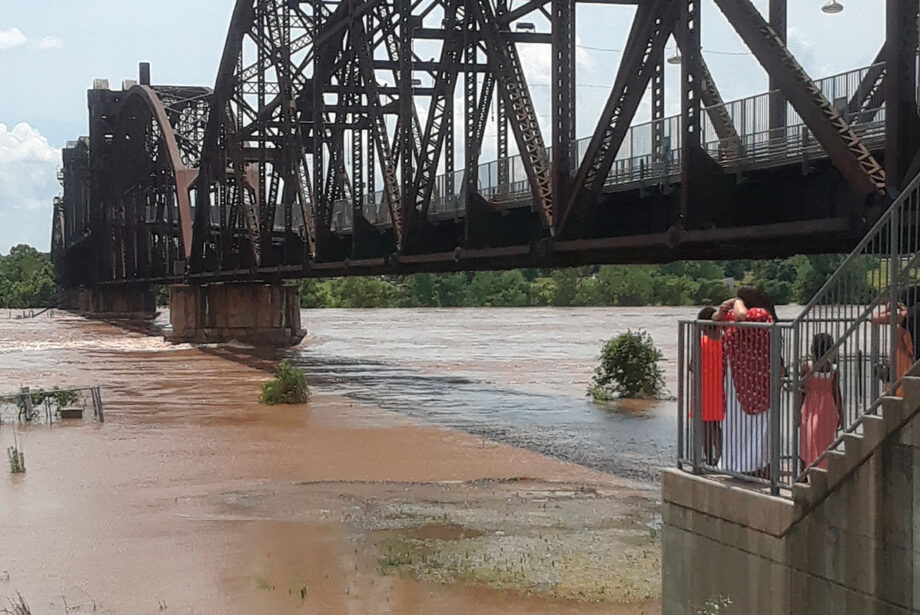
The Arkansas River rises against the Rock Island Bridge near the Clinton Presidential Center on June 2 as people watch from the north bank.
Plunging into disaster zones and telling the story is a job as old as journalism, but it’s perilous in body and spirit, so reporters should tread carefully.
The three-week disaster of Arkansas River flooding reminded Hillary Hunt of her policy: “Just be a human,” the KARK reporter and anchor says. “For victims, this isn’t just a story. This is their life.”
County law enforcement ushered one TV reporter off an apartment building parking lot in Little Rock after she pressed too hard for an interview, according to a landlord she interrupted as he hauled in gravel to fight the rising waters.
Even in the competitive TV news industry, such pushy tactics are usually rare, said Hunt and Matt Mershon, a reporter at rival KATV. They both said their goal is to inform viewers and help people, correcting rumors and letting victims have a voice at a grievous point in their lives.
“I think being on the local end of news coverage builds a bridge of trust,” Hunt said. “These are the people who take time to watch us, to say hello on the street. It makes reporting on these disasters more personal.”
Mershon’s vibe on the phone is droll, his voice verging on Bill Maher. Whenever the Massachusetts native and University of Illinois graduate catches himself complaining about the many miles and low pay reporters face these days, he thinks of the retiree wiped out by the tornado, the woman who lost everything in a fire.
The last thing they need is pressure.
“In anything like a natural disaster or a homicide, for example, my rule of thumb is I’m not going to push people to talk to me,” said Mershon, who sometimes leaves handwritten notes instead of business cards. “An interview should be a conversation, not a demand.”
He and Hunt said working with law enforcement is crucial at disaster scenes, and Mershon said he’s sensitive to the tightrope officers and elected officials walk between stirring panic and giving citizens proper disaster warnings. “You don’t want to scare the pants off people, but you also don’t want to be accused in hindsight of underplaying a threat,” Mershon said.
“We saw that at the levee at the Lollie Bottoms in Faulkner County,” where an imminent breach warning led to some evacuations before the levee held, becoming a kind of earthen folk hero. “Reporters help separate fact from rumor, and we press official sources to give us useful information that we can share with the viewers,” Mershon said.
His boss at the ABC affiliate, News Director Nick Genty, tells his crews to “never get in a situation where you are in danger; that’s for daily stories and disasters.” During his years in the field, Genty simply asked if victims wanted to tell their stories. “Running up camera rolling is just not professional.”
The Society of Professional Journalists’ code of ethics puts a premium on minimizing harm and treating others as human beings. “I hope and believe my team does that,” Genty said.
Former KARK and Fox 16 News Director Austin Kellerman wrote movingly about how news teams pitched in to save Texans after Hurricane Harvey in 2017.
His successor as news director, Ernie Paulson, agreed that covering a flood, tornado, shooting or accident shouldn’t mean “re-victimizing” the victims. “We will ask them if they wish to share their story. If they do not … we move on.”
Now that the waters have moved on, the extent of the flood damage is emerging. “That’s again where we have the advantage as local journalists,” Hunt said. “There’s still so much to cover, so much to be done. That’s why we did our telethon, and that’s why we keep viewers informed on available resources and help. We’re not going to disappear just because the disaster is over.”
 Sign up for Daily E-news