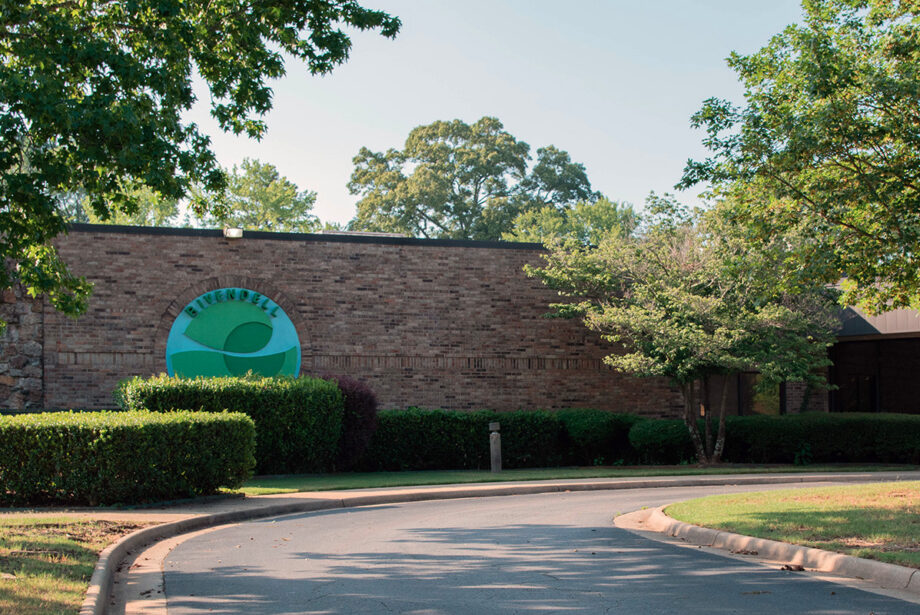
A Pulaski County Circuit judge recently ruled that the family of a 20-year-old woman who died of a drug overdose will win its lawsuit because Rivendell Behavioral Health Services of Arkansas intentionally destroyed key evidence.
The finding means the estate of Joely Clements, who died in the apartment of a male nurse who had treated her at Rivendell days earlier, doesn’t have to prove liability against the 80-bed acute psychiatric hospital in Benton and its management company, UHS of Delaware Inc. Unless an appeal is successful, the estate will only have to put on evidence of the damage it has suffered because of the defendants’ actions.
“That’s a pretty steep sanction,” said Joshua Silverstein, a professor at the Bowen School of Law at the University of Arkansas at Little Rock. “When evidence is destroyed, it is far from unheard of for judges to grant some type of judgment for the other side. This is a relatively extreme remedy, but it can be warranted on the facts.”
The estate’s claims against Rivendell and UHS include gross negligence and fraud.
Clements checked into Rivendell to treat a drug addition in 2018. The day she was discharged, the registered nurse who treated her, Justin Lusby, 31, of Little Rock, texted her and invited her to his apartment. She accepted. Three days later, Clements was found dead in Lusby’s apartment after a fentanyl overdose.
In addition to the rare judgment by Pulaski County Circuit Judge Mackie Pierce in favor of a plaintiff’s family, the case is notable for several reasons:
- Rivendell’s decision to hire Lusby, who had admitted stealing drugs from patients at an earlier job;
- Rivendell’s decision to keep him on even after he committed policy violations and was accused of having an affair with a patient; and
- Rivendell’s failure to report on Lusby’s performance to the Arkansas State Board of Nursing, which had put him on probation for the drug thefts.
Nevertheless, the ASBN found Lusby guilty only of “a boundary crossing” in his relationship with Clements and in May extended his probation until 2023.
“It was our board’s decision to put him on probation,” said Sue Tedford, ASBN’s executive director. “You have to look at what he is guilty of and the only thing that we found him guilty of … was a boundary crossing.”
She said that any time a nurse is in contact with a patient outside of a work setting, even if the patient has been discharged, “it’s a boundary issue.” But she said there’s not a rule or statute on how long nurses are supposed to wait before they start dating a patient. “That’s not defined by law in Arkansas,” she said.
Lusby’s attorney, Richard Holiman of Little Rock, told Arkansas Business that it would be inappropriate for him to comment because the case is pending.
Lusby and Rivendell’s parent company, publicly traded Universal Health Services Inc. of King of Prussia, Pennsylvania, were also named as defendants. They weren’t accused of destroying evidence, and the estate’s lawsuit against them is pending.
Destruction of Evidence
The estate’s lawyers, brothers Derek Potts of the Potts Law Firm of Houston and Dylan Potts of the Gill Ragon Owen law firm of Little Rock, said in a May 28 court filing that the destruction of evidence was deliberate. Pierce agreed.
“There can be no other conclusion other than evidence was intentionally destroyed or lost by Defendants,” Pierce wrote to the attorneys on June 27. “This is not a decision that comes lightly or without great thought and consideration.”
Pierce found that the Clements estate’s ability to obtain a “full and fair trial has been irretrievably compromised as a result of the destruction of emails from and to the human resources director, Shirley Spurlock.”
Rivendell and UHS also failed to preserve, “or even attempt to preserve,” text messages between employees about the case, Pierce wrote. “The Defendants have engaged in a willful and intentional destruction of evidence,” Pierce wrote.
The attorney for Rivendell and UHS, Scott Provencher of the Mitchell Williams Selig Gates & Woodyard law firm in Little Rock, said in an email to Arkansas Business last week that Pierce’s ruling will be appealed.
“We disagree that any intentional destruction of material evidence occurred,” Provencher said. “While Ms. Clements’ death was unfortunate, it was not caused by anything that Rivendell did or failed to do.”
He declined to comment further on the pending case. The attorneys for the estate also declined to comment.
Stealing Drugs From the ER
Lusby graduated from the University of Arkansas for Medical Sciences in 2011 with a degree in nursing. In a 2014 letter, he told the state nursing board that he had suffered from addiction since he was 19 and used marijuana and alcohol.
Starting in August 2013, Lusby said, he grew dependent on prescription narcotics and stole drugs while he worked in the emergency room at Ouachita County Medical Center in Camden.
“If an order was written for 5 mg of morphine, I would give 5 mg and take 5 mg,” Lusby wrote. “I have also given the patient less than the prescribed order and diverted the rest.” He said his battle with addiction spiraled out of control. “I was ashamed and felt guilty for what I was doing,” he wrote.
It wasn’t until September 2014, when he was scheduled to take a random drug test, that he confessed his addition and drug theft to the Camden hospital’s nursing director, his letter said. In November 2014, the board placed Lusby on probation for five years and required him to attend Alcoholics Anonymous meetings and file quarterly reports with the board.
“Lusby knew that finding a job as a nurse was going to be difficult in 2014,” the Clements lawsuit said.
He applied for between 65 and 75 positions. Rivendell was the only company that offered him an interview, Lusby said in a May 2019 deposition. Portions of the depositions were attached to the case.
Sex With the Patient Advocate
Lusby started at Rivendell in March 2015. While there, he had a sexual relationship with the director of patient advocacy, who was in charge of investigating patient complaints, according to the Clements lawsuit. Arkansas Business is not identifying the patient advocate, who couldn’t be reached for comment and no longer works at Rivendell.
“It was over and done with before all the Joely stuff,” Lusby said in the May deposition. He said that he kept the relationship secret because it could hurt the advocate’s career. It’s not clear when Rivendell learned of the relationship.
“This romantic relationship caused a huge conflict of interest because patients who wanted to report Lusby for troubling conduct would be doing so on the deaf ears of Lusby’s lover,” the Clements filing said. “In fact, Lusby was never investigated by [the patient advocate] once during his employment.”
In addition, as part of Lusby’s probation, Rivendell was required to submit a quarterly reports to the ASBN. Rivendell “blatantly (and repeatedly) lied” to the nursing board” about Lusby’s performance, the estate said in a June filing.
According to Clements’ estate, Rivendell reported to the board in June 2017 that Lusby’s work was “exceptional.” It turned out that earlier in 2017, Lusby had been written up for “poor performance and unprofessional conduct,” his eighth policy violation, the filing said.
Tedford, the ASBN’s executive director, told Arkansas Business that the board has no authority over any institution and couldn’t do anything about Rivendell not sending the board accurate information.
Joely Clements checked into Rivendell on March 30, 2018, to treat her drug addiction.
Lusby was one of her nurses.
Lusby said that he told Clements he couldn’t speak to her about personal matters until she wasn’t a patient, according to a Little Rock Police Department report about Clements’ death that was included as an exhibit in the case.
But within hours of Clements being discharged on April 4, Lusby began texting her — while he was on duty at Rivendell.
“Yeah I thought about you all f—— night and day,” according to the complaint, which included the text messages. “It’s f—— insane how attracted I am to you.”
He invited her to his apartment, and she arrived on April 5.
While at Lusby’s apartment, Clements told him that “she really wanted to use narcotics, and, thus, relapse,” the lawsuit said.
Lusby warned Clements that she would die if she used heroin. “I was like, ‘I just want you to feel safe,’” Lusby said to Clements, according to his interview with police.
Early the next day, on April 6, 2018, Lusby left Clements in his apartment and drove to Lake Erling in Lafayette County for a fishing trip.
When Lusby returned to his apartment the evening of April 8, 2018, he found Clements dead from an overdose.
Lusby Finally Fired
Clements’ father, Andy Clements, hired the Potts law firm shortly after his daughter’s death. Derek Potts sent a letter to Rivendell on April 18, 2018, telling it to preserve all hard copy documentation that might be evidence in the case, evidence that would include all records relating to Lusby.
Two days after the letter was sent, Rivendell fired Lusby.
As discovery in the case continued, the attorneys for Clements’ family alleged that UHS of Delaware “deleted pertinent evidence,” including the email accounts of Lusby and Shirley Spurlock, the former Rivendell human resources director. Rivendell also couldn’t find notes from a 2017 investigation of Lusby relating to allegations of a sexual relationship he had with another patient, which Lusby denied, the estate said in a May filing.
“These notes are material to Plaintiff’s case as they prove the corporate health care Defendants were on notice that separate Defendant Lusby successfully preyed on patients in the past, yet the corporate health care Defendants did nothing to prevent it from happening again,” the estate said in the filing.
A trial had been set for August in Judge Pierce’s courtroom, but that has been canceled pending the appeal on the finding of sanctions.
 Sign up for Daily E-news