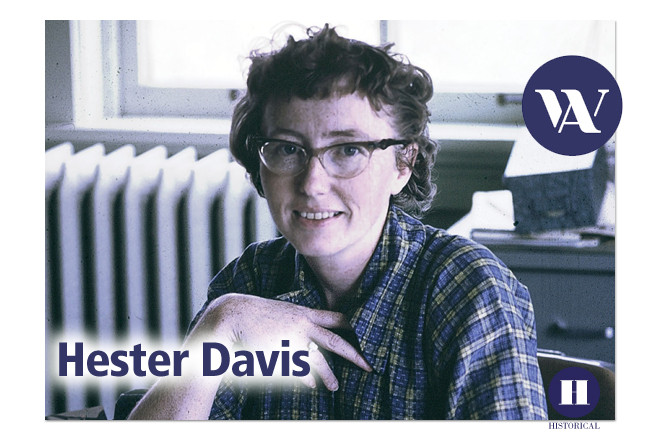
As an archaeologist, Hester Davis was forever chasing history. As Arkansas’ first State Archaeologist, and through countless other contributions to her field, the Massachusetts native made history.
“Hester Davis had so many accolades, awards and accomplishments that it would take several pages to list them all,” said Ann Early, her successor as Arkansas State Archaeologist, in a 2014 press release announcing Davis’ death at age 84. “On a personal level, she was instrumental in making the field more welcoming to women. Thanks to Hester and her fellow pioneers, women have a larger part in American archaeology.”
The Archaeological Conservancy, in its remembrance of Davis, was even more succinct.
“(Considered) a national treasure by the archaeological community … Hester was a good friend of The Archaeological Conservancy since our founding,” read the retrospective. “We are honored to have worked with her. She will be deeply missed.”
Born June 4, 1930, the youngest of five, Davis was earning her Bachelor of Arts in history from Rollins College in Florida when she accepted an invitation by her sister and brother to join them at a summer dig in New Mexico.
“I didn’t have a burning desire to go,” Davis said in a 2005 profile by The Archaeological Conservancy. “I didn’t have a passion for archaeology or anything like that. I just thought it sounded fun.”
Despite archaeology being an almost exclusively male field, Davis’ path in life was set by the end of that summer; particularly so once she discovered her colleagues were as put off by the camp’s lab work — keeping records and organizing the artifacts — as she was about digging.
“But somebody has to do it, and I happened to enjoy it,” she told the Archaelogical Conservancy. “I have a talent for making sure everything is correct and in detail.”
Upon finishing a Master of Arts in social and technical assistance from Haverford College outside Philadelphia and a Master of Arts in anthropology from the University of North Carolina, she was recruited to help bring order to the University of Arkansas’ vast, uncatalogued collection of artifacts for a new museum.
“Most of it was still in the paper sacks that it arrived in from the field,” Davis said in 2005. “[They] needed somebody to sort through it and organize it.”
She arrived in Arkansas in 1959 and never left, serving as preparator at the University of Arkansas Museum and later, as assistant director. She taught in the Department of Anthropology for a decade and in 1967 was appointed state archaeologist, a post she held for 32 years.
By that time, she was also an activist, sounding the clarion call for nationwide protection of archaeological sites, which federal building projects had threatened since the 1920s. Arkansas was no exception, where prehistoric Indian mounds were routinely in engineers’ crosshairs as cheap and nearby dirt from which to construct levees.
“They never thought about the history they were destroying,” Davis said in 2005. “They never thought about the lessons that could have been learned if those sites had been studied. It’s hard to imagine it today, but the whole mentality was different back then.”
Davis was a founding member of the National Association of State Archaeologists, the American Society of Conservation Archaeology, the Society of Professional Archaeologists and the Arkansas Archaeological Society. Drawing from this well of colleagues Davis emerged as pit boss, rallying dozens of prominent archaeologists to the cause and, working behind the scenes, orchestrated a withering assault on Washington lawmakers.
“She was the coach of the team,” colleague and fellow activist Don Fowler told The Archaeological Conservancy in 2005. “She was always a step ahead of the politicians, anticipating their questions.”
Congress ultimately passed the Archaeological and Historic Preservation Act in 1974, a law that expanded the responsibility of federal agencies to fund investigations of archaeological sites during federally-funded construction projects.
During the next 25 years, Davis remained a leading advocate for archaeology. A member of the U.S. Committee for the International Council on Monuments and Sites, she was also appointed by President Bill Clinton to the Cultural Properties Advisory Committee of the United States Information Agency. She turned her activist eye toward stemming the tide of looted artifacts for profit, resulting in the Archaeological Resources Protection Act of 1979.
Upon retirement in 1999, Davis established the Davis Internship in Public Archeology, an endowment helping students earn advanced degrees in anthropology. She authored “Remembering Awatovi: The Story of an Archaeological Expedition in Northern Arizona, 1935-1939” in 2008, to critical acclaim.
In 2001, Davis was profiled in “Grit-Tempered: Early Women Archaeologists in the Southeastern United States.” University of Florida archaeologist Nancy White, who contributed the chapter on Davis, called her one of the main inspirations for the book and a pioneer for women. “I don’t know of anyone who has done more to educate the public about what archaeology is,” White said.
In 2006, the Southeast Archaeological Conference agreed, presenting Davis its Lifetime Achievement Award.
“So who owns the past in this country? The answer depends upon whom you talk to,” Davis wrote in an article for Archaeology in 1998. “Archaeologists used to be taught that we owned the past — we found it, we studied it, we understood what it meant. More recently, we have said ‘The past belongs to everyone.’ ”
 Sign up for Daily E-news