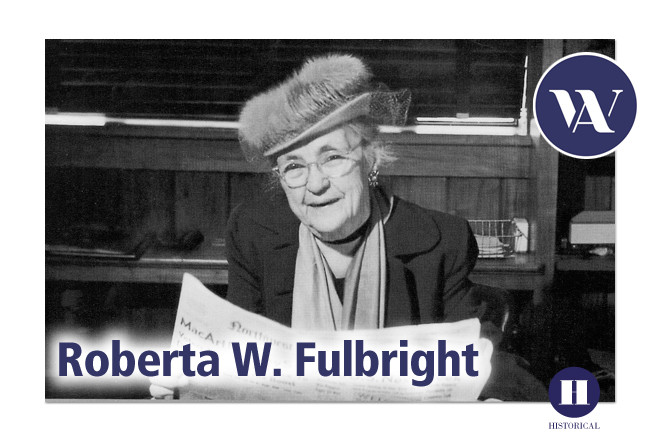
Roberta Fulbright was a fascinating amalgam for her times. Never content to be seen and not heard as was expected, hers became one of the loudest and most influential voices of her day.
Tireless always, tenacious as necessary, her determination to succeed was rivaled only by her concern for her community and the ordinary people who lived there.
In the 1997 biography, “Roberta: A Most Remarkable Fulbright,” authors Nan Snow and Dorothy Stuck wrote, “She believed in the good life offered by the beautiful Ozark hills and in the potential of the people who inhabited that region. Despite her successes and disappointments, the occasional anger and the more frequent praise, she never lost her fervor for life as she saw it.”
Raised hardscrabble in rural Missouri, Roberta Waugh Fulbright learned early the work of one’s hands was the key to surviving a harsh and unforgiving world. But she was also afforded a level of education unusual for the day, attending high school in Kansas City and two years at the University of Missouri, after which she taught school in Chariton County, Missouri.
She married the entrepreneurial Jay Fulbright in 1894 and the couple settled in Sumner, Missouri, where Jay owned the local bank and other businesses. When the couple and their growing family — they would welcome six children — moved to Fayetteville in 1906, he expanded his business holdings and between his prominent place on Main Street and Roberta’s extensive involvement in civil and social activities, the Fulbrights quickly became one of the central families in town.
Tragedy struck in 1923 when Jay Fulbright died unexpectedly and Roberta found the family holdings under assault from predatory business rivals and partners alike. Convinced a woman had neither the capacity nor call for such endeavors, they attacked the fractured collection of companies — which included a small railroad, two banks, a hotel and newspaper publishing company among others — from all sides.
They quickly discovered they had no idea who they were dealing with, as Roberta fought to retain control of the family holdings. She formed Fulbright Investment Company and brought her businesses under its protection, taking on much of the operational responsibilities personally.
Her business acumen shone through the darkest of personal times, as well as the crippling economic malaise of the Great Depression, during which she managed multiple bank holdings, one of just three women bank presidents in the state.
Commerce and cause intersected in the publishing business, where Fulbright took her most active role. She was determined the Fayetteville Daily Democrat (later the Northwest Arkansas Times) would be an influential and effective advocate for the community and the common people.
“It is a fallacious notion that a newspaper should or could be an isolated affair,” she wrote. “Its life-blood should flow in the veins of the community in which it lives.”
Through her column, “As I See It” Fulbright advocated new services for Fayetteville, including a hospital and a library, while savaging those who abused positions of power. Her repeated crusades against local and state political structures were unrelenting and the veiled or explicit threats that came her way as a result only fueled that fire. The power of Fulbright’s pen rooted out election fraud and other illegal activities as well as the local officials who harbored them.
“She was nobody’s fool,” recalled her sports editor Bob Wimberly in “Roberta: A Most Remarkable Fulbright.” Sam Schweiger, a former editor, added, “There was never a question of where she stood. She told you what she thought.”
Of the powerful men she took on, reporter Floyd Carl Jr. was blunt, “She was her own man. They never scared her.”
Underneath the uncrackable exterior beat a compassionate heart. As Stuck and Snow write, “At the newspaper – as in all her businesses – Roberta demanded a lot of her employees, but she gave a lot in return. Because she did not want to affect the employees adversely, she kept some businesses open which she actually would have preferred to close.”
Succeeding generations of Fulbrights remember well how Roberta stressed resourcefulness and achievement and many took up their own causes. Of these, none stands out more than J. William (Bill) Fulbright whose career included stints as University of Arkansas president, U.S. House of Representatives and a 30-year distinguished career in the U.S. Senate.
Her 1953 obituary was widely reported as front page news. The rival Arkansas Gazette editorial staff paid tribute to one of their own, writing, “Those who had had the good fortune to live in the hill country of Arkansas knew her in her own right – a tireless, strong woman who had created for herself the role of matriarch in the town of Fayetteville.”
And in return, Fayetteville paid tribute to her. The Fayetteville library and a women’s dorm and dining hall at the University of Arkansas bore her name for more than four decades before being replaced. In 2012, the Roberta Fulbright Dining Hall at the Northwest Quad was christened on campus.
She was named 1946 Mother of the Year by the Arkansas Mother of the Year Committee. In 1976, she was one of 13 women profiled in the book Mothers of Achievement in American History 1776-1976. Foremost among her lasting professional contributions, she founded in 1949 the Arkansas Newspaper Women, later the Arkansas Press Women.
Of true and lasting success, Fulbright herself once wrote: “The high point in human relations is the power to love and respect. The high point in achievement is to be loved and respected.”
 Sign up for Daily E-news