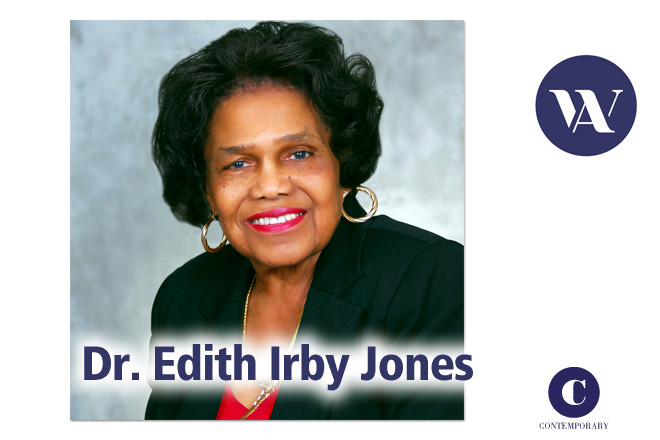
It is when we give of ourselves that we truly give,” Dr. Edith Irby Jones said during her 1985 inaugural address as president of the National Medical Association.
Jones was the first woman elected president of the National Medical Association, and in 1948 was the first African American student to attend the University of Arkansas School of Medicine (now the University of Arkansas for Medical Sciences).
Jones’ interest in medicine began during her childhood in Hot Springs. She saw her father die from a horseback riding accident and witnessed her 12-year-old sister and other family members succumb to typhoid. Jones said that in those situations, she felt helpless and wanted to be able to assist.
“I was inspired to become a doctor with the death of my sister,” Jones said in a National Library of Medicine biography. “I felt that if I had been a physician, or if there had been other physicians who would have been available, or if we had money adequately — which may not be true — that this physician would have come to us more frequently and that she would not have died.”
Jones suffered from rheumatic fever when she was 7, which made her unable to walk to or attend school for more than a year. Because of this, her mother did her schooling at home during that time.
When Jones went back into the public school system, she skipped parts of multiple grades because she was ahead of her classmates thanks to her home schooling, but she had missed out on parts of the math curriculum. Jones never learned her multiplication tables or fractions.
“I can count,” Jones said, laughing during a 2006 interview with the Pryor Center for Arkansas Oral and Visual History. “And I went to college, and I got through physics.”
At her all-black high school, Jones was a cheerleader, the prom queen and an officer for her class each year. She described herself as “aggressive” and said she went after what she wanted.
Jones attended college at the only school she applied to: Knoxville College in Knoxville, Tennessee, where she triple majored in chemistry, biology and physics. She arrived at the school with $60 to her name, but tuition cost $300. Jones was determined to go to school, and on the day of enrollment she talked to the president of the college and became his assistant secretary in exchange for tuition.
“I can’t think of being told ‘no’ about anything,” Jones said to the Pryor Center. “I can’t think of anything — lack of money for instance. I didn’t have any money to go to college. Money has never been a thing for me. I don’t have it now. I don’t need it. What do you do with it? It’s just for exchange.”
Knoxville was a predominantly black school, but according to Jones, about three quarters of the teachers were white. While there, she was involved with the student government, on the debate team and an active member of Delta Sigma Theta sorority.
After graduating from Knoxville College with only one B on her transcript, Jones began classes as the first black student to attend the University of Arkansas School of Medicine. She found out about her acceptance into the program via a telephone call from Time magazine.
“I answered, and they said, ‘This is from Time magazine. I called to find out if you are going to accept your place at the University of Arkansas,’ ” Jones said in the Pryor Center interview. “And I said, ‘I have not been accepted yet.’ And he says, ‘Yes, you have been.’ And I said, ‘Well, maybe the letter went home. I’m here in Chicago, and I haven’t heard from them.’ And he says, ‘But we want to know if you’re going to — if you’re going.’ I said, ‘Yes, I’m going.’”
So she went.
“Segregation didn’t make any difference. Money didn’t make any difference. Absolutely nothing made any difference. I had reached the point in life that I intended to get: accepted in medical school,” Jones said.
But again she ran into a problem: Jones didn’t have money to pay the $500 medical school tuition. This time, others came to her aid. People from Jones’ hometown of Hot Springs began raising funds — the mayor gave, they had collections after church, they shook cans on the street corners. And with so many people supporting her, Jones knew she had to succeed.
Although she had been accepted to attend classes, she was not allowed to use the same dining, lodging, or bathroom facilities as other students at UAMS. She was given a special room in the library where she could eat lunch, but chose not to put up a fuss about these accommodations. Many of her classmates chose to eat with her and to study with her at her apartment.
During Jones’ second year of medical school, she met James B. Jones, a professor at Arkansas Agricultural, Mechanical and Normal College, now the University of Arkansas at Pine Bluff.
“We started going to the parties that the faculty … would give, and so forth, and after school started for me, he would come over and spend some time on weekends when I wasn’t studying,” Jones said. “And we got to be real chummy.”
The two were married that same year.
After graduating in 1952, Jones practiced in Hot Springs for six years. She never viewed race as an issue. To her, people were simply people.
“When I saw the hunger, I tried to see that the hungry were satisfied,” Jones said. “It’s not just a racial situation, it’s people. And you will see from the patients who come to see me — they come to see me to have their needs met.”
In 1959, Jones and her family moved to Houston, Texas, where she was the first black woman intern at the Baylor College of Medicine Affiliated Hospital. She did the last three months of her residency at Freedman’s Hospital in Washington, D.C, and in 1962, Jones set up a practice in Houston that is still open today. The Houston Hospital, was renamed the Edith Irby Jones M.D. Health Care Center in her honor.
Jones said in her interview with the Pryor Center that because of her passion to work she only sleeps about three to four hours a night, and feels groggy when she gets more than that.
“I wake up every morning just eager to get up and get that day started,” Jones said. “I — I wouldn’t know what to do if ever a day came and I didn’t have anything I needed to do right then and there — when I felt that day was not full of anticipation.”
In 1985, she was elected the first female president of the National Medical Association (NMA) and is the only female founding member of the Association of Black Cardiologists (ABC).
Jones has taught, consulted, and/or provided healthcare in Haiti, Mexico, Cuba, China, Russia, and throughout Africa and was a charter member of Physicians for Human Rights, which won the Nobel Peace Prize in 1997.
And although all these accomplishments are prestigious and noteworthy, Jones was simply doing what she had strived for since her childhood. She has always maintained her practice in Houston’s “third ward” to serve those who could not afford to go anywhere else for medical care.
“I was going to be doctor in which money wasn’t going to make any difference with me — those who were less fortunate would get the kind of care that they needed,” Jones said. “I was going to do it as much as I could do it, and I was going to instill into others that they must do it, too. And so I have spent my lifetime trying to live out a childhood dream.”
 Sign up for Daily E-news