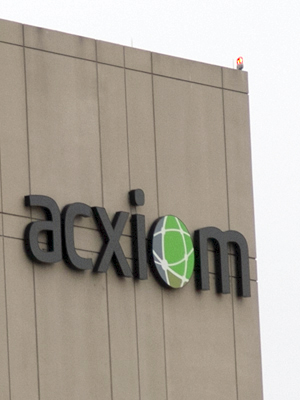
Acxiom Corp. of Conway announced after the market closed on Monday that it would sell its biggest line of business to publicly traded Interpublic Group of Companies Inc. of New York in a deal worth $2.3 billion in cash.
The division, Acxiom Marketing Solutions, provided about three-quarters of the company’s fiscal 2018 revenue. It includes data management services, data strategy services, analytics and “audience creation services.” Interpublic said the AMS business involves about 2,100 employees and 2,000 clients.
Acxiom stock (Nasdaq: ACXM), which closed at $29.95 on Friday, closed up by more than 14 percent on Monday, at $34.21. After-hours trading pushed it to $40, a level it hasn’t seen since 2000.
The sale, set to close before the end of the year and approved by both company’s boards of directors, is the culmination of a process Acxiom first announced in February, when it restructured its business units, going from three segments to two: Acxiom Marketing Solutions and LiveRamp. Acxiom said then that it intended to explore options for AMS, including a sale or spin-off.
The sale leaves Acxiom to focus completely on the LiveRamp “data onboarding” business. Acxiom purchased LiveRamp of San Francisco in May 2014 for $310 million.
The sale will also leave Arkansas with one less publicly traded company: Acxiom said it will transfer the Acxiom brand and related trademarks to Interpublic, rename itself LiveRamp and move its headquarters to San Francisco. It aims to trade common stock under the new symbol, RAMP.
“This transaction is a great outcome for both Acxiom and our AMS business unit,” CEO Scott Howe said in a news release. “Acxiom Marketing Solutions is a strong business with deep expertise in data-driven marketing, talented associates and an exceptional client roster.
“After careful consideration of a variety of options and potential partners, it became clear that a sale of AMS to IPG, with its vast scale and breadth of complementary services, represented the best possible path forward for our clients and associates.”
Michael Roth, Interpublic’s chairman and CEO, said the acquisition will “help us shape the future of our industry.”
“Acxiom’s leadership on data ethics is second to none, its business is solid and growing, and it has long played a foundational role in the marketing ecosystem,” Roth said. “The company also boasts 2,100 associates with data and analytics skills that are at a premium in business today. Combined with IPG’s world-class client roster, as well as our talented 50,000-person global workforce across media, advertising and marketing services, and you have an unrivaled offering.”
Interpublic said its news release that AMS will remain a stand-alone division reporting to Arun Kumar, its chief data and marketing technology officer. Acxiom executives Dennis Self and Rick Erwin will continue as co-presidents of AMS.
Interpublic also said AMS will represent 8 percent of the combined company’s revenue. The combined revenue is expected to be $8.2 billion.
During a conference call on fourth-quarter and year-end results in May, Acxiom CFO Warren Jenson said AMS had revenue of about $700 million in fiscal 2018. Total Acxiom revenue was $917 million.
Acxiom’s remaining LiveRamp business helps marketers connect offline data — like data stored in customer relationship management systems — with online data, allowing them to better target advertising to those customers. LiveRamp includes Acxiom’s old Connectivity segment and products like IdentityLinkT, AbiliTec and Acxiom’s TV integrations.
In the February conference call, Acxiom CEO Scott Howe said LiveRamp clients include some of the top banks, insurance companies, telecommunications firms, automakers, retailers and airlines.
Word of a deal had intensified in recent days. On Thursday, the Wall Street Journal reported that companies had until the end of that day to submit bids for the unit, and that Interpublic and Dentsu Inc. of Tokyo were expected to be among the bidders. On Monday, Reuters reported that Interpublic Group would be the likely buyer.
In its news release, Acxiom said it would realize about $1.7 billion in net cash proceeds after the deal closes. It said it would use the money to retire all $230 million of its debt; initiate a $500 million cash tender offer for common stock; and increase a stock buyback program by $500 million and extend it through the end of 2020.
The company said it would use the rest of the money to fund growth initiatives, strategic acquisition opportunities and meet ongoing cash needs.
Acxiom was founded as Demographics in 1969 in Conway. Last year, executives said the company had about 1,500 workers at its Conway headquarters, where it returned after years of operating out of Little Rock’s River Market District. In all, it has about 3,300 employees, with offices across the country and in China, Japan, Australia, Germany, France, Poland and the United Kingdom.
It was unclear Monday what would happen to Acxiom’s Arkansas workforce. In Conway, Acxiom is the city’s biggest employer, according to Jamie Gates, executive vice president of the Conway Chamber of Commerce.
“I think growing that company from a very small one into a $2 billion company, having that in Conway, was transformative for the community. The community has changed as much as the company has over that time, and they’re a big part of Conway’s success,” Gates told Arkansas Business. “And, obviously, the Conway workforce is a big part of why Acxiom is successful.”
Gates said that historically changes at Acxiom have been positive for Conway. He said he’d withhold judgment about whether this latest change would be good or bad for the community.
‘Remarkable Price’
In a Tuesday note to investors, Brett Huff, an analyst with Stephens Inc. of Little Rock, called the $2.3 billion sale price for AMS “remarkable,” considering the business has had “some growth challenges, customer losses, contract delays and regulatory headwinds.” He said he expects Acxiom stock to reach $44 per share.
In a Tuesday morning conference call, Interpublic executives said they would visit Acxiom’s Conway campus “very soon” to meet the people working there. They touted the division’s marketing and data management expertise and cited its “2,000 associates, including 1,600 data specialists,” among the factors that made the deal a win for its shareholders.
“Privacy has become a regular fixture in the headlines as a result of major data breaches and the introduction of [General Data Protection Regulation in Europe],” said Philippe Krakowsky, Interpublic’s chief strategy and talent officer and chairman and CEO of the company’s Mediabrands business. “Those concerns, along with potential regulation extending beyond Europe, to places like California, are tilting the playing field toward entities that own data and those that can handle it in a responsible and safe manner.”
Huff wrote that Interpublic bought AMS because “agencies are looking to beef up digital targeting and data-driven marketing as their historical media buying business slows.”
(Editor’s Note: This story has been updated to include notes from a Tuesday, July 3, conference call and an analyst’s reaction.)
 Sign up for Daily E-news