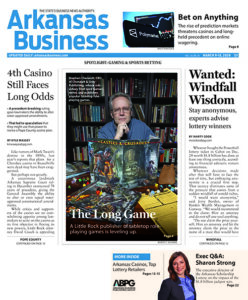
Arkansas Democrat-Gazette Publisher Walter Hussman was interviewed May 21 in a 45-minute telephone conversation conducted partly as he was driving home from the office. Three days before, he had published a letter to subscribers laying out the Little Rock newspaper’s plan to cut print publication to Sundays only, and an effort to convert subscribers to reading the paper on iPads his company will provide as long as readers keep up their subscriptions.
The interview has been lightly edited and condensed for readability. Questions and comments by the interviewer are in boldface type.
You pretty succinctly summed up your plans in your letter to subscribers published Saturday. Do you have any messages for a business readership?
A couple of years ago I heard Alex Jones give a talk. His family owned the newspaper over in Greeneville, Tennessee. Two of his brothers stayed in Tennessee, but Alex went off to work for the New York Times, and he ended up winning a Pulitzer Prize as a media reporter. He wrote about the Bingham family that owned the Courier-Journal [in Louisville, Kentucky], and the big family fight when they sold the paper. He wrote a book about that, and apparently the Suzlberger family was so impressed that they cooperated when Alex and his wife [Susan Tifft; they divorced in 2010] wrote a book about the New York Times.
“The Trust.” I read that book not long after I started at The Times, in 1999.
Yes, “The Trust.” After writing that, he went up to Harvard where he became head of the Shorenstein Center on Media, Politics and Public Policy, and I asked him to come and give a little talk. He said that at Harvard they taught that the internet was so significant that they needed to document how this came about. I’m in my car and it’s starting to rain, so I hope you can hear me.
They came to the conclusion that there were three times in human history where there have been transformational changes in the delivery of text communication. The first time was thousands of years ago when there was no written language, everything was oral. Somebody thought, well, wouldn’t it be great if we could take down this communication and put it down on a piece of papyrus. We could take that and transport it over distances — people miles away could read it, which is impossible if you’re speaking verbally. And we could transport it over time. People can read this text years from now. So that was the development of the first written language in the world. Obviously this had great implications for people communicating. Then in 1440, Guttenberg invented the printing press. Before that, hardly anybody read the Bible because they were so expensive to produce. You had monks copying them letter by letter. When the printing press came out, you could mass produce the Bible, so many, many more people were reading the Bible.
As a result, people started saying “where does it say anything in here about a pope?” [Laughter] People could read the Bible for themselves, and one result of that was a religious revolution called the Protestant Reformation. There were religious wars, a tremendous, tumultuous time as a result of that. When the printing press came out, the cost of replicating a piece of text dropped by more than 99 percent, compared to writing it out one letter at a time.
The third time of total transformation came in the early 1990s. Jones said it was not just the internet … I’m driving down the street, and somebody’s driving the wrong way up Cantrell, now he’s getting into the correct lane… anyway, he said it was the creation of the World Wide Web. That was different from internet in that it allowed anyone and everyone to communicate with anyone, or everyone. When that happened, the cost of replicating text compared to the printing press dropped by another 99-plus percent. That essentially made everybody a publisher.
Whether we like it or not, there has been an economic tsunami on the cost of communicating in print. If the Democrat-Gazette or Arkansas Business decided tomorrow to distribute five times as many copies, and they did it over the internet, what would be the incremental cost? Almost nothing.
So I try to keep that in mind, because regardless of what Walter Hussman wants to do, or what any publisher wants to do, this is a fact of life now. I love the printed page, and I’d love to keep the printed page forever. But anybody that’s going to rely only on the printed page is going to face a huge economic disadvantage. It’s just inherent. It’s not anyone’s fault.
This is something that I often communicate to civic club audiences.
So is there a timeline for going to Sunday-only print publication? You’ve mentioned making the transition by the end of the year.
I’d like to say we’re completely in control of what we do, but of course we aren’t. If we can do it by the end of the year, great. There could be things outside our control, but that would be desirable.
The 70 percent goal you set for converting subscriptions to digital, how many subscribers would that amount to?
Well, you’d take our daily circulation [about 100,000] and deduct single-copy sales. On Sunday, of course, we’ll still be selling single copies. And from that you can get an idea. And that 70 percent has been varying in different places as we’ve gone along. We started this in Blytheville a little over a year ago and as we’ve gone to different towns, and along the way we’ve tweaked and tried different things. We went to Newport, and we said we’re gonna rent you an iPad $9.99 a month. It would cost us more than that to rent, but we wanted the figure to be below $10. We got 43 percent. So we went back and did a pro forma to ask can we make money at 43 percent? The answer was no, so we dropped that and went back to people in Newport and said OK, forget about paying rent. We went to south Arkansas, to Camden, Magnolia and El Dorado, and said let’s try something new. Let’s give people the Sunday print edition, and that idea was really popular. We got more than 80 percent there.
In rural parts of the state, we’re getting maybe 55 or 60 percent. In more urban areas, like Jonesboro, we’re getting 75 percent. So it’s hard to say what we’re going to end up with. A lot of these places, we may run into a lot of resistance, people saying, no, we’re not going to do it. Or maybe it’ll be more popular in Little Rock where there’s more internet penetration and more local news. Who knows?
A lot of people assume that we know what we’re doing, that there’s a plan and that means it’s going to work out. I wish that was true. We don’t know exactly what we’re doing because nobody’s ever done this. So it’s a trial and error, experimentation. We’ve got a plan, but who knows if the plan will keep working, or work the same from town to town?
How will the one-to-one pitches to subscribers go?
One big disadvantage we faced in making this announcement over the weekend is that before, we would go in one town at a time and tell people what we were doing. Pretty soon after that we would sit down with them one-on-one in a hotel meeting room and show it to them. They liked it. They didn’t at first, and they told us, we don’t want to do this, we want to keep print. But after they used it for several weeks, they’d say “I can’t believe I’m saying this, but I like it better.” So by announcing that this is what we’re going to do, we stirred up a lot of misinformation, particularly on social media.
Some people think we’re going to give them a website or a blog or something. They don’t understand what a digital replica is. A lot of them had never seen it; some people had never seen an iPad. It would have been much better to go a town at a time, and when we got to the Little Rock area go a neighborhood at a time. But advertisers started getting confused. They said, “why should I keep advertising if you’re not going to have a newspaper?”
So we’d go and meet with them. There was a large auto dealer, and we said, look, your ad is going to be on the same page it’s always been on, and look what you can do with your ad now. There’s a link to your website, and you can go to the website and see a video of your ad. So we felt like with the confusion among advertisers we needed to go ahead and let people know what we were doing.
Will the change affect your ad rates? Digital advertising is often far cheaper than in print.
You know, we don’t know. It conceivably could, but advertising is going to become interactive, so advertisers are going to get more value out of that than they ever could have out of a static print ad. So maybe not, or maybe we’re going to start pricing advertising in a whole new way. I just know we’re not counting on advertising to keep us afloat.
Did you already have any digital-only subscribers? You were known for being one of the first publishers to put up a pay wall to protect content.
Actually before we started this we had about 4,000 people signed up for the digital edition, and they told us, you know, this is the greatest thing since sliced bread. I can take this with me on an airplane, or when I’m in Chicago I can download the paper. I get the paper on my iPad and when I get home I don’t have all these papers piled up. So we knew this was really popular with people who had done it, and some people would call and say just go ahead and drop my print delivery. I like it better on the iPad. So when we thought about how to remain a statewide paper while cutting distribution costs, we thought let’s give this a test in Blytheville and see.
Is there something different about the northwest Arkansas market that keeps it from being involved in this program? [The dozen counties covered by Hussman’s Northwest Arkansas Democrat-Gazette will keep getting a paper seven days a week.]
No, it’s just a different newspaper. Just like Chattanooga is a different newspaper or Texarkana is a different newspaper. We’re trying to do this one newspaper at a time, and the one that we’re doing is the Little Rock edition of the Arkansas Democrat-Gazette.
Are similar changes in store at this point for other Wehco Media Inc. newspapers? [Hussman’s chain has 18 newspaper properties in Arkansas and several other states.]
You know we made a change earlier at two of our papers, the Camden News and the Magnolia Banner News. Those papers have lost money for a couple of years, so we were trying to figure out what to do about them. So the idea was let’s convert them to weeklies. They were five-day-a-week print editions, and going weekly was logical, but we saw a problem. What about obits? Somebody dies and you have to wait till Wednesday for readers to find out about it.
What if the mayor got assassinated? Are we going to put that on a website, when so many of our readers are used to the paper and not a website? I know the rest of the world loves websites, and we like ours too, but websites are not going to keep journalism alive.
So I said why don’t we have a digital replica every day of the Camden News and the Magnolia Banner News. And since we’re really going to focus our attention on that Wednesday paper that’s printed every week, we’ll make a digital replica two pages. We’re not trying to sell ads, because ads have kind of gone away anyway. The replica pages let us get in the breaking news, the obits, the Little League games and high school sports. That’s what we did, so we had a sort of digital conversion at those two smaller papers.
I was at Hot Springs Village a few weeks ago speaking to their Rotary Club, and they asked are you going to do this at the Sentinel-Record? I said, let me tell you what, the Sentinel Record is still profitable, one of the few we’ve got that’s still profitable. And as long as it’s still profitable, we’re going to keep printing it.
For me to keep printing a paper that’s not profitable would be what I see as a dereliction of our responsibility. If we can figure out a way to keep a paper profitable without reducing any newsroom expenses, without reducing staffing in the newsroom, and give people the exact same content they have been getting, I think it’s a better model for sustainable publication and a better way to deliver journalism.
So what kind of job cuts are you expecting in printing, production and distribution?
We don’t know exactly. And in production, you know, the presses are going to be not as busy, so we’re looking at taking on some commercial printing work. Conceivably we could add people in production if we get enough commercial printing work. They’re going to keep printing the Sentinel Record for sure. The Texarkana Gazette is not profitable, but has a positive cash flow, so we’re going to keep printing it. Boy, I wish I knew the answer to that question. I’m not smart enough to know what’s going to be going on a year or two or three from now.
How would you compare your current situation to past crises you’ve faced, like shifting to morning publication in the 1970s and competing against the Arkansas Gazette when it was under the Patterson family, and then under the Gannett chain?
I do see some comparisons, but now we’re competing against just a complete disruption of the business model of newspapers; we’re competing with free news and a total shift in the way folks want to advertise. It’s not like we’re against one competitor. We’re against a totally changed environment. I do think there’s a similarity between this and what we’ve faced before. I heard somebody say this, and I think it applies: Sometimes you have to risk your business in order to save it. That’s where we are today.
Also I think of a phrase my dad had. He was a fabulous businessman. He died in 1988 so not many people know who he was these days. But he used to say that’s like the rabbit that climbed the tree. Somebody would say, well, rabbits don’t climb trees. Dad said, “yeah, I know, but this one had to.”
I kind of feel like that rabbit. We’ve got to climb that tree, even though we’re not supposed to be able to do it.
Your readers might be interested in this. The Oklahoma City paper sold for $12 million last year. We were prepared to spend $12 million on iPads for the Little Rock edition of the Democrat-Gazette. How many people are going to spend $12 million on a proposition that might not work, compared to saving that $12 million, selling and just putting that cash in the bank? I think that’s why a lot of people are not doing this. We’re taking a big risk.
Why? Are we just not good businessmen compared to others? I think it’s because if we sold the Democrat-Gazette, who would we sell it to? We’d be selling to some company that doesn’t intend to keep publishing it forever. They’d cut their expenses to the bone, sell the real estate, get all the cash out of it, and based on what they paid for it, they’re going to get an internal rate of return that’s acceptable, even if it’s just for four or five years.
Other companies have shut down newspapers. After publishing a newspaper in Little Rock for now 45 years, that’s not something I’m going to do. We just celebrated a 200th anniversary, and I want to keep the newspaper alive.
How are Wehco’s non-newspaper enterprises doing?
They’re doing fine.
Why have all that national and international news on the front page and in the A section? Why not sharpen the focus — put more into more Arkansas news?
The answer is simple. When our readers talk to me, they say this to me. “We travel a good bit, and your paper is just head and shoulders better than most papers, city to city.” So what they like is not just our local reporting, which is good. What they like is that we publish a complete newspaper. That’s what Arkansans like, and what they’ve had for decades and decades. So what we want to give readers in the digital replica is exactly what they’ve been getting in the print newspaper. There was a paper up in Canada that decided to stop printing on paper. They came up with the most beautiful website you ever seen. Man, it was marvelous. But it completely failed and the paper shut down. People don’t like change. It’s already a big change to go from paper to screen. So our paper is not going to change at all. Not the content, anyway. People like that.
How about the people side of convincing subscribers to take the digital leap: How does the process of reaching out work? Who does it, and how much is the company investing in that?
We started this thinking about how we could remain a statewide paper, back in about 2016. We came up with the digital replica on iPad. So we did a little test in Blytheville, 186 miles from Little Rock, where we had about 200 subscribers in an area of 5,000 households. It was hugely expensive getting a paper to those folks. So we asked those 200 subscribers if they would consider reading the paper on an iPad. They said why would I want to do that?
So we went back in early 2018 and said can’t continue to deliver a paper up here. We told subscribers about a special AT&T promotion that would provide an iPad for $99, and people could download the paper. That was a way to take away objections to using the iPad. Out of 200 people, we had four takers. It was a total failure. But like Walmart says, if you’re going to fail, fail fast and try something else. So as one last try, we offered to give people an iPad as long as they would keep up their subscription. You don’t even have to sign a contract. If you like it, keep in and keep paying your subscription. Or give it back whenever you want to stop.
So we smothered people with customer service like you’ve never seen, sent a letter to all of the people explaining what we were doing, and telling them to call us if they wanted the iPad.
Then we set up appointments at the Holiday Inn. We would give people the ipad with the app on it, show them how to turn the iPad on and launch the app, download the paper, enlarge the type, have articles read aloud to them, how to store 60 editions on there. Some people said they couldn’t be at the Holiday Inn at the specified time, that they were going to be on vacation, or whatever. So we asked for their addresses. We made house calls.
So this whole effort involved one-on-one consultation and explanations with every single subscriber. It was the most non-scalable program you could think of. It wasn’t like putting on a TV ad and waiting for the phone to ring.
One subscriber said he was 93, didn’t have a cellphone and didn’t have a computer. He said I don’t know what an iPad is, but I want to keep reading the paper because I’ve been a subscriber for 60 years. He got the iPad at the Holiday Inn and learned how to use it, but he called back the next day and said it wasn’t working. It had worked at the Holiday Inn but wasn’t working at his house.
So we went out there and found he didn’t have internet service. He asked what’s internet service? But you know what, he got internet service and is still reading the paper.
Our newspaper lost money last year, and it’s going to lose a lot more money this year. That’s not just the cost of the iPads. It’s the cost of the hotels and putting our people up and feeding them. But meeting with the subscribers is crucial, and these are nonrecurring costs. Your business readers will understand. We’re meeting with one subscriber at a time.
Some folks asked if we were going to maintain their iPads. Well, that’s not possible; they have to be responsible, though iPads are solid state and have no moving parts. They don’t usually need repair, unless a screen is broken, and those can be replaced. But you’ve got to be responsible. If you drop it in the lake, you’ve got to pay us for that iPad.
But the people we’re dealing with, hardly any of them have been subscribing less than five years. Most were 10, 20, 30-year subscribers. These people are not big credit risks, and they’re not likely to run off with the iPad. And we have the capability to disable the iPads. Of about 10,000 that we’ve distributed so far, only single digits haven’t been recovered. People are honest and feel like we honor that.
Do you think self-government could survive the death of local journalism?
I think it’s critical role that newspapers play, conveying information in a democracy. It’s absolutely necessary. The problem is that many newspaper owners today don’t necessarily see it that way. There are not a lot left like us, family-owned newspapers. A lot of families felt that journalism was a public trust. Now many publishers look at it just as another business. The newspaper business is really an odd business. You’ve got to put readers first, or you’re not going to have a paper of real value. The goal in most businesses is to maximize shareholder wealth; that’s what I was taught in business school. But if you start putting shareholders’ and advertisers’ and employees’ interests over readers, in the newspaper business you get really mixed up. I really worry about that around the country. When papers close or become shadows of what they were, they can’t serve that watchdog function.
What’s is your personal exit strategy? How much longer are you planning to do this?
I’m not CEO of company anymore, you know. That’s Nat Lea [Hussman’s nephew by marriage, Lea took over as chief executive in 2016; Hussman remains corporate chairman.] I’m 72, and I’m going to continue helping in this conversion, and I may get involved in this project for some of our other papers. I’m in good health, and I think continuing to work gives more meaning to life than just doing something like playing golf every day. But I do golf, and I played in a father-son tournament just last weekend with a young man just 20 years old. He wasn’t my son or grandson, but he was a good golfing partner. He contributed on some holes, and I contributed on some, and we won our flight.
 Sign up for Daily E-news