Right off the bat, engineer Wallace Smith corrected an assumption about the much-anticipated trail he’s planning from Little Rock to Hot Springs: It’s no mere bike path.
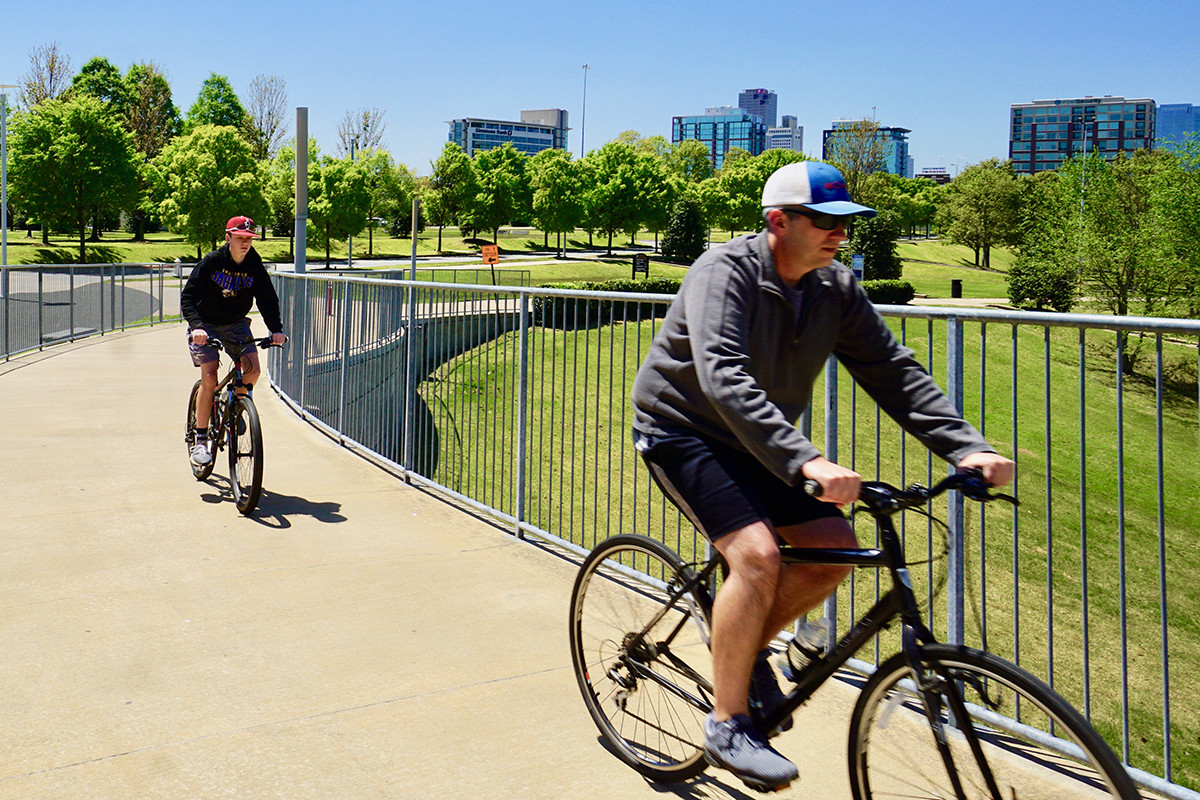
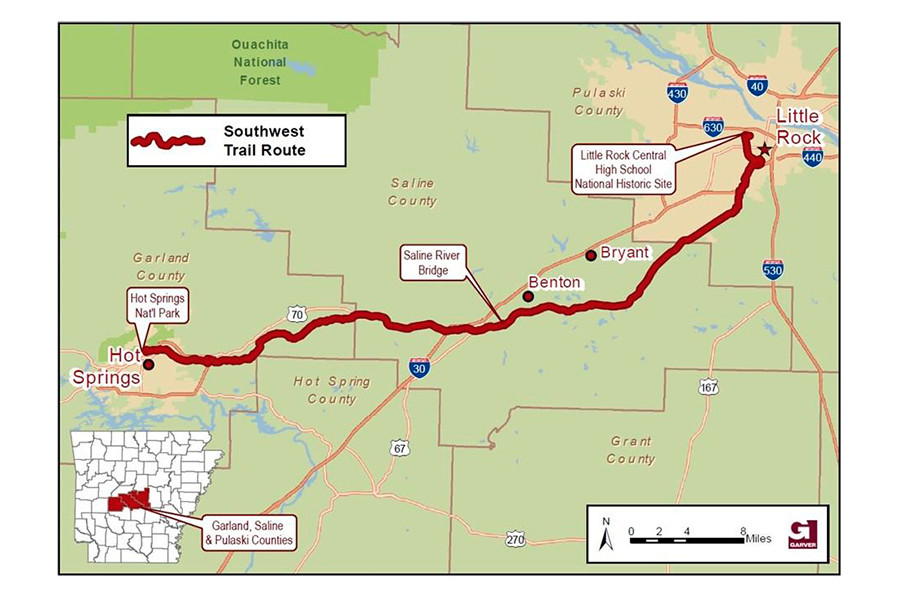
Instead, the rail-to-trail project will be a “recreational trail for bicyclists, joggers and walkers,” he said. The Southwest Trail will connect the 15-mile Arkansas River Trail loop in Pulaski County to Hot Springs National Park.
It’s also foreseen as a central Arkansas piece of a bicycle tourism boom already altering northwest Arkansas (see Cycling Gears Up After Two Decades of Investment in Northwest Arkansas) and stretching along the Delta Heritage Trail on the Mississippi near Helena.
“The Southwest Trail is going to be about 60 miles in length, paved with concrete or asphalt and 10-14 feet wide,” said Smith, who is overseeing the project for Garver of North Little Rock. His firm has been retained by Pulaski, Saline and Garland counties to create a trail linking with Hot Springs’ Northwoods Trails and the 1,700-mile Arkansas High Country Route, a favorite of the Adventure Cycling Association of Missoula, Montana.
Garver, which did trail and bridge work for the Razorback Greenway in the northwest of the state, has plotted a course from the Clinton Presidential Center and downtown River Market in Little Rock to the Little Rock Central High National Historic Site, over a rebuilt and repurposed Saline River Bridge in Benton, and on to the front door of the national park in downtown Hot Springs.
Traci Berry, Visit Hot Springs’ coordinator for the 27-mile Northwoods Trails, said bike riders have become so prominent in town that tourists and locals were noticing before COVID-19 disrupted most travel. “Residents had already been talking about how many bikes were on cars, roads and trails, then visitors started commenting on it.”
She expects bicycle tourists to aid the pandemic recovery for Hot Springs, the state’s top tourism attraction with Oaklawn, recreational lakes, the Ouachita Mountains and the national park, which typically draws about 1.5 million visitors a year. “I can see restaurants, bed and breakfasts and shops getting business from riders coming down the trail,” she told Arkansas Business in a telephone interview.
The projected $44 million trail construction, whose planning and initial work were funded by grants, is expected to be completed in two or three years if the counties can nail down the money.
Pulaski County Judge Barry Hyde, who said he regretted being too busy to be interviewed for this article, discussed the Southwest Trail in his state of the county address, calling it a “widely anticipated” job-builder.
Originally proposed in 2013, the trail “will further enhance the county’s recreational offerings for pedestrians and bicycle commuters, while creating hundreds of new jobs and injecting money into our local economy,” Hyde said in the address. “Out of the design phase and moving towards construction, the Pulaski County section of the trail is planned to be completed by the end of 2022.”
Points of Interest
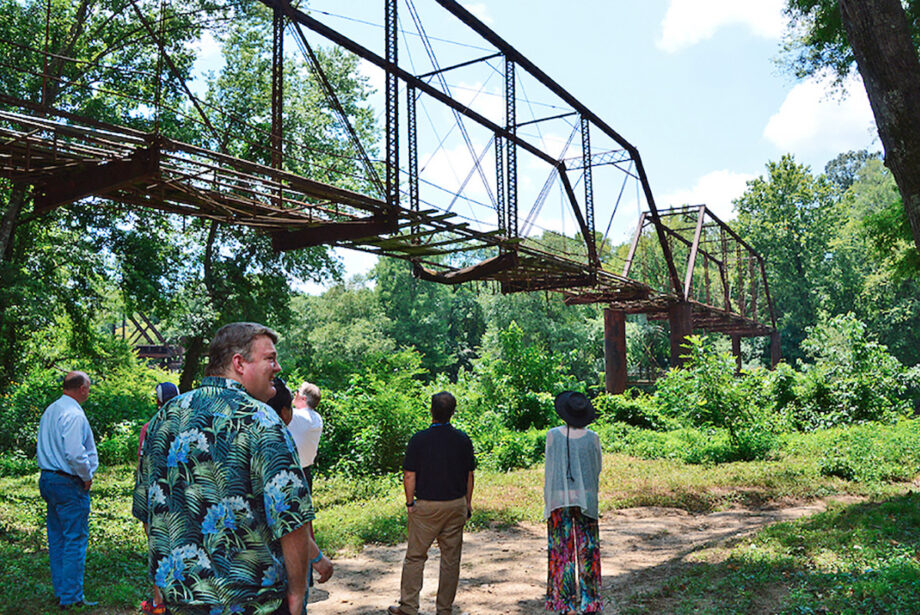
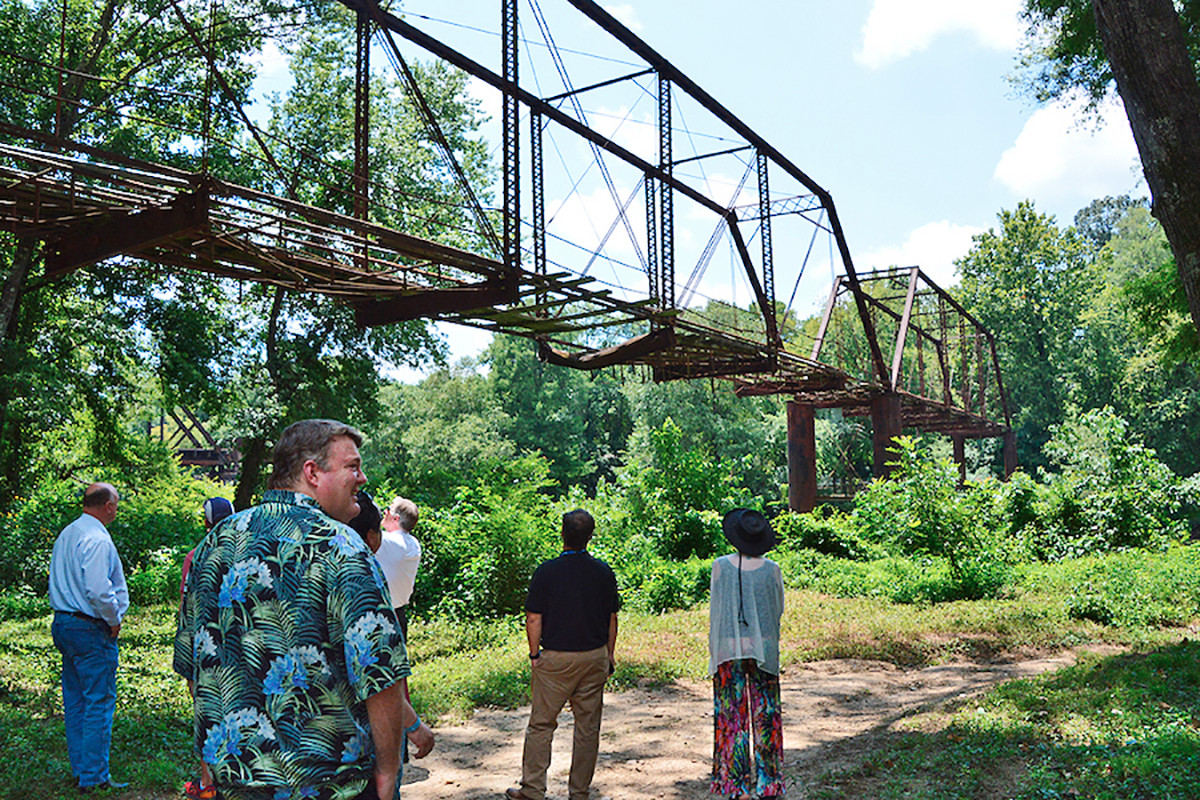
Alta Planning + Design of Oakland, California, which also worked on the Razorback Greenway, helped the Southwest Trail along with a 2015 economic impact study. It noted that the Clinton Presidential Library is Little Rock’s biggest tourism draw, identifying it and the River Market as key knots in a string of trail sites including Union Station, the state Capitol Mall, Central High, the State Fairgrounds and Fourche Bottoms en route to Saline County. There, the path will require rebuilding the Saline River bridge as a pedestrian and recreation span.
“That bridge, one of the oldest in the state, will be completely rehabilitated,” Smith said, noting that the counties had secured an $880,000 U.S. Transportation Department grant for that segment and for rebuilding several Rock Island Railroad bridges heading into Saline County. In other areas, the trail will follow existing roadway rights of way.
An accomplished trail rider could easily pedal from Little Rock to Hot Springs in an afternoon, but Smith thinks more users will walk or bike it for a few miles, or travel to destinations nearby and back again.
“We don’t want to restrict it, because the idea is for the trail to be open to as many people as possible,” including riders, hikers, casual walkers and even commuters using urban sections, Smith said. “We want moms with strollers; we want to be open to everyone.”
He said the project got a big push when the three counties “combined resources and applied for a FLAP grant.” That refers to Federal Land Access Program money, which is earmarked for access routes to federal lands, including roads, bridges and paved trails. “That grant got us the first $2.7 million for the project, and other grants have brought us up past $4.4 million,” Smith said.
Saline County won a FLAP grant to remake the Saline bridge, and this year Pulaski County was granted enough funds to build the first three bridge structures for the trail nearer to Little Rock.
“So, looking at where we are today,” Smith said, “2018 was a conceptual year and 2019 was a lot of environmental documentation, but in 2020 we hope to have actual pieces of the trail constructed. And by 2021 we should have the whole thing designed. Then comes the question of when we can obtain construction money. It might take more time than we would have wished.”
COVID Complications?
Smith said that, so far, COVID-19 has had minimal effect on the project. “Garver is the designer of record for the trail, and we’re moving forward with completing environmental documentation and moving into design. The funds for those efforts were already in place, so COVID is not slowing that process whatsoever.
“I’d also throw out there that trails are a hot attraction now in America,” Smith continued. “They are economic generators, and where they go in property values tend to rise.”
Pulaski County owns a 4.2-mile stretch from Hilaro Springs Road to the Saline County line.
While the trail may help the tourism industry recover once the pandemic ends, Garland County Judge Darryl Mahoney said now is not the time to spend much thought on a trail.
“We are in the middle of a pandemic crisis, so the Southwest Trail is not, nor should it be, at the top of anyone’s list,” Mahoney said in an email to Arkansas Business.
Saline County Judge Jeff Arey did not respond to a request for comment.
“Garver Engineering has applied for a Rural Build Grant, or will be in the near future,” Mahoney said. “Our plans for public involvement meetings this spring have gone astray while trying to follow guidelines from the CDC and Department of Health. We need to regroup at some point and get back on track with public meetings and have input from several areas of our county.”
The prime concern, Mahoney said, is “the health and safety of our some 100,000 residents.”
 Sign up for Daily E-news