A man can find room in his heart for a second love.
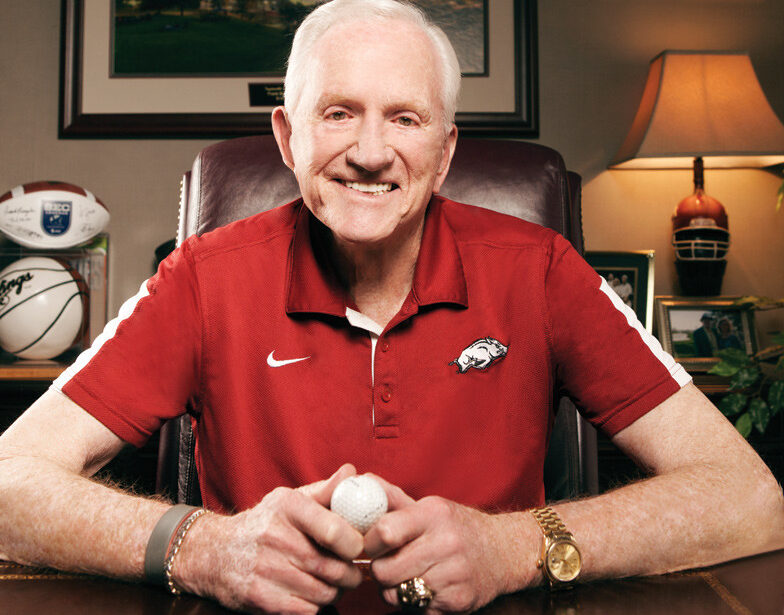
Frank Broyles, 89, made his name in college football, specifically Arkansas Razorbacks college football. Broyles and the game are so synonymous he has a major trophy — the Broyles Award for the top college assistant in the nation — and the field and athletic center at Fayetteville’s Reynolds Razorback Stadium named after him.
He is also in the halls of fame of several different bowl games, as well as the Arkansas Sports Hall of Fame, and at the turn of the century the statewide daily newspaper named Broyles its most influential figure in athletics in the 20th Century.
Broyles clearly still loves his Razorbacks. In fact, the legendary coach and former athletic director still keeps an office in the Razorback Foundation building that sits outside the left-field corner of Baum Stadium, the Hogs’ eye-pleasing baseball home.
But in the course of his football career (which outlasted early loves like baseball and basketball), Broyles also fell into a great passion for golf.
Taking up the game as an adult, Broyles found in golf a pastime, a hobby and a sanctuary. He has made and enriched long-standing friendships through golf, and found the game opening doors and providing experiences he might not have had otherwise.
In 1967 Broyles joined one of the most exclusive of golf fraternities, becoming a member at Augusta National, home of the Masters, in his native Georgia.
Broyles has since served on the Masters committee but is guarded in what he says about his membership and his service to the exclusive club, which opened its doors to black members under PGA pressure in 1990 and to women in 2012.
Broyles declined to handicap this year’s Masters, saying that the challenges of the course and the talent in the field make that impossible, though “the sportswriters always try to,” he said.
Nonetheless, Augusta is Broyles’ favorite course, bar none, and while he has nine career holes in one he says he can only recall the two he hit at Augusta, on No. 16 and No. 6.
His job and his high profile have given Broyles access to golfing experiences not always available to others, and he is appreciative of those opportunities.
On a sunny late-winter day, a day perfect for golf in fact and an oasis in what had been a brutal winter for most of the nation, Broyles took time to visit with Executive Golfer to discuss his love of the game and his gratitude for the adventures and life lessons it has provided.
“I love golf because it is a game that is always changing and can never be perfected. I have played golf for more than 55 years and there is always something that I can learn or change about my game. It is a sport that demands physical endurance and mental toughness, yet can provide relaxation away from the pressures of work and a great way to build relationships with friends.”
John Franklin Broyles was born Dec. 26. 1924, in Decatur, Ga. Golf was already a popular sport in America but Broyles was more caught up in baseball — still the national pastime — football and basketball.
In 1934 the first Augusta National Invitation Tournament was held on the relatively new course that golf legend and Atlanta native Bobby Jones co-founded with Clifford Roberts close to 150 miles west of Broyles’ birthplace. Jones played 12 times in his own tournament — soon to become known as The Masters — and was a witness in 1935 when rival Gene Sarazen made his “shot heard ’round the world.”
Sarazen scored a double eagle that made up a three-stroke deficit and helped him force the 36-hole playoff in which he won the tournament.
Sarazen’s feat put Augusta and the Masters on the map, and young men like Broyles couldn’t help but notice, even if they might have been enchanted by other sports at the time.
“Certainly growing up in Georgia, you were aware of the tremendous golf tradition in the state. All of the legends of golf came to Augusta to play the Masters and so naturally Georgia played a big role in the world of golf. But at that time, I was focused on other things like football, basketball and baseball. Later on I became interested in golf. “
Broyles played all three of his favorite sports at Georgia Tech, though a bad shoulder would eventually curtail his baseball efforts. As Tech’s quarterback he wrapped his playing career around a stint in the Navy at the end of WWII.
A photo collage on his office wall has as its centerpiece a wedding picture of Broyles in his ensign’s uniform with his bride, first wife Barbara, whom he married May 6, 1945. It was the day before the German surrender in Europe and close to four months before the Japanese surrender in the Pacific.
Broyles likes to joke that when the two countries learned he’d gotten into the war, they gave up.
Before and after the war, Broyles helped Tech to three bowl appearances.
On Jan. 1, 1945, he set an Orange Bowl record, finally broken by Michigan’s Tom Brady in 2000, with 304 passing yards. Broyles was named Southeast Conference player of the year before graduating in 1947 and entering the coaching ranks.
Broyles assisted at Baylor, Texas and Georgia Tech before taking his first head-coaching job, a one-year stint at Missouri. In 1958 he began his 19-year run as Arkansas’ head coach. It would became the job that made Broyles a household name in college football, and, coincidentally, the job that truly awakened his second love — golf.
“When I came to Arkansas, I found that the coach was expected to be an outdoorsman and since I didn’t hunt or fish, I gravitated to golf. Many of our Razorback Club events around the state involved golf and I learned to play so that I could be competitive and become friends with the many Razorback fans who loved golf as well as their Razorbacks.”
Broyles coached the Razorbacks to 144 victories, still a school coaching record, and 10 bowl games, compiling a 4-6 postseason record and maintaining a steady presence in the national rankings as the state united behind the program.
While his beloved Augusta National was slow to admit minority members, Broyles was the first football coach to play black athletes at both Missouri and Arkansas.
He became athletic director in 1973 and after stepping down as coach in 1976 he hired successors like Lou Holtz and Ken Hatfield.
Though Broyles was known to spar with his coaches, the program continued to prosper — the athletic budget grew from $900,000 to $44 million at the time of his retirement in 2007 — and as attention, revenues and new athletic construction blossomed, so did Broyles’ passion for golf. Whether observing the pros he saw on TV, or in person, or working with noted swing doctor Mike Dunaway, Broyles was ravenous to improve, and still is, though his favorite golf tip is still the one he heard a long time ago: “Don’t look up.”
“I think if you are serious about your golf game you are always looking for instruction or tips from those who can provide you with some insight and instruction. Early in my career I looked to some of the greats of the time like Ben Hogan, Arnold Palmer and Jack Nicklaus. But you also look to those club pros that may see something in your swing that they can help you with. Over the years, Mike Dunaway has also been someone that I enjoyed talking about the golf swing with as well. Mike and I have visited a great golf teacher in California named Mike Austin who was active teaching golf until his death at age 95.
“Honestly, I think the best golf teacher I have had is the game itself. It rewards consistency and patience. The successful golfers aren’t always the fastest or the strongest, but the ones that balance all of the elements. Golf is always teaching me something.”
His high profile position — Broyles shared the broadcast booth with fellow Georgian Keith Jackson on ABC from the 1970s to 1985 — allowed Broyles to meet some of golf’s greats and play a round with one of the greatest.
“At a Quarterback Club meeting in Fort Worth back in the 60s, I had the great experience of being paired with Ben Hogan in a celebrity pro-am. … I don’t ever remember going out to play golf with a celebrity other than that one opportunity in Fort Worth with Ben Hogan. I’ve had dinner with many, but not a round of golf.”
Many amateur golfers talk about the game as an escape, yet at the same time the golf course is notorious for being a place where business deals are made.
Broyles insists he never hired or fired a coach, scheduled a football game or made many major decisions affecting the Razorbacks while on the golf course. But he believes the time spent was therapeutic to the point that it helped him to better serve his Razorback constituency.
“I think not only playing golf, but being around other people and enjoying their company helped make golf a good respite.
“I can’t recall any specific decision that was made on the golf course, but sometimes getting away for a few hours can give you clarity of thought when you are facing a difficult decision. But to be honest, most of the time I was worried about the distance to the pin or how I needed to hit the next shot. Golf is a great way to slow down and allow your mind to focus on something else for a while.”
Golf seems to frequently be the fund raiser/charity event of choice for coaches with causes they support as well as alumni groups and athletic foundations. With all those coaches and athletes hitting the links, Broyles has had plenty of chances to gauge the abilities of men like himself who made their living in one sport while playing another for recreation. But he says he never wanted a coach he could also play a round of golf with; in fact, just the opposite.
“Well I have always said I didn’t want a coach that was a good golfer, because that means they are spending too much time on their game instead of being out there coaching and recruiting. The best golfer in my profession was Darrell Royal [Texas], with whom I got to play often when we were no longer coaching and were both athletic directors. “
Broyles and Royal squared off as coaches in “The Big Shootout” of 1969, when No. 1 Texas edged No. 2 Arkansas in Fayetteville, a game ranked as one of the greatest in college football.
Yet, while Broyles could never watch a replay of the heartbreaking loss, the two coaches forged a strong friendship.
Broyles fondly recalls trips he and Barbara took with Royal and his wife Edith during which the women would pursue their own adventures while the men golfed.
Broyles lost Barbara to complications from Alzheimer’s disease in 2004 and remarried Gen Whitehead in 2005. Through a book — “Coach Broyles’ Playbook for Alzheimer’s Caregivers,” personal appearances and foundation work Broyles has been a strong advocate for Alzheimer’s since Barbara’s death.
In 2012 he learned of Royal’s own Alzheimer’s diagnosis and Royal, his old friend, died later that year, making the golf memories that much more poignant.
“I would have to say the most rewarding thing about golf has been the time I have spent with many wonderful people from all walks of life.
“The golf course has a way of bringing people together. I think back to all the rounds of golf I played with my dear friend Darrell Royal. Darrell and I with our wives would vacation together to Palm Springs (and one memorable trip in Mexico) and we would play golf and our wives would shop. We were never scratch golfers, but they were scratch shoppers.
“But it was just a wonderful time and I have so many fond memories of those trips.”
Broyles announced his retirement during the never-ending turmoil of 2007, when fans seemed as interested in the emails and text messages of boosters and coaches as they were the playing time, or lack of it, for certain football players under then-coach Houston Nutt.
Broyles and those around him insisted the freedom of information requests, legal actions and the general mania surrounding the program did not force Broyles to step down against his will, that he left on his own terms.
But while stepping down he didn’t step away. Broyles holds the title of athletic director emeritus with the Razorback Foundation. He keeps his office hours and more than ever he still enjoys golf.
When he plays these days Broyles likes to venture onto The Blessings, the Razorbacks’ home course that Tyson Foods Inc. Chairman John Tyson had constructed in Fayetteville. He also likes to play on the local courses operated by real estate developer and former Razorback Jim Lindsey.
“I don’t play on a regular basis, but always enjoy getting together with friends for a weekend or for a few rounds over a couple of days. To be honest, when I have the opportunity here at home, I enjoy going to the golf range to work on my game. … Generally when I play now it is with a group of friends or business colleagues at a course of their choosing.”
Broyles won’t lay claim to a favorite course in Arkansas, saying his favorite is always the last one he played, but he acknowledges the impact of plush courses like Alotian, which financier Warren Stephens built in Roland near Little Rock, and the Blessings and their impact on the state golf scene.
As an athletic director Broyles has had a chance to see up close the growth and improvement of not only the Razorbacks men’s and women’s programs, but of college golf in general. He says his favorite players to root for these days are the ones with Arkansas ties, and as he spoke both the Razorbacks and Lady Razorbacks were nationally ranked.
“Razorback Golf has grown and looks nothing like it did back many years ago. That is a credit to the outstanding coaches we have had in Steve Loy, Bill Woodley and now Brad McMakin. I’m proud that when you look on the PGA Tour you see players that came to the University of Arkansas and are having success. I am also pleased that with the Mary B. and Fred W. Smith Golf Center at Blessings, the Razorback men’s and women’s teams have outstanding practice facilities and a fantastic home course.”
When it comes to his own game Broyles, even at 89, is also still looking ahead, still looking to improve. He is a pretty fair hitter off the tees, but says games are won with the irons and wedges and putters.
Still, a resounding tee shot is just as satisfying now as it was when Broyles took up the game 55 years ago, when he was trying to burnish his credentials as a newly-minted Arkansan.
“I‘ve always been able to hit fairly well off the tee box, but I have learned that the shots that follow are truly the important ones to a good score. In the pros, the longest hitters aren’t always the ones with the best scores, but it sure feels good when you hit one out there a long way.”
 Sign up for Daily E-news