An adjunct professor teaching a three-hour course on Arkansas Tech University’s Ozark campus will be paid just $1,200 for a semester.
And other two-year and four-year public colleges and universities in Arkansas don’t pay adjunct professors much more.
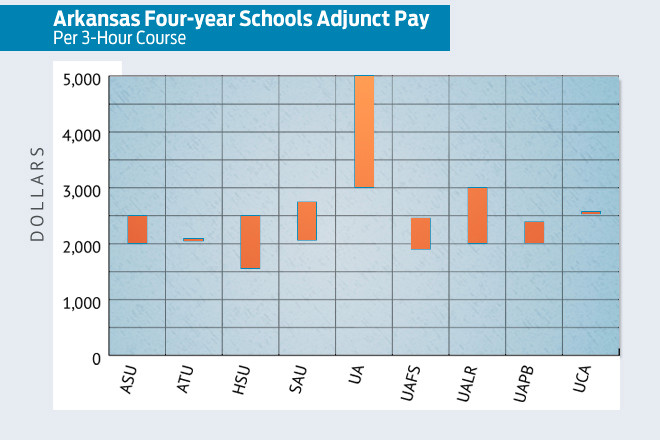
Arkansas Business surveyed more than a dozen public colleges and universities across the state and found two-year schools typically pay adjuncts between $1,200 and $2,000 per three-hour course taught, while four-year schools generally pay between $2,000 and $2,500.
While the issue of reliance on low-paid adjuncts to deliver increasingly expensive college-level instruction has made national news, the Arkansas Department of Higher Education doesn’t keep statistics on how many adjuncts each school employs or how much they are paid. The University of Arkansas System doesn’t even keep such statistics for its member schools.
The Arkansas State University System, however, does track adjuncts and had data available for its four community colleges and its flagship university at Jonesboro.
In recent months, adjuncts at several colleges across the country have lobbied to join unions; some even held a “hunger strike” to draw attention to their low pay. A study released in April found that 25 percent of such part-time lecturers nationally receive some form of government assistance, according to the University of California Center for Labor Research & Education.
“From a university’s perspective, adjuncts are cheap labor,” said Benjamin Ginsberg, a political science professor at Johns Hopkins University in Baltimore and author of “The Fall of the Faculty.”
Adjuncts, who almost always hold graduate degrees, are usually paid around $2,500 a course and don’t have benefits, he said. Many of the adjuncts would like to be full time or be on a tenure track, but those positions aren’t available. As a result, the adjuncts don’t have job security and might not be rehired at the end of the semester.
In Arkansas, some colleges agree that the pay for adjuncts is low.
“I would really like them to be higher,” Christina Drale, associate vice chancellor for academic affairs at the University of Arkansas at Little Rock, told Arkansas Business last week. UALR pays its adjunct faculty $2,000-$3,000 per course.
She said UALR, and other schools, fear that if they raise the rates for the adjuncts then tuition would rise.
But tuition has been rising anyway. In May 2014, the University of Arkansas System approved tuition and fee increases on its campuses for the 2014-15 school year that ranged from 3.5 percent at the Pine Bluff campus to 6 percent at Fort Smith.
“It’s all part of that budget formula,” Drale said. “Here at UALR we’ve had budget cuts. We’ve not only been unable to raise the rates for lecturers and graduate students, but we’ve … had to reduce the number that we are funding.”
At UALR, an Arkansas resident would pay $837 in tuition and fees for a three-hour course. A class of 20 students would generate $16,740 in revenue. If the class is taught by an adjunct, no more than $3,000 of that revenue would be spent on instruction.
Full-time college instructors generally teach a minimum of four classes per semester, and their pay can range widely depending on subject, education and experience. Adjuncts can teach the equivalent for between $5,000 and $12,000 per semester, without the cost of benefits.
Ginsberg, who wasn’t talking specifically about Arkansas schools, said universities have slashed instructional costs by hiring adjunct facility members while administrative costs have skyrocketed.
“The tuition rises, but [the schools] don’t put their money into teaching,” he said. “They put lip service into teaching and money into administration.”
In 2014, Arkansas Business reviewed the Administrator’s Compensation Survey reports filed with the state Department of Higher Education for the 2010 and 2014 fiscal years.
Arkansas Business’ study of the data found administrators at Arkansas universities during that period typically saw an increase in compensation of between 10 and 20 percent, which included the increased cost of benefits like health insurance.
What’s more, the ranks of the highly paid increased dramatically. During the same four-year period, the number of employees earning $100,000 or more grew from 460 to 703, and 26 positions were created with titles containing the words “chancellor” or “president” (not including positions at the University of Arkansas for Medical Sciences).
“So universities and colleges are cheating the students in order to enrich administrators,” Ginsberg said, speaking generally. “That’s what it comes down to.”
Union Efforts
UALR’s Drale said she didn’t know of any efforts for the adjuncts in Arkansas to form a union. But across the country, adjuncts are pushing for unionization.
In July, adjuncts at Whittier College in California ratified their first union contract and saw their pay rise from $3,450 per three-hour course to $3,900 in the fall of 2015; and it will be $4,350 next fall, according to the Southern California Public Service Workers’ website.
The instructional cost for eight three-hour courses — a minimal load for a full-time instructor — would still be less than $35,000 a year.
In September, the adjuncts at Emerson College’s campus in Los Angeles urged its college president to allow them to join an existing union of part-time faculty at Emerson College in Boston.
A decision hadn’t been made as of last week, said Jennifer Vandever, an organizer of the union who has been teaching writing and film studies at the Los Angeles campus for 14 years.
She said that adjuncts at the Boston campus have a set schedule for raises and are eligible for benefits including health insurance.
“Here in Los Angeles, we’re not eligible for benefits at all,” Vandever said. “A lot of adjuncts kind of cobble together employment at a number of different institutions, which is part of what makes this job so challenging. You’re never at one particular place.”
In September, a hunger strike was set for St. Louis University to bring attention to the low pay of adjunct professors, according to a Sept. 9 article in the St. Louis Post-Dispatch.
Michael Lewis, an associate provost for the university, didn’t return a call from Arkansas Business.
Ginsberg, of Johns Hopkins, said it was difficult for adjuncts to form unions because they might not be at the same school year after year.
“They are sometimes, foolishly in my view, leery of unionization,” he said. “But … the only way they can protect themselves is to unionize.”
Benefits of Using Adjuncts
Drale, of UALR, said there are several reasons for using adjuncts. They can help teach mandatory courses that full-time faculty members don’t have time to teach, such as a freshman composition course. “It’s very difficult to service those courses with a permanent workforce,” Drale said.
She also said that adjuncts are often flexible and can fill in when there are quick changes in scheduling.
In a statement to Arkansas Business last week, ASU System President Chuck Welch agreed. “Using adjunct faculty enables our campuses to be flexible and responsive based on student demand for various classes,” he said.
Efforts to Raise Pay
The University of Central Arkansas’ faculty senate is expected to recommend that adjunct pay be increased for the fall of 2016, said Ben Rowley, who is the faculty senate president and an associate professor of biology.
He said that last year it recommended that UCA raise the adjuncts’ pay, but the money wasn’t available so pay wasn’t increased.
“These days everyone has very limited resources at the university level,” Rowley said.
But he said that the adjunct pay at UCA is starting to fall behind the averages for adjunct pay in Arkansas.
According to the figures provided to Arkansas Business, UCA pays its adjuncts $2,600 per three-hour course. That’s more than Arkansas State University at Jonesboro pays, which is in the range of $2,000 to $2,500, and less than the UA at Fayetteville.
UA said it paid its part-time adjuncts, whom it calls lecturers, between $3,000 and $5,000 per course.
“Contrary to the stereotype of ‘adjunct’, many of these lecturers are professionals in the community who we recruit to teach courses in their areas of expertise,” UA spokesman Steve Voorhies said in an email to Arkansas Business.
Welch, in his statement, said the ASU System “has focused on making full-time faculty salaries competitive to Southern Regional Education Board averages, and we have made great strides.”
He said ASU values its adjunct faculty members and their pay at ASU “is within state and regional averages.”
The rock-bottom pay for adjuncts at Arkansas Tech University’s Ozark campus, which is $1,200 per three-hour course, is designed to keep the cost of tuition down, Chancellor Bruce Sikes said.
“We are extremely grateful for the opportunities our adjunct faculty provide our students,” Sikes said.
He said they are professionals who typically have full-time jobs but offer the students “real-world experience. … Our students get great benefit from them.”
Steve Adkison, the provost and vice president for academic affairs at Henderson State University in Arkadelphia, said the school is looking at raising the pay for adjuncts and faculty and is in the middle of developing a four-year faculty and staff compensation plan.
Adkison, who started at the school in July 2014, said he doesn’t want HSU to add more adjunct professors and that he’d like to keep the number of adjuncts as low as possible.
“It’s the quality of instruction and the quality of the faculty is what sets us apart from other public schools,” he said. “If we don’t invest in our faculty, then we can’t maintain our institutional core values. And investing in our faculty doesn’t mean hiring more part-timers to teach more classes.”
Four-year Schools
| Instructor Count Fall 2013 | Instructor Count Fall 2015 | Percent Change, 2013-2015 | Adjunct Pay Per 3-Hour Course | |
| Arkansas State University Jonesboro |
||||
| Adjunct Faculty | 187 | 207 | 10.70% | $2,000-$2,500 |
| Full-Time Faculty | 502 | 494 | -1.59% | |
| Arkansas Tech University Russellville |
||||
| Adjunct Faculty | 141 | 145 | 2.84% | $2,100 |
| Full-Time Faculty | 279 | 293 | 5.02% | |
| Henderson State University Arkadelphia |
||||
| Adjunct Faculty | 69 | 68 | -1.45% | $1,600-$2,500 |
| Full-Time Faculty | 179 | 180 | 0.56% | |
| Southern Arkansas University Magnolia |
||||
| Adjunct Faculty | 81 | 87 | 7.41% | $2,100-$2,700* |
| Full-Time Faculty | 183 | 200 | 9.29% | |
| University of Arkansas Fayetteville |
||||
| Adjunct Faculty | 160 | 169 | 5.63% | $3,000-$5,000 |
| Full-Time Faculty | 1,083 | 1,137 | 4.99% | |
| University of Arkansas at Fort Smith | ||||
| Adjunct Faculty | 218 | 162 | -25.69% | $1,950-$2,400 |
| Full-Time Faculty | 263 | 257 | -2.28% | |
| University of Arkansas at Little Rock | ||||
| Adjunct Faculty | 302 | 244 | -19.21% | $2,000-$3,000 |
| Full-Time Faculty | 471 | 434 | -7.86% | |
| University of Arkansas at Pine Bluff | ||||
| Adjunct Faculty | 37 | 38 | 2.70% | $2,060-$2,345** |
| Full-Time Faculty | 159 | 162 | 1.89% | |
| University of Central Arkansas Conway |
||||
| Adjunct Faculty | 190 | 190# | 0.00% | $2,600 |
| Full-Time Faculty | 533 | 537# | 0.75% |
Two-year Schools
| Instructor Count Fall 2013 | Instructor Count Fall 2015 | Percent Change, 2013-2015 | Adjunct Pay Per 3-Hour Course | |
| Arkansas State University-Beebe | ||||
| Adjunct Faculty | 144 | 109 | -24.31% | $1,650 |
| Full-Time Faculty | 112 | 104 | -7.14% | |
| Arkansas State University-Mountain Home | ||||
| Adjunct Faculty | 37 | 43 | 16.22% | $1,350 |
| Full-Time Faculty | 48 | 43 | -10.42% | |
| Arkansas State University-Newport | ||||
| Adjunct Faculty | 58 | 83 | 43.10% | $1,650 |
| Full-Time Faculty | 61 | 68 | 11.48% | |
| Arkansas State University-Mid-South West Memphis |
||||
| Adjunct Faculty | 89 | 89 | 0.00% | $1,650 |
| Full-Time Faculty | 44 | 44 | 0.00% | |
| Arkansas Tech University Ozark campus |
||||
| Adjunct Faculty | 44 | 40 | -9.09% | $1,200 |
| Full-Time Faculty | 52 | 57 | 9.62% | |
| Pulaski Technical College North Little Rock |
||||
| Adjunct Faculty | 327 | 212 | -35.17% | $2,025## |
| Full-Time Faculty | 165 | 144 | -12.73% | |
| University of Arkansas Community College at Morrilton | ||||
| Adjunct Faculty | 40 | 17 | -57.50% | $1,875 |
| Full-Time Faculty | 69 | 58 | -15.94% | |
| University of Arkansas Community College at Hope Texarkana campus |
||||
| Adjunct Faculty | 48 | 46 | -4.17% | $2,647 |
| Full-Time Faculty | 40 | 41 | 2.50% |
*$2,100 for adjuncts with master’s degrees teaching undergraduates; $2,400 for adjuncts with terminal degrees teaching undergraduates; $2,700 for teaching graduate courses
**$2,060 for adjuncts with master’s degrees; $2,345 for adjuncts with doctorates
#Fall 2014
##For general education classes; pay varies widely based on subject matter
Sources: the institutions. Researched by Mark Friedman
 Sign up for Daily E-news