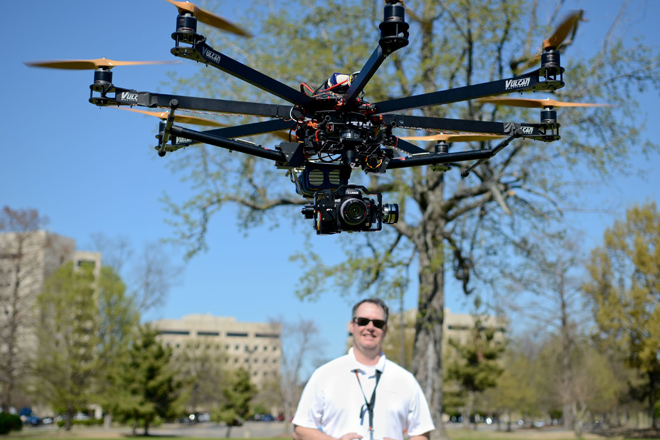
Tim Trieschmann started out using remote airplanes to take still photos. But rotor technology has advanced far enough that it affords superior stability for shooting aerial video, allowing him to find work with film studios and TV stations.
A cooperative agreement announced last week between the Federal Aviation Administration and CNN for the company to use unmanned aircraft for news gathering has some operators hopeful for the future.
Whether the agreement signals a loosening of airspace restrictions remains to be seen.
The announcement last Monday came as a surprise to many who have tracked proposed regulations that will outline how drones will share the skies with traditional commercial aircraft.
Those regulations, which have been rumored to include requiring a pilot’s license to operate an unmanned aerial vehicle for commercial purposes, are expected out by the end of the year.
Under the current rules, hobbyists are allowed to fly their aircraft with some limitations, but commercial uses are prohibited, aside from a handful of exemptions. At the same time, the FAA rarely enforces that ban.
The agreement with CNN allows the news company to “get beyond hobby-grade equipment” and find what can be done to produce higher quality images for news, a CNN executive said in a company news release.
The FAA will then use data under the agreement to “formulate a framework for various types of UAVs to be safely integrated into newsgathering operations,” the company said.
“Unmanned aircraft offer news organizations significant opportunities,” FAA Administrator Michael Huerta said in the release. “We hope this agreement with CNN and the work we are doing with other news organizations and associations will help safely integrate unmanned newsgathering technology and operating procedures into the National Airspace System.”
Brian Emfinger, a photojournalist for KATV-TV in Little Rock, who for more than a year has used an unmanned aircraft largely to cover weather-related events, said that when media companies have an option between drone and ground footage, they take the aerial images every time. He said he thought the announcement would open the door to other media companies.
“We knew that several media companies and conglomerates had been lobbying for this type of action, but there wasn’t any sort of hint that it was going anywhere,” he said.
Emfinger said that while the announcement was promising, strict regulations could still hamper an industry that’s ready to take off. “The demand is unbelievable considering [that] I’ve never publicly said, ‘Hey, I will fly my drone and get video for you,’” Emfinger said.
According to the Association for Unmanned Vehicle Systems International, the industry’s trade group, 70,000 jobs would be created within the first three years of integrating the use of unmanned aircraft. The association also estimates an economic impact of $13.6 billion in that period, growing to $82 billion by 2025.
Hobbyists and those already breaking into the fledgling industry point to the nearly endless potential uses for the aircraft — including crop and pipeline monitoring, real estate photography and emergency management — as a reason for looser regulations.
Tim Trieschmann, the owner of The Shot Above, which has offices in Little Rock and California, said he saw the potential in the field when he started his business in 2010. He said hundreds of models are now available right off the shelf.
Trieschmann said the new agreement is a step closer to news reporters keeping a drone in their car, and that the most important guideline should be preventing contact with commercial aircraft.
“I think reasonable regulations around that are what’s needed. And allowing CNN news reporters and other news reporters [to fly with certain limitations on altitude], … I think all that’s very positive news, and it should apply to other sectors as well that can follow those same rules,” Trieschmann said.
Les Dorr, a spokesman for the FAA in Washington, said in an email that there is no date set for publishing the proposed regulations.
“We are continuing to work with our administration colleagues to finish the proposed rule for small unmanned aircraft … [and] our goal is to get the proposal right,” Dorr said.
 Sign up for Daily E-news