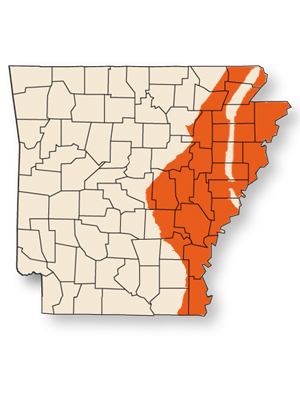
The area of Arkansas eligible to take part in the USDA's Climate Change EQIP Project.
Arkansas farmers and landowners in 27 eligible counties have until June 10 to apply for $2.5 million now available through the USDA’s Environmental Quality Incentives Program (EQIP) aimed at curtailing climate change.
This project encompasses much of the eastern third of the state, including all or part of Randolph, Clay, Lawrence, Greene, Independence, Jackson, Craighead, Mississippi, Poinsett, White, Woodruff, Cross, Crittenden, St. Francis, Pulaski, Lonoke, Prairie, Monroe, Lee, Jefferson, Arkansas, Phillips, Lincoln, Desha, Drew, Ashley and Chicot counties.
Reginald Jackson, public affairs specialist for the Arkansas State Office of the USDA National Resources Conservation Service (NRCS), said the funding was unexpected and news of it had been well received.
Highest priority will be given to applicants seeking to improve soil health, nitrogen stewardship and irrigation water management, according to a news release.
Applications are available at any local NRCS office.
Highest priority will be given to applicants who plan to address all three objectives, with those addressing two objectives ranked in the middle but higher than those addressing one.
Under the soil health objective is promotion of reduced tillage, reduced compaction, cover crops and perennial vegetation where appropriate, according to the release.
Reduction of nitrous oxide emissions through nitrogen fertilizer management based on the four Rs — the concept of farmers using the right fertilizer source, the right rate of nitrogen, planting at the right time and planting in the right place, according to state NRCS agronomist John Lee — is also something EQIP can help fund.
Lee said the four Rs that are best practices the USDA recognized and they help farmer halt nutrient loss.
He also said the NRCS office is helping farmers adjust to the reality of climate change and programs like EQIP encourage them to do their part in slowing it.
On irrigation management, rice is a concern.
The news release states that the paddies are typically continuously flooded to kill weeds and irrigate the crop, but the EQIP program could help farmers utilize alternative wetting and drying or intermittent flooding instead.
Flooding produces anaerobic conditions that cause methane gas to form, according to the release. The alternative allows a portion of the field to dry to a muddy condition in which the top few inches of soil become aerobic so that methane gas isn’t formed.
Lee agreed that water conversation is especially important in Arkansas because farmers here are using aquifers and, once that resource is gone, it cannot be replenished.
In related news, Agriculture Secretary Tom Vilsack recently announced a targeted allocation of $72.3 million for conservation practices.
It’s part of the USDA’s Building Blocks for Climate Smart Agriculture and Forestry plan, which estimates that both sectors can reduce up to 18 million metric tons of greenhouse gas emissions by 2025, according to a news release.
The release also states that, in fiscal year 2016, the NRCS will invest approximately $300 million through EQIP for practices that have climate change benefits.
 Sign up for Daily E-news