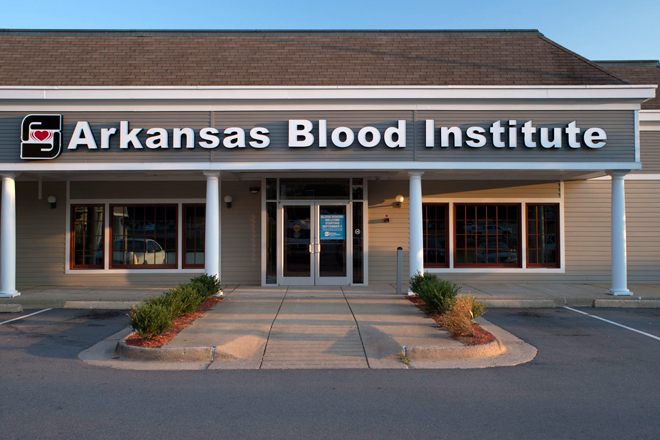
The Arkansas Blood Institute opened its donation station at 101 S. Shackleford Road in Little Rock.
The Arkansas Blood Institute has started a battle over blood in Arkansas.
In June, ABI opened its first blood donation station in Little Rock at 101 S. Shackleford Road.
“With our products and services, we anticipate a lot more growth in the coming months,” said Paulette Nieuwenhof, who took the job of executive director of the ABI last month.
ABI began serving Arkansas hospitals in 2010 and has a distribution center in Hot Springs and a donation center in Fort Smith.
It has exclusive arrangements to provide blood for patients in 22 hospitals across Arkansas, including CHI St. Vincent hospitals and the Arkansas Heart Hospital, according to an ABI news release.
ABI is a direct competitor to the American Red Cross, which has been collecting and distributing blood in Arkansas since 1963.
But Arkansas is big enough for both agencies, Michelle Rupp, a spokeswoman for the Red Cross in Arkansas, said in an email response to questions from Arkansas Business.
“Only about 3 percent of the population gives blood,” she said. “Our communities are best serviced when blood services providers focus on increasing the overall pool of active blood and platelet donors.”
The Red Cross supplies nearly 60 hospitals in the region that includes Arkansas, parts of Mississippi, Missouri and Tennessee. That includes six hospitals in the Little Rock area.
Rupp said the Red Cross’ growth strategy won’t change because of ABI.
“Our focus remains the same as it has for more than 50 years in Arkansas,” she said. It will continue to provide not only blood products but offer other services such as help to disaster victims.
“Red Cross is the only blood services provider in the country that also offers this range of humanitarian services,” she said.
ABI’s Nieuwenhof said that’s where the two organizations differ. ABI’s only service is to provide blood, and it will serve the local region first.
Seeking More Workers
Nieuwenhof said ABI has 23 employees and is looking to hire three more. She also said that the approximately 6,000-SF Little Rock center would add more employees when the need arises.
Nieuwenhof said that to grow the nonprofit she is spreading the word about the donor center. “That’s where our strength is,” she said.
Neither ABI nor the Red Cross pays donors for blood. And both organizations say they charge hospitals a “cost-recovery fee” for the costs associated with providing the blood to patients. The fees vary depending on a number of factors.
Both ABI and the Red Cross are constantly in need of blood.
“Blood has an expiration date,” Nieuwenhof said. “Since there’s no substitute for human blood, the supplies must be constantly renewed.”
She also said she will work to secure blood service contracts with other Little Rock hospitals, suggesting she hopes to take business away from the Red Cross.
Nieuwenhof declined to release revenue figures for ABI, but she said revenue increased 5 percent for its fiscal year that ended on March 31, compared with the previous year. She said it is on track to have an 8 percent increase in revenue for its fiscal year that ends in March.
ABI was formed five years ago when the Oklahoma Blood Institute of Oklahoma City acquired the Fort Smith and Hot Springs locations of United Blood Services of Scottsdale, Arizona.
The Oklahoma Blood Institute had revenue of $85 million and a loss of $403,721 for its fiscal year that ended March 31, 2014, according to its most recent form 990 filing with the IRS. It had revenue of $85.6 million and net income of $3.5 million for the year before that.
 Sign up for Daily E-news