A group of five corporate site selectors from the Site Selectors Guild visited Little Rock Tuesday through Thursday to learn about the region’s economic development and give feedback on potential ways to improve the state’s odds of winning corporate project site bids.
The visiting site selectors were: Mark Williams, president of Strategic Development Group Inc. of Greenville, South Carolina; Robert Boehringer, managing director in KPMG’s Global Location and Expansion Services practice of Philadelphia, Pennsylvania; Darin Buelow, global leader of location strategy at Deloitte Consulting of New York City; Bob Hess, vice chairman of global strategy at Newmark of New York City; and Kim Moore, executive managing director at Newmark.
Combined, the panelists have selected sites for companies like Costco, Hyundai, Boeing, Firestone, Nike, BMW, Bank of America, AT&T and more.
Throughout the trip, the guild members received tours of the Clinton Presidential Center, Saline County Career Technical Campus, the Port of Little Rock, Arkansas Governor’s Mansion, Arkansas Capitol and Arkansas Museum of Fine Arts. They also attended workforce talks and visited sites in Arkadelphia, Jefferson County, North Little Rock, Jacksonville, Lonoke and Searcy.
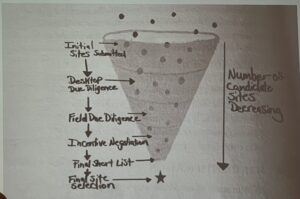
The selectors’ visit concluded Thursday with a panel hosted by the Little Rock Regional Chamber, where they gave insights into their visit and advice for how the state can gain more from its sites going forward. Key points included the need for well-prepared sites with utilities and infrastructure ready, as well as a regional approach to attract large projects.
Shovel Ready
The panelists said an actual shovel-ready site doesn’t really exist. But there are things economic developers can do to make a site as ready as possible for a project.
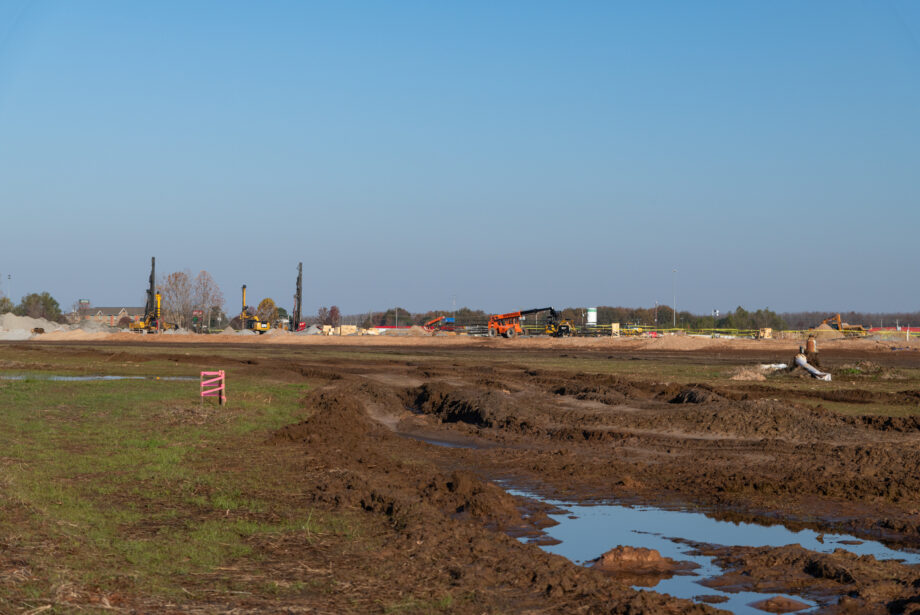
Taking down trees, getting wetlands delineated, floodplain maps updated, topography surveyed, soil borings and other administrative tasks on the front end helps clients visualize the site better, the panelists said.
“These are the kinds of things that remove risk, remove unknowns and help promote that site closer to being shovel ready,” Buelow said. “It’s about getting that work done ahead of time, so that when the client gets there, they don’t have to guess, and they don’t have to build an extra cost to your site compared to a competing out-of-state site because of the unknown.”
Moore said the visualization capability of their clients is “overestimated,” so the more a site is prepared beforehand, the better.
And with land available for sites dwindling, developers are now looking outside of the traditional rectangle, flat lots, the panel said.
“We’re sifting through what’s left. If they’re relatively flat, and you’ve got the studies done and they’re square-ish, that’s becoming more rare,” Buelow said. “If they’re publicly controlled, even more rare. If you’ve got utilities or a plan to get sufficient utilities there, even more rare. If it’s got rail — holy smokes.”
Local Community
The panelists agreed that site selection is not all quantitative. A lot of the time, it comes down to a feeling, Williams said.
“Typically as site selection consultants, we are trying to get a sense of how we will fit, how we will be protected after we get here, how we can contribute and so on and so forth,” Williams said. “That feeling in most cases wraps up a decision that this is going to work. And it’s very important.”
The community also comes into play with what projects the state should be going for. While “Superbowl” projects are nice and the numbers sound great, there’s also room for smaller projects that may fit into a community better.
Buelow said smaller- and medium-sized communities are “winning deals all the time,” despite not having huge utility infrastructure to support bigger projects. But it really comes down to the community preparing for a project and being able to support a site. The panelists said those hoping to get a site should prepare for the bandwidth, budget and wherewithal to support a project long after its built.
“Be careful what you win,” Hess said. “Those are big projects. Once you win them, that’s awesome. Then, what about housing? About infrastructure? What about place making? You really have to think about the aftercare and regional economic developments.”
The panelists also emphasized that communities need to work together to win big site bids, because it’s likely one region or county can’t do it alone.
“Our clients are not as concerned about the geographic boundaries as you all are,” Boehringer said. “When they come into one of these locations, they’re talking about a larger metro. They’re not understanding what those county lines are and what all these folks are doing.”
Williams echoed the sentiment, stating “none of these big projects happen without all of the stakeholders and constituents pulling the lever at the right time and at the right place.” And that with a smaller population, Arkansas will be challenged with talent and scalability, so working together is essential.
But Hess believes the state is already one step ahead when it comes to the working together front, citing experiences he had during a site visit to Searcy.
“You’re going to have to all be rolling together,” Hess said. “There’s a lot of places in the country that are trying to do what you are doing. Don’t lose that, especially for a place of your size and scalability, when you’re competing with states that have 10 million people, even metros that are bigger than the entire state. You have got to work together on that.”
Strategic Patience
The panelists emphasized the idea of “strategic patience,” meaning super sites and big projects won’t happen overnight, but they also won’t happen without strategical investment in site development.
“Those sites are just not going to be site ready because you wish it one day,” Moore said. “It takes a lot of money to bring that to a readiness capability, and some of that is money spent long before a project even looks at the site.”
The panel said they see opportunity for the state if developers exercise that strategic patience and develop sites now, because “certainly there’s going to be more projects.”
“Your time is coming,” Boehringer said. “You’ve got to be prepared for those, but you have to have a balanced approach to retraction, retention, entrepreneurship, innovation and growing your own.”
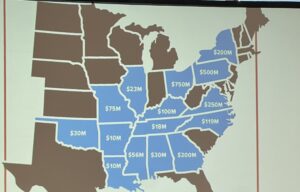
A slideshow at the panel showed Arkansas having invested $10 million into site preparation, compared to $56 million and $75 million in neighboring Mississippi and Missouri. Ohio has invested upwards of $750 million, and Georgia $200 million.
Arkansas in June announced the creation of the Arkansas Site Development Program, designed to distribute $10 million in matching funds for site development programs throughout the state. Funding from the program can be used for a range of projects, including extension and improvement of public infrastructure, dozer or dirt work, grading, site mitigation, site rehabilitation, due diligence study costs and other site development-related activities deemed necessary by AEDC.
Another panel topic was strategic patience — not turning down smaller sites while waiting for a “gorilla” project to show up.
“Know thyself. You as communities will want the big, billion dollar projects and 4,000 people because the numbers sound fantastic, but is that really the right thing to do for your community?” Moore said. “So really understand the size that you really can compete with, how you compete with them, what you really want as a community.”
Ultimately, those smaller projects can lead to more wins for the state than a large one, Moore said.
Enhanced Voice
The main critique the panelists had for Arkansas was that the state wasn’t promoting itself enough to alert companies that sites here are a feasible option.
To be what was described as a “disruptive city,” that are talent magnets and attract sites, the cities need to be well-known and not closed off to new residents. The panel said capital cities, college towns, or both, are growing quickly and attracting super sites, offices and headquarter transitions.
“Where is your talent recruitment campaign for Arkansas? We feel like you’ve got a lot of great quality of life,” Moore said. “Where the talent is, businesses naturally float.”
The panel said Arkansas needs to “have a louder voice” in terms of getting to the marketplace, and alerting people like site selectors to “make sure that they know the value proposition” of recommending a project in the state.
Ultimately, the site selectors said they are really “site eliminators,” and that a lot goes on behind the scenes of choosing a site. But they said the state and the Little Rock metropolitan area are in a good place to grow into a destination for outside business and start attracting new projects.
It’s a complex process, but often it moves very quickly,” Boehringer said. “We’re really charged with helping bring clarity to those decisions for our clients and move them through the process. It’s one that really requires you all to be engaged, informed, and know your state, your community, your data and your sites, in order to compete within that process.”
 Sign up for Daily E-news