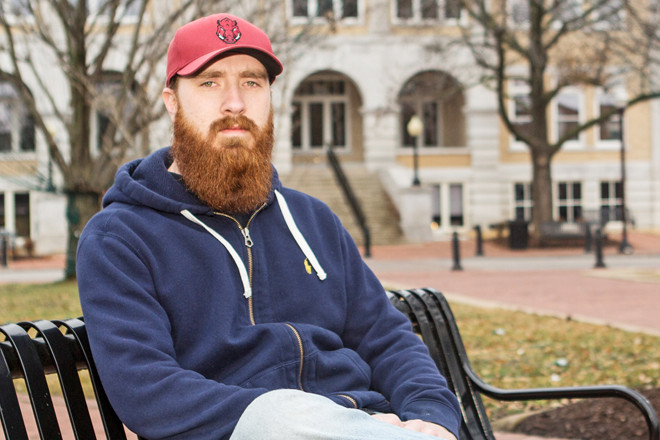
Life had become “absolute hell” for Blake Ruckle as his five-year hitch in the Navy came to an end in 2014.
Ruckle, now 26, was a flight deck firefighter on the USS Enterprise, an aircraft carrier involved with the United States’ anti-piracy actions off the Horn of Africa. His duties included being a first responder when the bodies of four Americans killed by pirates were brought aboard the Enterprise in 2011.
The images he saw stuck in Ruckle’s mind. He said the last six months of his tour were plagued with nightmares and anxiety attacks that he kept secret so he could obtain an honorable discharge rather than a medical one.
Back home in Bentonville, Ruckle still struggled with nightmares and anxiety attacks, he said. He didn’t want to use prescription drugs to combat his problems because a close family member had died of an overdose of prescription medication in 2012.
Racked by depression and suicidal thoughts, Ruckle turned to marijuana in the fall of 2014, a few months after his discharge. He grew up dreaming of becoming a policeman and has unflinching beliefs about what’s right and wrong, but he felt marijuana was his best chance at winning his life back.
“I got ahold of it and bought some,” Ruckle said. “I tried it the first time, and I was little bit nervous. I had never done it before. It has helped my every-single-day life. Smoking takes away anxiety.”
Setting Up a System
In November, voters in Arkansas passed Issue 6 to make it legal for qualifying patients to use marijuana for medical purposes. Ruckle gave an interview to CNN after the measure passed, but grew worried at work the next day.
He declined to say where he worked other than to say it was in the food industry. But he said his co-manager complimented him on his TV appearance and has said nothing more about his marijuana use.
The amendment will make it illegal for employers to discriminate against workers qualifying for medical marijuana use. Ruckle, who has a 6-year-old daughter and another child due in July, said having job security is a big relief.
The five-person Medical Marijuana Commission has met several times to decide on five cultivation facilities and a $100,000 annual licensing fee for each grower. The amendment gives the Arkansas Legislature the authority to change aspects of the law by a two-thirds vote as long as those changes don’t affect the number of facilities, dispensaries or the legality of medical marijuana.
State Rep. Doug House, R-North Little Rock, was named by House Speaker Jeremy Gillam as the legislative point man for medical marijuana issues. House, a retired Army colonel, said he had been outspoken in opposing the amendment but, now that it has passed, the Legislature’s duty is to implement the program as effectively as possible.
“The amendment addressed employers, but it’s not really an employer issue as much as it is a worker safety issue,” House said. “We do not want anybody under the influence of anything at a job site in a critical situation where, if their judgment is clouded, somebody, including themselves, can get hurt.”
The state has estimated that medical marijuana will bring in approximately $2.5 million in tax revenue annually but expenses could be as high as $5.7 million. Amendment author David Couch, a Little Rock lawyer, believes the tax revenue number will be much higher and the cost number is overstated.
“No one really talks about the economics,” said Couch, who said states with comparable programs have seen higher-than-projected revenues. “Ours is going to be a lot bigger than what [people think]. If you look at the states that have legalized medical marijuana, the amount of money that states have spent on Medicaid for narcotics has dropped like 50 percent. Police will tell you they’ve never been to a domestic disturbance where someone was high.”
House said he believes it will be three years before the medical marijuana program can pay for itself.
“We believe it is obvious at this point that we will not collect enough money from administration of the program — at least certainly in the first year and maybe the first two or three years — to pay for administration of the program,” House said. “That bothers us. I think we the Legislature need to clarify that administration of the program is the first priority.”
Marijuana’s Future
Much was made about Arkansas being the first so-called Bible Belt state to legalize medical marijuana. Arkansas also voted overwhelmingly for Republican presidential nominee Donald Trump, who has expressed support for medical marijuana in the past but then, as president-elect, nominated U.S. Sen. Jeff Sessions, R-Ala., an avowed opponent of legalized marijuana, as his attorney general.
Marijuana is classified as a Schedule I drug by the federal Controlled Substances Act because it has been judged to have a high potential for abuse and no accepted medical use.
The Act prohibits doctors from writing prescriptions for Schedule I drugs, which is why Arkansas’ program has doctors verify a patient’s qualifying condition as written in the amendment.
Maggie Ellinger-Locke, the legislative counsel overseeing Arkansas’ program for the Marijuana Policy Project, said that is hard to know exactly what Trump will do as president regarding marijuana because he has never served in political office before. Twenty-nine states have legalized medical marijuana, so it would be a dicey political move to oppose it after President Obama took a “hands-off” approach to legalized medical or recreational marijuana.
“Of course that is a concern and we’re watching very closely,” Ellinger-Locke said. “It’s hard to speculate. Under the Controlled Substances Act, the federal government has the power to really harm these programs. However, realistically, does the USA want to get involved with locking up patients for using their medicine?”
Ellinger-Locke said Arkansas’ politicians deserve applause for their diligence in implementing a program most of them opposed, most notably Gov. Asa Hutchinson, the former head of the federal Drug Enforcement Administration. House joked that Gillam appointed him in part because, as a former Army colonel, he is well-versed in following orders he doesn’t necessarily agree with.
Ruckle thinks fears about medical marijuana will prove to be overblown. He doesn’t smoke to get high; he smokes to treat his post-traumatic stress disorder.
“It’s just an awesome way I start my day most of the time,” Ruckle said. “When I go out, no one even knows. It’s like taking my regular medicine. I don’t think it’s fair to infringe on the health of others just because you’re afraid others are going to abuse something.”
 Sign up for Daily E-news