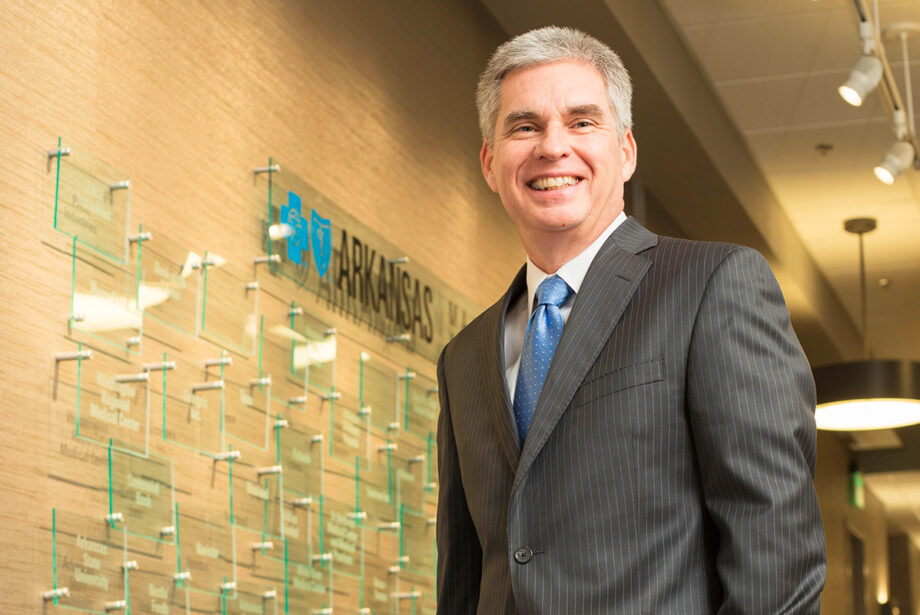
Arkansas Blue Cross & Blue Shield CEO Curtis Barnett doesn’t know exactly how long his company streak was.
The Little Rock mutual health insurance company is still the state’s largest private company with revenue of $2.48 billion in 2018. However, the revenue figure was down — a little less than 2% — from $2.52 billion in 2017, ending a streak of at least 15 years of revenue growth.
Pardon Barnett for not gnashing his teeth and ripping his cloak asunder.
“We are more focused on the members we serve,” Barnett said. “Our revenue numbers are good, strong numbers and appropriate. We are focused on the number of lives and number of members we are taking care of. That number continues to be very strong.”
Arkansas Blue Cross & Blue Shield handles health insurance for 1.9 million people, Barnett said. A majority of those insured live and work in Arkansas, but others are outside the state working for Arkansas-based companies.
What keeps Barnett from panicking over a slight revenue drop is that it wasn’t unexpected. The company forecast a tighter year because of changing and emerging trends in the ever-turbulent world of health insurance.
“We could see what was happening as it was happening,” Barnett said. “Really, it was expected.”
Barnett said two factors in the revenue drop were the Arkansas Works program and other companies switching from fully insured to self-insured.
“We were able to forecast both of those things and a lot of it is being in touch with the market and understanding what is going on,” Barnett said. “Those assumptions were built into our overall model so there were no surprises there.”
In 2018, the Arkansas Legislature voted in a work requirement for Arkansas Works, the state’s Medicaid program. The program uses federal Medicaid funds to buy private insurance for Arkansans.
Barnett said 18,000 people lost their insurance in 2018 for failing to comply with the reporting requirements to stay eligible. He said approximately 9,000 of those canceled plans had been with Arkansas Blue Cross & Blue Shield.
Self-Insurance
The other factor, the move toward self-insured coverage, is nothing new in the health insurance world. With self-insurance, a company provides health insurance for its employees — and assumes all the risk with the hope and expectation that it’ll save money through lower premiums.
When companies have switched to self-insurance, many still contract with health insurance companies to run their plans.
For Arkansas Blue Cross & Blue Shield, these administrative fees are still revenue but they pale in comparison to the company-wide premiums of before.
“[W]e have seen, especially in the large group account market, more movement toward self-funding versus fully insured groups,” Barnett said. “A fully insured arrangement is where they pay us a premium, and we cover all the risks and provide the administration. In a self-funded arrangement, they pay us an administrative fee but they take the risks. We had some large accounts that had been thinking about it for a while that decided to go self-funded. When that happens the administrative fee that is paid is probably about 10% of what you get in premiums. It is a pretty good drop.”
Barnett said a good portion of the company business is administration of plans, so it wasn’t any great upheaval logistically to adjust to it. The fact that the company brain trust also foresaw the trend affecting the premium revenue cushioned the financial hit.
“We do a lot of self-funded administration, and it is an important part of our business; it has been for a long, long time,” Barnett said. “This is a continued movement in that way. We continue to invest in our capabilities with regard to all our customers, certainly the large-account customers, and we understand that market segment and where they are headed. We continue to think about that and protect that membership base.”
Barnett said that halfway into 2019, the year is looking to be similar to 2018. Whether that means Arkansas Blue Cross & Blue Shield leaps back as a revenue grower will be determined, but Barnett is satisfied with his company’s strength and position in the market.
“Certainly the economy and low unemployment, especially in our state the last year or two, has been something we’ve been glad to see,” Barnett said. “The employer market is still very important to us. When the economy is performing well, then the employer market tends to perform well. It figures into our plans going forward.
“Our business tends to run on cycles and, if you look over the last two or three years, we think we are in a positive cycle with all the things we track.”
Good News
Barnett was optimistic about the company’s finances, but he was more enthusiastic about the changes in health care that are taking root in the state.
Barnett said this is most apparent in the growth of primary care in Arkansas. Seven years ago, the federal government instituted a comprehensive primary care initiative that has funneled $200 million to the state, and Barnett said Arkansas Blue Cross & Blue Shield has taken an active role in the public-private partnership.
The state now has 180 primary care practices with more than 700 physicians, Barnett said. That has resulted in improved care of chronic conditions and fewer emergency room visits.
“Primary care is a challenge nationally; it’s a challenge in our state as well,” Barnett said. “We believe it is foundational to have an affordable, sustainable health care system. We are helping to fund that. We have seen improvement in quality. We think those are all good signs.”
Arkansas Blue Cross & Blue Shield also continues to invest in the social work aspect of medicine, Barnett said. Barnett said research shows that people with social obstacles — food insecurity, lack of transportation or employment, poor education — are not as healthy as those not facing such challenges.
“A big part of what we are focused on these days is what you hear called the social determinants of health,” Barnett said. “Five years ago we didn’t talk much about this. Now it is something that we are working on each and every day. We are focused on that on a daily basis. We have a large network of social workers who work with us.”
Barnett said technological investments also mean that a person in rural northeast Arkansas, for example, can learn about the availability of local resources to help with social issues. The goal, Barnett said, is to help people focus on getting healthy.
“We feel good about the business,” Barnett said. “As we think about the current environment and looking toward the future, I feel optimistic. I do feel like health care is, can and will get better. It’s a very exciting time, there’s no question about that.”
 Sign up for Daily E-news