Employment growth in Jonesboro has exceeded the nation’s growth for the ninth consecutive quarter, according to an August survey by the Federal Reserve Bank of St. Louis.
Jonesboro’s unemployment rate is 5.1 percent while, compared to 4.2 percent in Fayetteville and the national average of 5.4 percent, according to the third quarter 2015 Burgundy Book reports, which offer snapshots of economic activity in zones throughout the Fed’s Eighth District.
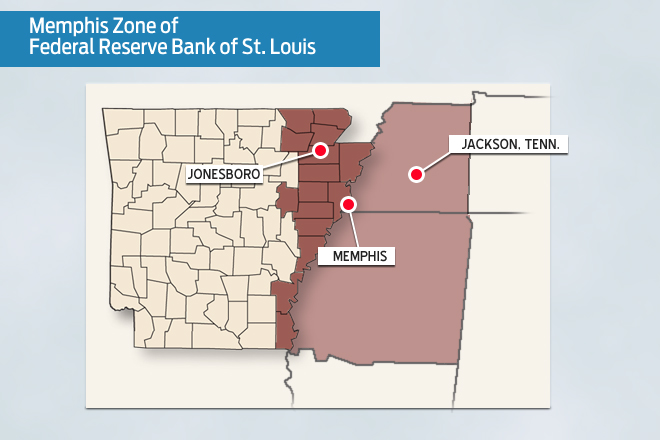
Jonesboro is a part of the district’s Memphis Zone, which also includes northern Mississippi, eastern Arkansas and western Tennessee. The Little Rock Zone includes all but eastern Arkansas.
While growth in Jonesboro has outpaced the rest of the country during the quarter, employers are still seeking help. A Jonesboro area manufacturer surveyed in the Memphis Zone said that “employees with highly technical skills are in demand.”
More than three-quarters of contacts surveyed in the Little Rock Zone expect wages and labor costs to continue increasing slightly, and 40 percent expect prices to be higher than they were at the end of last year.
Here are summaries of other parts of the Fed report:
Manufacturing
Manufacturing exports from Arkansas decreased in the second quarter, with declines concentrated in transportation equipment, fabricated metal products and food products. Arkansas manufacturing exports have trended down since 2012 and exports are now 20 percent lower than the pre-recession peak in 2008.
Transportation
Transportation employment growth slowed significantly in Arkansas following faster-than-average growth in the first quarter. Transportation providers continue to report difficulty in filling truck driver vacancies. Transportation employment is down 2.6 percent in the Little Rock Zone compared to a year ago.
Real Estate and Construction
Year-to-date home sales increased from a year ago in the Little Rock zone, but zone sales lag national sales for the first time since the first quarter of 2013. According to a Little Rock area real estate contact, “Lack of inventory and rising prices have slowed [home] sales.”
But commercial and industrial real estate leasing activity improved in the Little Rock Zone. Metro area vacancy rates fell for most property types and rents increased for all property types.
Construction activity has showed signs of growth and new health care and manufacturing facilities have been announced or begun construction. In Jonesboro, building permits decreased by 6 percent year-to-date.
Banking and Finance
Arkansas’ personal income grew by 4.7 percent year-over-year in the first quarter of 2015, slightly below the previous quarter’s growth rate but still well above the national rate.
In the Little Rock Zone, average household debt composition continues to move away from mortgages and credit card debt toward auto and student debt. Retail contacts indicated that consumers are benefiting from low gas prices
Two of three bankers surveyed in the Little Rock Zone reported loan demand was slightly higher in the third quarter than it was during the same period last year.
According to a Little Rock banker, “Low rate specials are driving volume for consumer loans.”
Return on average assets increased by 1.2 percent in the Arkansas area of the Memphis Zone. The increase in ROA was driven mostly by increases in average net interest margins.
Agriculture
According to the USDA’s August estimates, total production will decline for three of five major crops in Arkansas. Although Arkansas rice production is expected to decline by 6.6 percent in 2015, total production is expected to exceed levels seen during the 2011-13 harvests.
Arkansas sorghum production will more than triple last year’s output, while the state’s average soybean yield is projected to be higher than 2014’s record- breaking level.
The trends in Arkansas field crop production and the natural resources sector mirror those of the nation. Mining and logging employment is down by 3.8 percent in Arkansas and 4.4 percent in the U.S.
 Sign up for Daily E-news