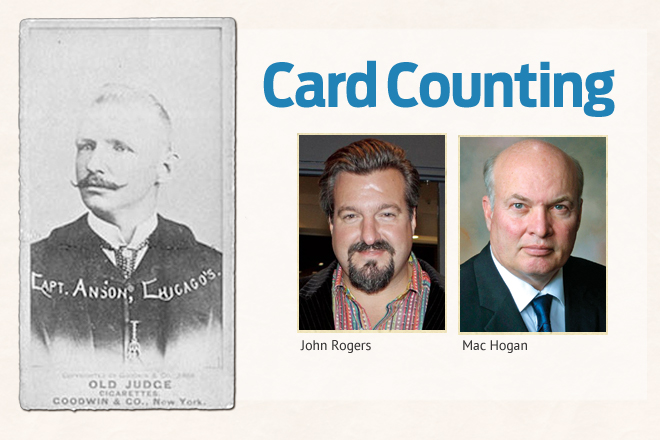
The Fritsch collection contains a complete set of N172 Old Judge baseball cards, including the one above of Cap Anson who reached 3,000 hits in 1897, a major league first. The authenticity of the collection, purchased by John Rogers in 2013, has been called into question by former business partner Mac Hogan.
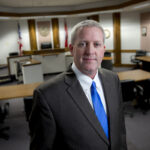
Even if John Rogers acted on a tip that FBI agents would soon come calling with search warrants, criminal investigators still found sports memorabilia in his possession worthy of seizure.
Some of the material that federal agents carried away as evidence on Jan. 28 a year ago came from an area of his North Little Rock enterprise not solely under his control: a double-lock safe that also required First Arkansas Bank & Trust officials to open.
The safe contained collateral helping secure more than $14 million in loans from the Jacksonville bank. Among the valuables in the safe was a collection of baseball cards known as the Fritsch collection that was of special interest to the FBI.
Talk of counterfeit cards and allegations of fraudulent transactions have swirled around the embattled newspaper and sports memorabilia dealer since a string of lawsuits erupted in the weeks following the raid.
The Fritsch collection in particular is described, in a lawsuit filed by former business partner Mac Hogan, as a bogus deal among a series of phantom transactions. First Arkansas loaned Rogers $3.5 million as part of a purported $6 million acquisition of the Fritsch collection in spring 2013. Hogan provided an additional $1.5 million loan.
Bank officials were alarmed to see their collateral carted away and shrouded with questions about authenticity. First Arkansas sent a two-page letter to Rogers, declaring his loans in default.
“As you know, we were compelled yesterday to allow FBI agents access to a certain safe containing Fritsch Collection baseball cards, and, upon presenting the agents with a key, certain bank representatives witnessed the agents removing the Fritsch Collection baseball cards from the safe.
“It is our understanding that these baseball cards are part of an ongoing criminal investigation, will remain in the possession of the FBI for an indefinite period of time and may or may not be returned to you or the bank.”
(More: Babe Ruth Bat Part of $5.5M Lawsuit Against John Rogers.)
What did the Fritsch collection contain?
According to a March 10, 2013, purchase agreement signed by Rogers, the collection included 41 complete card sets, some purported to be more than a century old and extremely rare.
Literally topping the list of items in the Fritsch collection purchase agreement was a single 1909 T206 Honus Wagner. Rogers bought a Wagner card for $1.6 million in a 2008 auction.
Buried in the roster of assets listed in the Fritsch collection purchase is a unicorn among rarities: a complete N172 Old Judge set.
The baseball cards were a promotional item issued from 1886-90 with Old Judge cigarettes by Goodwin & Co. The New York tobacco company featured more than 500 players of the day in multiple poses resulting in more than 3,000 known cards.
“Nobody has a complete set,” said a national memorabilia dealer, who agreed to be interviewed but not named.
The dealer said the items listed in the Fritsch collection purchase agreement, though impressive, were worth far less than $6 million. He expressed disbelief that a savvy dealer like Rogers would agree to pay such an exorbitant sum.
“Even if everything was in top condition, it doesn’t add up to $6 million,” the dealer said. “I’m just speculating, but my experience is that this is something someone concocted.”
According to the purchase agreement, Rogers paid $6 million to Frederick Greenwood, whose New Jersey office address and existence are deemed suspect by some.
Sources who have examined the deal closer now question whether there ever was a Fritsch collection acquisition, although First Arkansas did wire money to an account portrayed as the seller’s to fund the now controversial transaction.
The source of the cards referred to as the Fritsch collection by Hogan and First Arkansas is clouded for now.
The bank wouldn’t be the first Arkansas lender to allege loan fraud on a phantom transaction. Bank of Little Rock wired $900,000 to a now-suspect vendor in Oregon to pay for digital scanning equipment that Rogers claimed to order but was never delivered.
No criminal charges have been filed against Rogers. But allegations of fraud in civil cases continue to mount.
(Also see: Ownership of Charles Conlon Collection in John Rogers Case Up in the Air)
 Sign up for Daily E-news