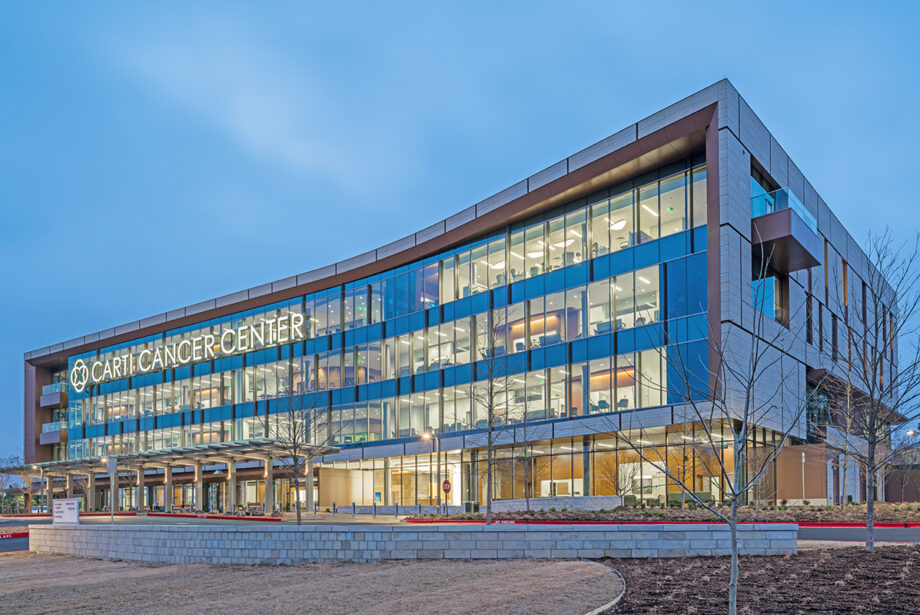
In November, CARTI began seeing patients at its $88 million cancer center in west Little Rock.
The 175,000-SF, four-story center, which took nearly two years to build, offers medical, surgical, interventional and radiation oncology, diagnostic radiology and hematology services.
CARTI President and CEO Jan Burford said the center was necessary to have several of services under one roof.
“Instead of having a number of labs scattered throughout Little Rock, we’ve brought them all together, and we can operate more effectively,” Burford said.
CARTI is expected to see about 16,000 patients a year at the center.
Burford said CARTI didn’t build the center to see more patients, though.
“We were already seeing the patients,” she said. “We just needed a nice facility where the patients could get everything under one roof.”
And seeing more patients isn’t necessarily a financial benefit to CARTI. About half of CARTI’s patients are on Medicare, the federal health care insurance program for people 65 and older and for the disabled. Medicare’s reimbursement for chemotherapy is often less than the cost of the chemo drug, Burford said.
Many of the patients, though, have supplemental insurance, which helps cover the cost, she said.
The Affordable Care Act also has changed the way CARTI does business because many patients saw their annual deductibles go from $1,000 to $6,300.
“And when you’re getting any kind of cancer treatment, … you’re going to hit that $6,300,” Burford said. “That’s more than a lot of patients can even figure out how to pay, and so we’ve had to start asking for money up front instead of collecting it on the back end, the way we used to.”
For the fiscal year that ended June 30, 2014, CARTI had net income of $9.76 million on net patient revenue of $136.1 million, according to its most recent IRS Form 990. The previous fiscal year, CARTI had a net income of $15.8 million on $108.7 million.
Burford said the cancer center should save money over time. It operates more efficiently by having the employees working closely together, so as employees leave, some might not be replaced, she said.
The center has about 350 employees, and CARTI has about 100 full-time equivalent employees at its other locations in Arkansas.
Calming Design
CARTI wanted to make the cancer building “patient centered,” Burford said.
It was designed to get patients inside the center as quickly as possible.
“We ended up with five patient entrances to the building,” said Burford. “And we put parking for the patients as close to those entrances as we could rather than having one grand entrance.”
The building also was designed to make patients feel as calm as possible.
The waiting rooms don’t have any television sets, which should reduce stress, said Alison Melson, a spokeswoman for CARTI. “We picked out 10 different stations with spa-like music to be played overhead.”
The building also features natural light. And down the walkway from the three-level parking garage sits a “healing garden” with a waterfall.
“We really wanted to focus on nature, bringing nature into the healing,” Burford said.
Nabholz Construction Corp. of Conway oversaw the building of the campus. Perkins+Will of Atlanta was the the lead architecture firm on the project, in partnership with Polk Stanley Wilcox Architects of Little Rock.
 Sign up for Daily E-news