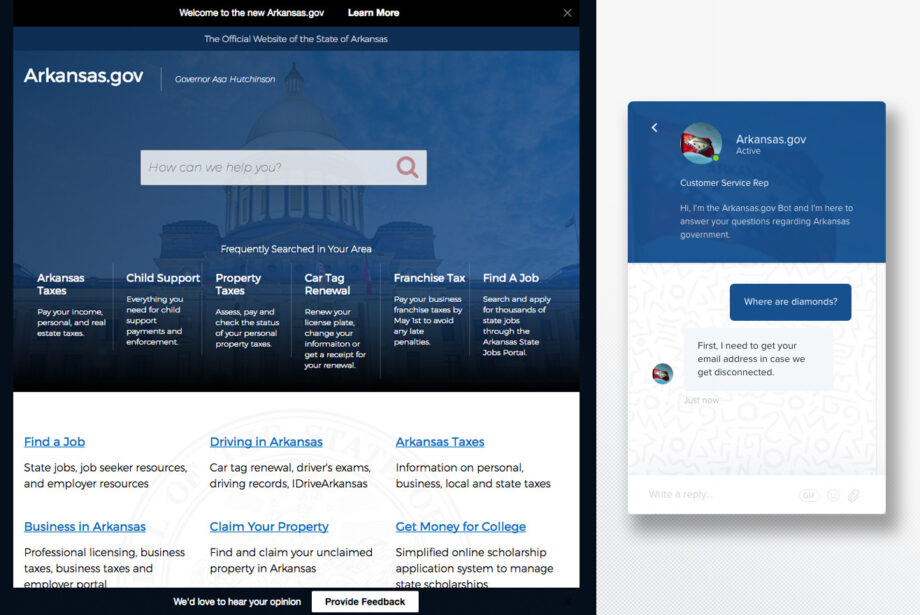
The Information Network of Arkansas is gathering feedback on a new version of the state government’s official website, and it has found that 34 percent of visitors to either the beta or current version of the site who contacted INA for support are using its most striking new feature: chatbot technology.
The INA is a public-private partnership between the state and the Arkansas Information Consortium that helps state agencies put information and services online.
The INA, through a contract with the state to operate Arkansas.gov, funds its operations through convenience fees paid by citizens and businesses who use the website’s 850-plus services, General Manager Bob Sanders said.
The INA launched Beta.Arkansas.gov in June, and users of the site can now offer suggestions via a link at the bottom of the home page. A date to end the test period has not been set, Sanders said, but the INA hopes to launch the new Arkansas.gov by the end of the year.
When it does, chatbots will be part of the service. Karl Hills, director of operations for INA and formerly its director of technology, described chatbots as stand-ins for people who would typically answer a user’s questions.
The chatbots can answer many common questions or send users to the person who can help if a question isn’t in its repertoire, he said. Users can interact with a chatbot over the web, by text message, by email and via a chat interface on platforms like Facebook Messenger.
Artificial intelligence plays a role in chatbox technology, Hills said, because natural language processing allows the chatbots to understand human speech and machine learning allows them to improve their responses based on users’ feedback.
The chatbots have already been programmed to answer 15-20 of the most frequently asked questions — questions that currently would be answered by Arkansas.gov service desk and social media personnel.
But chatbot technology isn’t all the redesign entails. The INA plans to add easy-to-read text; place links to the most commonly accessed government services on the homepage; consolidate as well as present information in a conversational way; and optimize content so that it can be more easily found through search engines.
The INA also recently launched a new version of the Gov2Go that will allow users to make payments using stored information, sign in with a fingerprint and assess national services, including Amber Alerts, elections and federal park passes.
Gov2Go, accessible through Arkansas.gov, is an online application that helps users plan government tasks for a year; sends reminders about tasks, like renewing car tags or paying property taxes; and helps users get tasks done by providing shortcuts to where they need to go online to complete the tasks.
Sanders said, “The big feature in this version is built-in payment — Gov2Go users will be able to make payments quickly using payment information they’ve chosen to store in their profile. While the feature is now available in Gov2Go, it has not been integrated with Arkansas services yet.” Integration is the next step.
He also said the redesign and Gov2Go changes are about better serving the public.
The result is cost savings for the state and citizens, Sanders agreed. Citizens won’t have to crowd revenue offices or create paper waste by conducting their business with state government by mail.
The redesign is based on the INA’s observations of how Arkansas.gov was being used. “What we have noticed over the past few years is that citizens are not coming and browsing the content on the site. They’re not going and engaging with the content as you might on a commercial site. They’re there to look for answers,” Sanders said.
Hills said the new Arkansas.gov will focus on answering questions, departing from its brochure-like approach. He said content that answers questions such as “What do I need to do to drive in Arkansas?” will be grouped together rather than being spread across different parts of the site as they are now.
This redesign continues the evolution of Arkansas.gov, which is in its 20th year and has been reimagined at least seven times since its inception.
The INA redesigns Arkansas.gov every two or three years, Sanders said, and his vision extends beyond this update. One day, he wants to see voice-activated technology like Amazon’s Alexa-enabled Echo speaker or Apple’s Siri-enabled HomePod speaker remind users of a government task, then complete that task at their request.
 Sign up for Daily E-news